

Agriculture Products Business Plan Powerpoint Presentation Slides





Try Before you Buy Download Free Sample Product
 Impress Your
 Audience
 100%
100% Editable
 Save Hours
 of Time


A business plan is a document that defines in detail the organizations objectives and how it plans to achieve its short and long term goals. The agricultural and farming sector is considered the prime sector for any country. Check out our professionally designed Agriculture Products Business Plan ppt, which provides detailed information on agriculture industry statistics, growth drivers, market trends, and key challenges of the industry, including lucrative opportunities. Moreover, it focuses on the company overview which includes vision, mission, goals, start up expenses, key products offered and success factors. Also, it describes the customer analysis for agriculture industry, buyers persona, and market sizing. Additionally, it covers the competitor analysis, SWOT analysis, PORTERS framework and detailed marketing plan. The document also covers a financial summary section including a revenue model, economic impact, profit and loss statement, break even analysis, etc. Get access now.
People who downloaded this PowerPoint presentation also viewed the following :
Content of this Powerpoint Presentation
Slide 1: This slide displays the title Agriculture Products Business Plan.
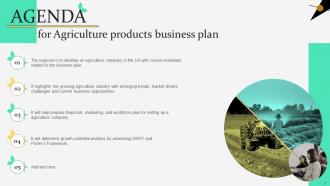
Slide 2: This slide displays the title Agenda.
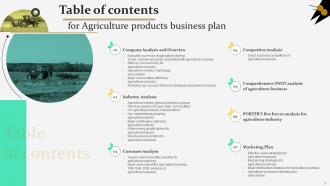
Slide 3: This slide exhibit table of content.
Slide 4: This slide exhibit table of content.
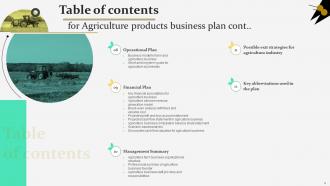
Slide 5: This slide exhibit table of content that is to be discuss further.
Slide 6: This slide provides a glimpse of the agriculture company including a quick pitch that describes the current market status of the industry.
Slide 7: This slide covers the agriculture company vision, mission, and goals.
Slide 8: This slide provides information about start-up expenditures that incur during the process of establishing a agriculture company.
Slide 9: This slide covers the problem associated with the agriculture industry and how the company will implement an effective service solution to overcome the existing gap.
Slide 10: This slide highlights the agriculture commodities by the company. It includes wheat (heard, soft and spring wheat), Rice (basmati, brown, sushi and jasmine rice) etc.
Slide 11: This slide covers the essential points to be considered while offering agriculture products in the market.
Slide 12: This slide exhibit table of content that is to be discuss further.
Slide 13: The purpose of this slide is to highlight the market size of the global agriculture industry.
Slide 14: The purpose of this slide is to highlight the world production of crops which includes sugar cane, maize, wheat, rice, paddy, oil palm fruit and potatoes.
Slide 15: This slide highlights the United States of America agriculture industry outlook which includes market share by industry, average farm size etc.
Slide 16: This slide highlights the market trends that have the potential to change the current market scenario, as well as ways that the company can stay ahead of competitors.
Slide 17: This slide highlights the key market trends that have the potential to change the current market scenario.
Slide 18: This slide portrays details about various challenges faced by the agriculture industry.
Slide 19: This slide portrays details about various challenges faced by the agriculture industry.
Slide 20: This slide caters to details about various growth drivers for agriculture industry.
Slide 21: This slide portrays an ideal business location for a agriculture business which highlights that US boats the biggest consumer market in the world.
Slide 22: This slide exhibit table of content that is to be discuss further.
Slide 23: This slide covers an assessment of how the company’s service will fit into a particular market and where they will acquire the most traction with customers.
Slide 24: This slide provides a glimpse of how to better understand the target audience, to fine-tune marketing campaigns, and increase e-commerce personalization.
Slide 25: The purpose of this slide is to depict the market potential of agriculture industry in terms of TAM, SAM, and SOM to assist startups and enterprise firms.
Slide 26: This slide exhibit table of content that is to be discuss further.
Slide 27: This slide is to provide a glimpse of major participants and key competitors of the industry to gain insight into their products, sales, and marketing tactic.
Slide 28: This slide exhibit table of content that is to be discuss further.
Slide 29: The purpose of this slide is to identify the industry' strengths, weaknesses, opportunities, and threats related to the business.
Slide 30: This slide exhibit table of content that is to be discuss further.
Slide 31: The threat of substitute products or services in the agriculture industry is moderate, as there are some alternative products.
Slide 32: This slide exhibit table of content that is to be discuss further.
Slide 33: This slide highlights the top sales strategies for agriculture business which include direct sales, focus niche markets, strong distribution, partnership.
Slide 34: This slide highlights the top pricing strategies for agriculture and farming business which include volume-based pricing strategies, cost-plus pricing strategies.
Slide 35: This slide highlights the top sales strategies for agriculture business.
Slide 36: This slide highlights customer journey mapping to track users' actions and key touch points across levels.
Slide 37: This slide exhibit table of content that is to be discuss further.
Slide 38: This slide highlights the business model for farm and agriculture business which includes key partners, key activities, value propositions, customer relationships.
Slide 39: This slide highlights the short-term and long-term milestones which includes establishing the company and acquiring land.
Slide 40: This slide provides a glimpse of important financial assumptions in terms of income, expense, and balance sheet.
Slide 41: This slide exhibit table of content that is to be discuss further.
Slide 42: The slide shows the effective revenue model of the agriculture industry, which displays the cost incurred and the various sources of income.
Slide 43: The slides highlight the break-even analysis of the firm.
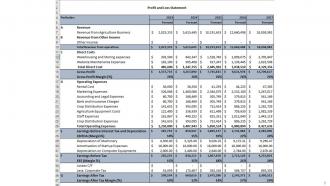
Slide 44: The slides provide a glimpse of the projected profit and loss statement to visualize the agriculture business financial performance for the next five years.
Slide 45: The slides provide a glimpse of the projected profit and loss statement to visualize the agriculture business financial performance for the next five years.
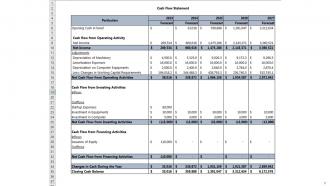
Slide 46: The slides highlight the company's cash flow statement to provide a detailed picture of what happened to a business's cash during a specified period.
Slide 47: The slides highlight the company's cash flow statement to provide a detailed picture of what happened to a business's cash during a specified period.
Slide 48: The slides cover the snapshot of the company's financial position at a specific time by showing the details of the assets of the company along with its liabilities.
Slide 49: The slides cover the snapshot of the company's financial position at a specific time by showing the details of the assets of the company along with its liabilities.
Slide 50: This slide is to examine the effects of potential future events on the company’s performance by considering different outcomes.
Slide 51: This slide is to examine the effects of potential future events on the company’s performance by considering different outcomes.
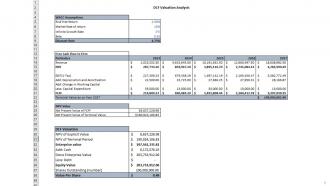
Slide 52: The purpose of this slide is to calculate the amount of money an investor would get from an investment after adjusting for the time value of money.
Slide 53: This slide exhibit table of content that is to be discuss further.
Slide 54: The slide highlights the organizational hierarchy in the company.
Slide 55: This slide highlights the founder’s biggest professional achievements and most valuable skills and the proven ways in which he will use those skills.
Slide 56: This slide highlights the job roles and responsibilities of agriculture staff to determine what kind of job has to be done and what kind of person is ideal for it.
Slide 57: This slide highlights the job roles and responsibilities of agriculture staff to determine what kind of job has to be done and what kind of person is ideal for it.
Slide 58: This slide exhibit table of content that is to be discuss further.
Slide 59: This slide represents exit strategies such as sell-offs, IPOs, mergers, and acquisitions that enable the entrepreneur to liquidate their position in a financial asset.
Slide 60: This slide exhibit table of content that is to be discuss further.
Slide 61: The purpose of this slide is to highlight the shorter version of existing words to save time and take up less space.
Slide 62: This is the icons slide.
Slide 63: This slide presents title for additional slides.
Slide 64: This slide display Venn.
Slide 65: This slide shows puzzle for displaying elements of company.
Slide 66: This slide exhibits ideas generated.
Slide 67: This slide display Our goal.
Slide 68: This slide exhibit Roadmap.
Slide 69: This slide presents your company's vision, mission and goals.
Slide 70: This is thank you slide & contains contact details of company like office address, phone no., etc.
Agriculture Products Business Plan Powerpoint Presentation Slides with all 75 slides:
Use our Agriculture Products Business Plan Powerpoint Presentation Slides to effectively help you save your valuable time. They are readymade to fit into any presentation structure.





































































FAQs for Agriculture Products Business Plan
**INPUT**: What are the key components of an effective agriculture business plan? **OUTPUT**: Key components include market analysis, financial projections, production planning, risk management strategies, and operational workflows. These elements work together by identifying target markets, forecasting revenues and costs, and establishing sustainable farming practices, with many agricultural enterprises finding that comprehensive planning ultimately delivers improved resource allocation, operational efficiency, and competitive advantage in increasingly dynamic markets. **Word count: 58 words**
Market trends significantly influence agriculture business planning by shaping crop selection, technology adoption, pricing strategies, and distribution channels. These trends help farmers identify emerging opportunities like organic produce demand, sustainable farming practices, and direct-to-consumer sales models, while enabling strategic resource allocation and risk management, ultimately delivering competitive advantage and improved profitability.
Agriculture business plans should include revenue forecasts, production cost estimates, cash flow projections, break-even analysis, and seasonal working capital requirements. These financial projections help farming enterprises, agribusiness ventures, and food production companies demonstrate viability to investors while enabling strategic resource allocation, with many agricultural businesses finding that detailed seasonal analysis ultimately delivers better funding outcomes and operational efficiency.
Businesses can assess agricultural risks through comprehensive market analysis, weather pattern evaluation, soil testing, pest and disease monitoring, and regulatory compliance reviews. Financial institutions and agribusiness companies increasingly use predictive analytics and satellite monitoring to evaluate crop yields, climate vulnerabilities, and supply chain disruptions, ultimately enabling more informed investment decisions and strategic risk mitigation.
Technology plays a pivotal role in modern agriculture business planning by enabling precision farming, data-driven decision making, automated resource management, predictive analytics, and supply chain optimization. These digital solutions streamline operations by reducing input costs, maximizing crop yields, and minimizing environmental impact, with many agricultural enterprises finding that integrated technology platforms ultimately deliver enhanced profitability and competitive advantage.
An agriculture business plan addresses sustainability through integrated resource management, renewable energy adoption, soil conservation practices, water efficiency systems, and waste reduction strategies. These approaches enable farms to minimize environmental impact while maintaining profitability, with many agricultural enterprises finding that sustainable practices ultimately reduce operational costs, enhance crop yields, and create competitive advantages in increasingly environmentally-conscious markets.
Best practices for market analysis in agriculture include evaluating crop demand trends, analyzing competitor pricing strategies, assessing seasonal market fluctuations, studying supply chain dynamics, and researching consumer preferences. These approaches enable farmers and agribusinesses to optimize planting decisions, negotiate better contracts, and identify emerging opportunities, ultimately delivering higher profit margins and reduced market risks.
Defining your target audience in an agriculture business plan involves identifying specific customer segments through demographics, geographic location, purchasing behavior, and industry needs. Successful agricultural businesses typically segment by farm size, crop types, distribution channels, and seasonal requirements, with many finding that focused targeting in sectors like organic producers, commercial distributors, or direct-to-consumer markets delivers higher conversion rates and sustainable growth.
Agriculture ventures can access funding through bank loans, government subsidies, venture capital, angel investors, crowdfunding platforms, and agricultural development funds. These financing options enable farmers and agribusinesses to scale operations, invest in modern equipment, and expand market reach, with many agricultural startups finding that combining multiple funding sources delivers greater financial stability and accelerated growth in an increasingly competitive market.
An agriculture business plan adapts to changing regulations by incorporating flexible compliance frameworks, regular policy monitoring systems, diversified revenue streams, and strategic partnerships with regulatory experts. Through scenario planning and modular business structures, farms can pivot operations quickly, adjust production methods, and leverage new incentives, ultimately maintaining profitability while staying compliant in an increasingly regulated environment.
Effective agricultural marketing strategies include direct-to-consumer sales, cooperative marketing, digital platforms, value-added processing, and strategic partnerships with retailers and distributors. These approaches enhance market reach by diversifying sales channels, building brand recognition, and reducing dependency on commodity pricing, with many farms finding that combining traditional farmers' markets with e-commerce platforms ultimately delivers higher profit margins and stronger customer relationships.
Crop rotation is essential in agriculture business plans, enhancing soil fertility, reducing pest buildup, minimizing disease risks, and optimizing resource allocation across growing seasons. Through strategic rotation systems, farms achieve higher yields, lower input costs, and improved crop quality, while many agricultural operations find that diversified rotation schedules ultimately deliver sustainable profitability and competitive market positioning.
Key agriculture business success metrics include yield per acre, cost per unit produced, profit margins, cash flow ratios, and return on investment. These measurements enable farmers to optimize resource allocation, equipment efficiency, and crop selection strategies, with many agricultural enterprises finding that tracking both production and financial metrics simultaneously delivers competitive advantage and sustainable growth in an increasingly data-driven industry.
Partnerships in agriculture business plans can include supplier agreements, distribution networks, research institutions, technology providers, and cooperative arrangements with other farms. These strategic collaborations enhance operational efficiency by sharing resources, reducing costs, and expanding market reach, with many agricultural enterprises finding that partnerships ultimately deliver competitive advantages and accelerated growth opportunities.
Organic agriculture businesses face unique planning challenges including longer certification processes, premium input costs, yield variability, limited pest management options, and complex supply chain requirements. While these factors require more detailed financial planning and risk management, they also present opportunities for premium pricing and growing market demand, with many organic farms finding that strategic planning around certification timing and diversified crop portfolios ultimately delivers competitive advantages.
-
Extremely professional slides with attractive designs. I especially appreciate how easily they can be modified and come in different colors, shapes, and sizes!
-
Editable templates with innovative design and color combination.