

Analytical CRM Software Impact Of Implementing Salesforce CRM Analytics SA SS




Try Before you Buy Download Free Sample Product
 Impress Your
Audience
 100%
Editable
 Save Hours
of Time


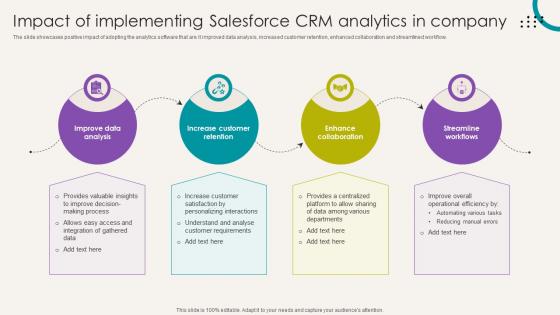
The slide showcases positive impact of adopting the analytics software that are it improved data analysis, increased customer retention, enhanced collaboration and streamlined workflow.
People who downloaded this PowerPoint presentation also viewed the following :
Analytical CRM Software Impact Of Implementing Salesforce CRM Analytics SA SS with all 9 slides:
Use our Analytical CRM Software Impact Of Implementing Salesforce CRM Analytics SA SS to effectively help you save your valuable time. They are readymade to fit into any presentation structure.








FAQs for Analytical CRM Software Impact Of Implementing Salesforce CRM
Analytical CRM software features advanced data mining, predictive analytics, customer segmentation, statistical modeling, and comprehensive reporting dashboards that transform raw customer data into actionable business insights. Unlike operational CRM's transaction focus or collaborative CRM's communication emphasis, analytical CRM enables organizations to identify buying patterns, predict customer behavior, and optimize marketing strategies, ultimately delivering enhanced customer targeting and increased revenue growth across industries.
Businesses leverage analytical CRM to enhance customer segmentation by analyzing purchase patterns, behavioral data, demographic information, and engagement metrics to create precise customer profiles. Through advanced analytics and machine learning capabilities, companies can identify high-value segments, predict customer lifetime value, and develop targeted marketing campaigns, ultimately delivering personalized experiences and improved retention rates.
Data visualization transforms analytical CRM software by converting complex customer data into intuitive charts, graphs, dashboards, and heat maps that reveal actionable insights at a glance. These visual tools enable sales teams, marketing departments, and customer service representatives to quickly identify trends, spot opportunities, and make data-driven decisions, ultimately delivering faster response times and enhanced customer experiences.
Analytical CRM enhances sales forecasting by analyzing historical data, customer behavior patterns, and market trends to predict future sales outcomes with greater accuracy. Through advanced analytics and machine learning algorithms, sales teams can identify high-potential leads, optimize pipeline management, and track performance metrics, ultimately enabling more strategic decision-making and improved revenue generation across organizations.
Analytical CRM systems typically integrate customer transaction records, website behavioral data, social media interactions, email engagement metrics, and support ticket histories. These diverse data sources enable organizations to streamline customer segmentation, enhance predictive analytics, and deliver personalized experiences, with many retail and financial services companies finding that comprehensive data integration ultimately drives significantly higher customer lifetime value and competitive advantage.
Predictive analytics within analytical CRM transforms customer relationship management by forecasting customer behaviors, identifying at-risk accounts, and predicting future purchasing patterns through advanced data modeling. This enables companies to proactively address customer needs, personalize engagement strategies, and optimize retention efforts, with many organizations finding that predictive insights significantly enhance customer lifetime value and reduce churn rates.
Organizations face implementation challenges including data integration complexities, user adoption resistance, insufficient training resources, and aligning analytics with existing business processes. These obstacles can be overcome through phased rollouts, comprehensive staff training programs, and strategic data mapping, with many companies finding that partnering with experienced vendors and establishing clear success metrics ultimately delivers enhanced customer insights and competitive advantage.
Machine learning algorithms enhance analytical CRM software by automating pattern recognition, predicting customer behavior, and personalizing marketing campaigns at scale. These algorithms enable businesses to identify high-value prospects, forecast churn risks, and optimize cross-selling opportunities, with many organizations finding that predictive analytics ultimately delivers faster customer insights and significantly improved conversion rates.
Businesses should track customer lifetime value, purchase frequency, support ticket resolution times, Net Promoter Score, email open rates, website interaction duration, and churn rates using analytical CRM. These metrics enable organizations to identify engagement patterns, predict customer behavior, and optimize satisfaction strategies, with many companies finding that comprehensive tracking ultimately delivers improved retention and increased revenue growth.
Integrating social media data into analytical CRM enhances customer insights by capturing real-time sentiment, identifying behavioral patterns, and revealing unstructured feedback across multiple touchpoints. This strategic combination enables organizations to predict customer preferences, personalize engagement strategies, and proactively address concerns, with many retailers and financial services finding that social integration delivers more comprehensive customer profiles and competitive advantage.
Analytical CRM software enhances marketing decision-making by providing customer segmentation insights, predictive analytics, campaign performance metrics, and behavioral pattern analysis. Through data-driven intelligence, marketing teams can optimize targeting strategies, personalize messaging approaches, and allocate budgets more effectively, while retail and financial services companies increasingly find that these insights deliver higher conversion rates and improved ROI.
Banking institutions like JPMorgan Chase use analytical CRM for risk assessment and personalized lending, while retailers like Amazon leverage customer data analysis for targeted recommendations and inventory optimization. Healthcare organizations implement these systems for patient engagement tracking and treatment outcome predictions, with telecommunications companies like Verizon using analytical insights to reduce churn rates and enhance service personalization, ultimately delivering improved customer retention and operational efficiency.
GDPR and data privacy regulations significantly impact analytical CRM functionality by requiring explicit consent management, data anonymization capabilities, and robust audit trails for all customer data processing activities. These compliance requirements enhance customer trust and data quality, while many organizations find that implementing privacy-by-design principles ultimately delivers more transparent analytics and stronger competitive advantage.
Analytical CRM software enables small businesses to maximize limited resources by automating data analysis, identifying high-value customers, and optimizing marketing spend through targeted campaigns. These platforms streamline operations by revealing sales patterns, predicting customer behavior, and prioritizing leads, with many small retailers and service providers finding significant improvements in conversion rates and customer retention without requiring dedicated analyst teams.
Emerging analytical CRM trends include AI-powered predictive analytics, real-time customer sentiment analysis, omnichannel data integration, automated personalization engines, and advanced behavioral modeling capabilities. These technologies enable organizations to anticipate customer needs more accurately, deliver hyper-personalized experiences across touchpoints, and optimize retention strategies, with many enterprises finding that proactive analytics significantly enhances competitive positioning.
-
Time saving slide with creative ideas. Help a lot in quick presentations..
-
Great product with effective design. Helped a lot in our corporate presentations. Easy to edit and stunning visuals.