

Analyzing Cloud Based Service Offerings Roles And Responsibilities Of Application




Try Before you Buy Download Free Sample Product
 Impress Your
Audience
 100%
Editable
 Save Hours
of Time


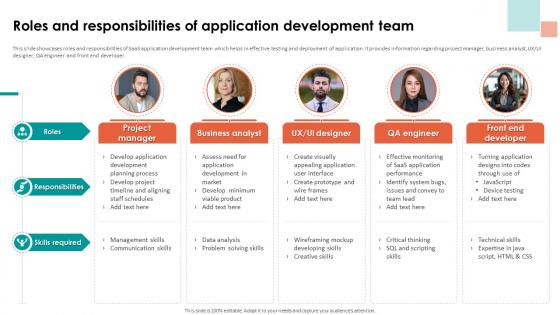
This slide showcases roles and responsibilities of SaaS application development team which helps in effective testing and deployment of application. It provides information regarding project manager, business analyst, UX or UI designer, QA engineer and front end developer.
People who downloaded this PowerPoint presentation also viewed the following :
Analyzing Cloud Based Service Offerings Roles And Responsibilities Of Application with all 9 slides:
Use our Analyzing Cloud Based Service Offerings Roles And Responsibilities Of Application to effectively help you save your valuable time. They are readymade to fit into any presentation structure.








FAQs for Analyzing Cloud Based Service Offerings Roles And
Cloud-based services deliver cost reduction, enhanced scalability, improved accessibility, automatic updates, and robust data backup for small businesses. These solutions enable companies to access enterprise-level technologies without significant upfront investments, streamline operations through remote collaboration, and compete more effectively with larger organizations, with many small businesses finding operational costs decrease by 15-20% within the first year.
Cloud-based services enhance remote team collaboration by enabling real-time document sharing, seamless communication across multiple platforms, and centralized project management with instant access from anywhere. Through integrated workflows, teams can simultaneously edit presentations, conduct virtual meetings, and track project progress, ultimately delivering faster decision-making and improved productivity across distributed organizations.
Organizations should consider encryption for data in transit and at rest, multi-factor authentication, regular security audits, access controls, and compliance with industry standards like SOC 2 or ISO 27001. These measures work together to create layered protection, with many financial institutions and healthcare providers finding that strategic security investments ultimately deliver enhanced customer trust and regulatory compliance.
Cloud-based services dramatically enhance business scalability by enabling rapid resource adjustment, eliminating infrastructure constraints, and providing pay-as-you-grow pricing models. Through automated scaling capabilities, organizations can seamlessly expand operations, reduce capital expenditures, and accelerate market entry, with many enterprises finding that cloud adoption delivers 40-60% faster deployment times and significantly improved operational flexibility.
Businesses should evaluate security measures, compliance certifications, scalability options, pricing structures, data location requirements, and service level agreements when selecting cloud providers. Financial institutions prioritize regulatory compliance and data encryption, while manufacturing companies focus on integration capabilities and uptime guarantees, ultimately ensuring operational efficiency and strategic alignment with growth objectives.
Cloud-based services typically operate on pay-as-you-use subscription models, eliminating large upfront capital expenditures for hardware, software licenses, and infrastructure setup that traditional IT investments require. This shift from CapEx to OpEx enables organizations to scale resources dynamically, reduce maintenance costs, and achieve better budget predictability, with many enterprises finding significantly lower total ownership costs.
Healthcare, financial services, retail, education, and manufacturing rely most heavily on cloud-based services due to their need for scalable data storage, real-time analytics, and remote accessibility. These industries leverage cloud solutions to enhance operational efficiency, reduce infrastructure costs, and enable seamless collaboration, with many organizations finding that cloud adoption delivers faster innovation and competitive advantage.
Businesses ensure cloud data compliance through comprehensive data governance frameworks, selecting certified cloud providers with industry-specific certifications, implementing robust encryption protocols, and conducting regular compliance audits. Through strategic partnerships with compliant providers, organizations streamline regulatory adherence while maintaining operational flexibility, with many financial services and healthcare institutions finding that cloud-native compliance tools actually enhance their regulatory reporting capabilities and reduce administrative overhead.
Cloud-based services provide critical infrastructure for disaster recovery through automated backups, geographically distributed data centers, rapid scalability, and remote access capabilities. These technologies enable organizations to maintain operations during disruptions by ensuring data availability, minimizing downtime, and facilitating seamless remote work transitions, with many enterprises finding that cloud solutions significantly reduce recovery time objectives while delivering enhanced operational resilience.
Cloud-native applications deliver superior performance through microservices architecture, containerization, auto-scaling, and distributed processing, while traditional applications rely on monolithic structures and fixed infrastructure. These cloud-optimized designs enable faster deployment cycles, seamless resource allocation, and enhanced fault tolerance, with many financial services and retail organizations finding significantly reduced downtime and operational costs.
Cloud migration challenges include data security concerns, integration complexities with existing systems, potential downtime during transitions, staff training requirements, and ongoing cost management. While these obstacles present initial hurdles, many organizations find that strategic planning, phased implementation approaches, and partnering with experienced cloud providers ultimately streamlines operations, enhances scalability, and delivers long-term competitive advantages.
Organizations optimize cloud spending through resource right-sizing, automated scaling policies, reserved instance planning, cost monitoring dashboards, and regular usage audits. These strategic approaches enable companies to reduce operational expenses by 20-40%, eliminate resource waste, and maintain performance standards, with many enterprises finding that proactive cost governance ultimately delivers enhanced budget predictability and competitive advantage.
Cloud-based services support AI and machine learning by providing scalable computing power, vast data storage capabilities, and specialized processing frameworks that eliminate infrastructure barriers. Through cloud platforms, organizations can access advanced GPU clusters, pre-built ML models, and automated scaling features, enabling faster algorithm development, cost-effective experimentation, and seamless deployment of intelligent applications across industries.
Best practices for managing vendor lock-in include adopting multi-cloud strategies, using containerization technologies, implementing standardized APIs, maintaining data portability protocols, and negotiating flexible contract terms. These approaches enable organizations to preserve operational flexibility, reduce dependency risks, and maintain competitive leverage, with many enterprises finding that strategic vendor diversification ultimately delivers cost optimization and enhanced service resilience.
Cloud-based analytics tools enable data-driven decision-making by providing real-time insights, scalable processing power, and advanced visualization capabilities across distributed teams. These platforms streamline data collection, analysis, and reporting, with retailers optimizing inventory management, financial services enhancing risk assessment, and healthcare organizations improving patient outcomes through predictive analytics, ultimately delivering competitive advantage and operational efficiency.
-
I am really satisfied with their XYZ products. Used their slides for my business presentations and now I am taking their help for my son's high-school assignments. Super satisfied!!
-
Attractive design and informative presentation.