

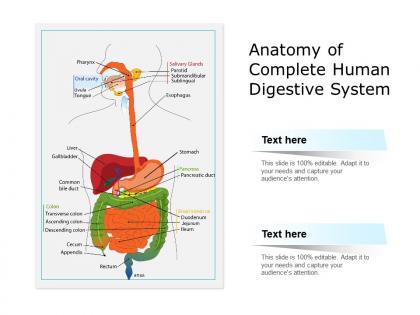
Anatomy of complete human digestive system




Try Before you Buy Download Free Sample Product
 Impress Your
 Audience
 100%
100% Editable
 Save Hours
 of Time


Our Anatomy Of Complete Human Digestive System are topically designed to provide an attractive backdrop to any subject. Use them to look like a presentation pro.
People who downloaded this PowerPoint presentation also viewed the following :
Anatomy of complete human digestive system with all 2 slides:
Use our Anatomy Of Complete Human Digestive System to effectively help you save your valuable time. They are readymade to fit into any presentation structure.

FAQs for Anatomy of complete
The primary components of the human digestive system include the mouth, esophagus, stomach, small intestine, large intestine, liver, pancreas, and gallbladder. These organs work together by mechanically breaking down food, chemically processing nutrients through enzymatic action, and facilitating absorption, ultimately delivering efficient nutrient distribution and waste elimination for optimal bodily function.
The esophagus facilitates digestion by transporting food from the mouth to the stomach through coordinated muscular contractions called peristalsis, while preventing acid reflux through strategic sphincter control. This streamlined transport mechanism enables efficient nutrient delivery, minimizes digestive complications, and ultimately supports optimal gastric processing, with many healthcare professionals finding that proper esophageal function significantly enhances overall digestive efficiency.
The stomach serves as a temporary storage chamber while mechanically breaking down food through muscular contractions and chemically digesting proteins using gastric acid and pepsin. This acidic environment, with pH levels around 1.5-2, kills harmful bacteria, activates digestive enzymes, and transforms food into chyme, ultimately enabling efficient nutrient absorption in the small intestine.
Gastric acids contribute to food breakdown by denaturing proteins through pepsinogen activation, creating an acidic environment that optimizes enzyme function, and breaking down complex food structures into smaller molecules. This acidic process, primarily driven by hydrochloric acid production, enables efficient protein digestion while facilitating nutrient absorption, ultimately delivering enhanced digestive efficiency and proper metabolic function.
The small intestine comprises three segments—duodenum, jejunum, and ileum—featuring specialized villi and microvilli that maximize surface area for nutrient absorption. These anatomical structures enhance digestion by facilitating carbohydrate, protein, and fat breakdown, while simultaneously absorbing vitamins and minerals into the bloodstream, ultimately delivering essential nutrients throughout the body for optimal physiological function.
The liver contributes to digestion by producing bile salts that emulsify fats, metabolizing nutrients absorbed from the intestines, and storing glycogen for energy regulation. While the liver doesn't produce digestive enzymes directly, it creates bile components and plasma proteins that facilitate fat breakdown and nutrient absorption, ultimately enabling efficient digestive processes and metabolic balance throughout the body.
The pancreas produces essential digestive enzymes including amylase for carbohydrate breakdown, lipase for fat digestion, and proteases like trypsin for protein processing, while also secreting bicarbonate to neutralize stomach acid. These pancreatic juices enable efficient nutrient absorption in healthcare settings, with hospitals and medical institutions finding that understanding pancreatic function enhances patient digestive health management and treatment outcomes.
The large intestine primarily absorbs water, electrolytes, and forms solid waste, while the small intestine focuses on nutrient absorption, enzyme secretion, and chemical digestion. Through specialized mechanisms, healthcare institutions and medical education programs demonstrate these functional differences, enabling students to understand digestive efficiency, ultimately delivering comprehensive anatomical knowledge and improved patient care outcomes.
The microbiome plays a crucial role in digestive health by facilitating nutrient absorption, synthesizing essential vitamins, maintaining immune function, and regulating metabolism through beneficial bacterial interactions. These microorganisms enhance digestive efficiency by breaking down complex compounds, producing short-chain fatty acids, and supporting intestinal barrier integrity, ultimately delivering improved nutrient utilization and systemic health outcomes.
Digestive disorders significantly alter anatomical structures and physiological functions through inflammation, tissue damage, and compromised nutrient absorption. Conditions like Crohn's disease cause intestinal wall thickening and strictures, while peptic ulcers erode gastric mucosa, and irritable bowel syndrome disrupts normal motility patterns, ultimately compromising digestive efficiency and overall health outcomes.
Anatomical features that enhance intestinal absorption include villi, microvilli, circular folds, crypts of Lieberkühn, and specialized epithelial cells. These structural adaptations work together by creating microscopic projections, increasing folding patterns, and optimizing cellular arrangements, ultimately delivering a surface area nearly 600 times larger than a smooth tube, with many healthcare institutions finding this knowledge essential for understanding digestive efficiency and nutritional absorption processes.
Digestion is regulated through complex hormonal cascades including gastrin, cholecystokinin, secretin, and GLP-1, alongside parasympathetic and sympathetic neural pathways that coordinate secretion timing. These regulatory mechanisms work by stimulating enzyme release, controlling gastric emptying, and coordinating bile production, ultimately delivering synchronized digestive processes that optimize nutrient absorption and metabolic efficiency across different meal compositions.
Herbivores feature longer intestinal tracts, specialized stomachs for cellulose breakdown, and extended digestion times, while carnivores possess shorter digestive paths, stronger stomach acids, and sharp teeth for protein processing. These anatomical differences enable each group to maximize nutrient extraction from their respective food sources, with herbivores requiring complex bacterial fermentation systems and carnivores streamlining rapid protein absorption for optimal energy conversion.
Age and genetics significantly influence digestive anatomy through changes in enzyme production, muscle tone, gastric acid levels, and tissue regeneration capacity. While genetics determine baseline digestive efficiency and predisposition to conditions like lactose intolerance, aging progressively reduces motility and absorption rates, with many healthcare providers finding that understanding these factors enables personalized treatment approaches and enhanced patient outcomes.
**INPUT**: What advancements in imaging technology have improved our understanding of digestive system anatomy? **OUTPUT**: Imaging advancements include high-resolution MRI, CT enterography, capsule endoscopy, 3D ultrasound, and AI-enhanced visualization systems. These technologies revolutionize medical education and clinical practice by delivering detailed structural analysis, real-time diagnostic capabilities, and enhanced patient outcomes, with many healthcare institutions finding that advanced imaging streamlines treatment planning while significantly improving diagnostic accuracy.
No Reviews