

Android Device Security Management Addressing Mobile Device Management Approach




Try Before you Buy Download Free Sample Product
 Impress Your
 Audience
 100%
100% Editable
 Save Hours
 of Time


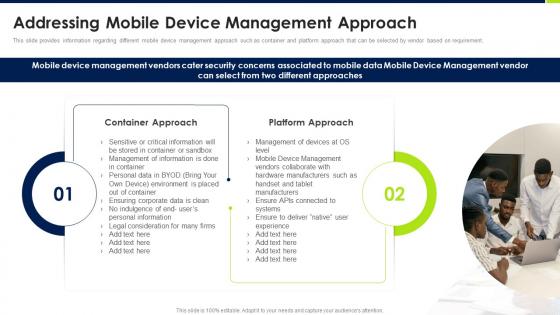
This slide provides information regarding different mobile device management approach such as container and platform approach that can be selected by vendor based on requirement.
People who downloaded this PowerPoint presentation also viewed the following :
Android Device Security Management Addressing Mobile Device Management Approach with all 6 slides:
Use our Android Device Security Management Addressing Mobile Device Management Approach to effectively help you save your valuable time. They are readymade to fit into any presentation structure.





FAQs for Android Device Security Management Addressing Mobile
Android security management operates on defense-in-depth principles including application sandboxing, permission-based access control, secure boot processes, runtime application security, and regular security updates. These layered protections work together by isolating applications, controlling data access, and maintaining system integrity, with many enterprises finding that comprehensive Android security frameworks significantly reduce breach risks while enabling secure mobile productivity.
Android implements application sandboxing by assigning each app a unique user ID, isolating processes in separate memory spaces, enforcing strict permission models, and utilizing SELinux policies for access control. Through this multi-layered approach, banks and healthcare organizations enhance data protection, prevent malicious cross-app interference, and ensure regulatory compliance, while users experience seamless functionality with significantly reduced security vulnerabilities across enterprise environments.
Google Play Protect and built-in security features serve as Android's foundational defense layer, providing real-time app scanning, malware detection, device encryption, secure boot processes, and automatic security updates. These integrated technologies streamline security management by continuously monitoring app behavior, blocking malicious downloads, and enabling remote device management, with many organizations finding that these native protections significantly reduce security overhead while maintaining robust threat prevention across their mobile device fleets.
Developers can ensure secure data handling through encryption protocols, secure storage mechanisms, authentication frameworks, data transmission security, and access controls. Through implementing AES encryption, Android Keystore integration, and SSL/TLS protocols, banking and healthcare applications significantly minimize data breaches, enhance user trust, and maintain regulatory compliance, ultimately delivering competitive advantage in increasingly privacy-conscious markets.
**INPUT**: What are the best practices for securing API endpoints in Android apps? **OUTPUT**: Best practices include implementing certificate pinning, using OAuth 2.0 authentication, encrypting sensitive data, validating all inputs, and enabling rate limiting. These security measures streamline protection by preventing man-in-the-middle attacks, unauthorized access, and data breaches, with many financial services and healthcare organizations finding that comprehensive API security ultimately delivers enhanced user trust and regulatory compliance.
The Android permission model enhances user privacy and app security by requiring explicit user consent for sensitive data access, implementing runtime permissions for critical functions, and providing granular control over app capabilities. This system enables users to selectively grant or deny permissions like location, camera, and contacts access, while preventing malicious apps from operating covertly, ultimately delivering greater transparency and user control.
Third-party app stores present elevated security risks including unvetted malware, bypassed security protocols, insufficient app screening, and limited update mechanisms compared to Google Play Store's comprehensive verification processes. While some alternative stores serve legitimate purposes, enterprises increasingly find that restricting installations to official channels significantly reduces exposure to malicious software, data breaches, and compliance violations.
Organizations implement MDM solutions by deploying centralized management platforms that remotely configure security policies, enforce encryption standards, manage app installations, and monitor device compliance across their Android fleet. These systems enable IT teams to automatically push security updates, remotely wipe compromised devices, and establish access controls, with many enterprises finding that comprehensive MDM deployment significantly reduces security incidents while streamlining device administration.
Android devices should use VPN connections, enable "Always-on VPN" settings, disable auto-connect for unknown networks, verify network authenticity, and utilize mobile hotspots when possible. These security measures protect against man-in-the-middle attacks, data interception, and malicious hotspots, with many organizations finding that comprehensive Wi-Fi policies significantly reduce security incidents while maintaining operational flexibility.
Biometric authentication significantly enhances Android security by replacing vulnerable passwords with unique physical identifiers like fingerprints, facial recognition, and voice patterns that cannot be easily replicated or stolen. Through Android's BiometricPrompt API, financial services apps, healthcare platforms, and enterprise applications deliver faster user verification, reduce fraud risks, and streamline secure access, ultimately providing seamless protection while improving user experience.
Regular software updates are crucial for Android security as they deliver critical security patches, address newly discovered vulnerabilities, enhance existing protection mechanisms, and strengthen device defenses against evolving threats. These updates enable organizations to maintain robust security postures, minimize breach risks, and ensure compliance standards, with many enterprises finding that consistent update protocols significantly reduce their overall security exposure while delivering enhanced operational confidence.
Android security bulletins assist developers and users by providing detailed vulnerability disclosures, patch availability timelines, severity assessments, and remediation guidance for identified security threats. These comprehensive reports enable developers to prioritize updates systematically while helping users understand exposure risks, with many organizations finding that regular bulletin monitoring streamlines their security patch management processes and enhances overall device protection.
Root access significantly compromises Android device security by disabling built-in protections, bypassing app sandboxing, and removing manufacturer security controls, creating vulnerabilities to malware, data breaches, and unauthorized system modifications. While this presents challenges for enterprise environments, organizations increasingly implement mobile device management solutions and security policies that detect rooted devices, ultimately maintaining network integrity and protecting sensitive corporate data.
Encryption enhances Android device security by converting stored data into unreadable code, requiring specific keys for access, and protecting information even if devices are compromised or stolen. Through advanced algorithms like AES-256, organizations can safeguard sensitive customer records, financial data, and proprietary information, while ensuring regulatory compliance and maintaining competitive advantage in increasingly security-conscious business environments.
Effective malware mitigation strategies include implementing robust antivirus solutions, enabling app verification, restricting installations to trusted sources, conducting regular security updates, and deploying mobile device management systems. Through comprehensive endpoint protection and user education programs, organizations streamline threat detection while enhancing operational security, with many enterprises finding that proactive monitoring ultimately delivers stronger data protection and reduced incident response costs.
-
The designs are very attractive and easy to edit. Looking forward to downloading more of your PowerPoint Presentations.
-
Colors used are bright and distinctive.