

Application Security Upgradation Proposal Complete Deck Ppt Example





Try Before you Buy Download Free Sample Product
 Impress Your
Audience
 100%
Editable
 Save Hours
of Time


The Application Security Upgradation Proposal is designed to help organizations enhance their application security and data privacy framework by upgrading to the latest mechanisms. Check out our insightful Application Protection Proposal template that covers details about more robust solutions by providing the latest services and so on. This Online Protection Proposal aims to identify problems with the traditional application security technology and handling system and develop a plan for migrating to the latest application security framework. Our Cyber Application Security Proposal deck exhibits details about the expert team, client testimonials, sponsorship agreement, and the terms and conditions. It further incorporates the timeline and contact details of the organization. This Application Protection Proposal can help companies adhere to industrial standards and regulatory compliance requirements. Download our 100 percent editable and customizable template, which is also compatible with Google Slides.
People who downloaded this PowerPoint presentation also viewed the following :
Content of this Powerpoint Presentation
Slide 1: This slide introduces Application security upgradation proposal.
Slide 2: This slide shows Cover letter for application security upgradation proposal.
Slide 3: This slide shows Table of Content for the presentation.
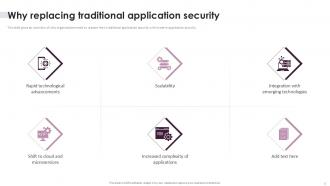
Slide 4: This slide gives an overview of why organizations need to replace their traditional application security with modern application security.
Slide 5: This slide highlights the project context for the application security proposal which includes the requirements and the key deliverables by the service provider.
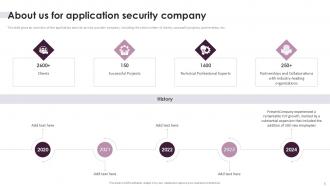
Slide 6: This slide gives an overview of the application security service provider company, including the total number of clients, successful projects, partnerships, etc.
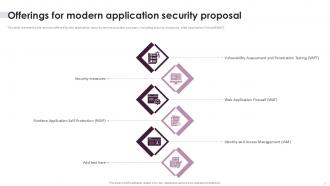
Slide 7: This slide represents the services offered by the application security service provider company, including security measures, Web Application Firewall(WAF).
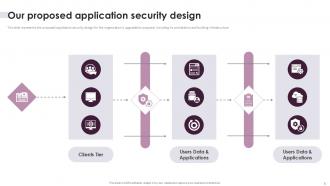
Slide 8: This slide represents the proposed application security design for the organization's upgradation proposal, including its workstation and building infrastructure.
Slide 9: This slide discusses the key steps for implementing application security for an organization; these are security requirement, architecture design, etc.
Slide 10: This slide shows the time framework for upgrading the application security proposal the steps include identifying requirements, developing architecture, etc.
Slide 11: This slide represents the estimated cost of upgrading an application security program in an organization; the cost categories are Infrastructure, etc.
Slide 12: This slide represents an overview of the team structure for the application security upgradation proposal including the names and designations of each member.
Slide 13: This slide represents an overview of the team structure for the application security upgradation proposal including the names and designations of each member.
Slide 14: This slide highlights the case study of application security including problems faced by the company, and their related solutions.
Slide 15: This slide showcases a collection of customer testimonials received from multiple clients who have graciously shared their feedback with the organization
Slide 16: This slide showcases a collection of customer testimonials received from multiple clients who have graciously shared their feedback with the organization.
Slide 17: This slide illustrates terms and conditions based on which the organization will sign a contract with the agreement party which covers service & payment, etc.
Slide 18: This slide covers the next step after the proposal has been accepted.
Slide 19: This slide shows Contact us for application security upgradation proposal.
Slide 20: This slide is titled as Additional Slides for moving forward.
Slide 21: This slide contains all the icons used in this presentation.
Slide 22: This is About Us slide to show company specifications etc.
Slide 23: This is a Timeline slide. Show data related to time intervals here.
Slide 24: This slide shows Post It Notes. Post your important notes here.
Slide 25: This slide provides 30 60 90 Days Plan with text boxes.
Slide 26: This is Our Target slide. State your targets here.
Slide 27: This slide displays Logo with related icons and text.
Slide 28: This slide depicts Venn diagram with text boxes.
Slide 29: This slide showcases Magnifying Glass to highlight information, specifications etc
Slide 30: This is a Thank You slide with address, contact numbers and email address.
Application Security Upgradation Proposal Complete Deck Ppt Example with all 38 slides:
Use our Application Security Upgradation Proposal Complete Deck Ppt Example to effectively help you save your valuable time. They are readymade to fit into any presentation structure.















FAQs for Application Security Upgradation Proposal Complete
SQL injection and broken authentication are the big nasties - they're behind most major breaches. XSS attacks are still everywhere too. Honestly, supply chain vulnerabilities through third-party code scare me more than anything lately. Cloud storage misconfigurations keep exposing tons of sensitive data because people rush deployments. Start with secure coding practices from the beginning instead of patching later. Regular security scans help catch stuff early. Oh, and insecure APIs are becoming a massive problem since everything's connected now.
Focus on the scary stuff first - critical vulns with high CVSS scores that could actually wreck your business. Internet-facing assets are where I'd start since that's attacker entry point 101. Build a simple risk matrix (likelihood vs damage) and actually use it instead of getting distracted by every medium-severity alert that pops up. Threat modeling helps you map your attack surface properly. Honestly, if you've got RCE vulnerabilities just sitting there, who cares about that random medium finding? Fix what'll hurt most first.
Honestly, threat modeling is just getting into an attacker's head before they mess with your app. Map out how your system works, figure out where the weak spots are, then decide what's actually worth worrying about. Way smarter than randomly slapping security stuff everywhere. The cool thing is it makes you really understand your data flows and entry points - stuff you totally miss when you're buried in code. I always tell people to start super basic: sketch your app, mark where data goes in and out, then think "okay, how would I screw this up?" Works every time.
Input validation is your first line of defense - sanitize everything because users are basically chaos agents. Use parameterized queries to stop SQL injection attacks. Hash passwords with bcrypt, never store them as plain text (I've seen this disaster too many times). Keep dependencies updated since new vulnerabilities pop up constantly. Authentication and authorization need to happen at every level of your app. Oh, and run a security scanner on your existing code first - you might be surprised what it finds. That'll give you a good starting point.
Dude, automated security tools are a game changer. They'll catch the usual suspects - SQL injection, XSS, sketchy dependencies - way faster than you ever could manually. Hook them into your CI/CD pipeline and you're finding problems early instead of dealing with a mess later. Honestly, they don't get distracted or miss the obvious stuff like I do after staring at code for 6 hours straight. Best part? You get to spend your time on the weird edge cases and business logic problems that actually need a human brain. I'd start with a SAST tool in your build process - pretty straightforward to set up.
So the OWASP Top Ten is basically your go-to list for the nastiest security holes that'll bite you. Covers injection attacks, crappy authentication, data leaks - you know, the stuff that makes headlines. I'd focus on the top 3 or 4 that actually apply to whatever you're building first, then work down from there. Don't wait until the end to think about this stuff either. Build it right into your code reviews and testing. It's a lot at first glance, but honestly way more useful than most security docs once you start using it.
Honestly, you've gotta make security everyone's thing, not just dump it on the security team. Show devs real vulnerabilities from your actual code - they eat that stuff up when it's relatable. Bug bounties work surprisingly well because developers get weirdly competitive about finding flaws. Build security checks right into code reviews so it becomes routine. The trick is framing it as skill-building, not extra busywork nobody wants. I'd start with just one practice and expand from there - going big right away usually backfires. Oh, and definitely celebrate the wins when people catch stuff early.
JWT tokens are your best bet - way better than basic API keys since they actually expire. Rate limiting's huge too, stops people from hammering your endpoints. Always use HTTPS, obviously. Plain HTTP is basically handing over your data to anyone listening. Input validation's critical, and set up proper user permissions so people can't peek at stuff they shouldn't. IP whitelisting works great for really sensitive calls. Log everything though - you'll thank yourself later when weird stuff starts happening. Honestly, just those first two will handle most script kiddies trying basic attacks.
Yeah so third-party stuff is sketchy because you're basically handing your data to strangers. I always check vendors first - like actually look at their security setup, not just trust their marketing. Rotate those API keys regularly too. Oh and dependency scanning tools are clutch for catching sketchy libraries before they bite you. Monitor who's accessing what from third parties because I swear half the breaches I hear about start there. You want to be able to cut them off fast if things get weird. Just don't integrate random code without vetting it first - learned that one the hard way.
Oh man, data breaches are the worst. First thing - isolate everything that's compromised and stop it from spreading. Figure out what data got hit, then start notifying people (customers, regulators, whoever) within their deadlines. The forensics investigation sucks but you gotta know how they got in so you can fix those holes. Document literally everything for legal stuff. But here's the thing - have your incident response plan ready beforehand! Scrambling to create one during an actual breach is absolute chaos. Oh, and test it regularly so your team isn't completely lost when something actually happens.
Dude, you absolutely need continuous monitoring - it's like having a security cam that never turns off. New vulnerabilities show up all the time, and hackers keep getting smarter. You can't just set up security once and forget about it (I learned this the hard way at my last job). Without monitoring, you'll only find out about breaches after they've already wrecked everything. Set up automated alerts for weird activity and scan regularly for new threats. Even basic monitoring tools are better than nothing. Trust me, flying blind is not an option here.
Dude, shift-left security is everywhere right now - basically just building security into your dev process from day one. Zero-trust architecture too, though honestly that term gets thrown around so much it's losing meaning. AI threat detection is getting pretty solid actually. OWASP updated their Top 10 again (swear they do this constantly lol). DevSecOps is becoming standard where everyone owns security, not just the security guys. Container security's massive with all the K8s stuff happening. If you haven't already, just start with automated security testing in your CI/CD pipeline. Easy win and you'll see results fast.
So basically you're moving security checks way earlier in your dev process instead of waiting until the end when everything's already built. Way smarter, honestly. You integrate automated scans and security policies right into your CI/CD pipeline so devs get feedback in minutes, not weeks later during some painful pen test. The cool part? Your team starts catching vulnerabilities when they're actually cheap to fix. Just throw a couple automated security scans into whatever pipeline you're already using - your developers will pick it up faster than you'd expect.
So moving to the cloud basically means your security setup changes completely. Instead of protecting one network boundary, you're now splitting responsibilities with your cloud provider. Yeah, you lose some direct infrastructure control, but honestly? You get access to security tools that would cost a fortune to build in-house. Identity management becomes API-heavy, encryption happens everywhere (data moving around and stored), plus container security if that's your thing. Here's what I'd do first - and this trips up so many teams - map out exactly who handles what security-wise. Don't assume your provider covers everything because they definitely don't.
Alright so you'll want to encrypt stuff both when it's sitting around and when it's moving between systems. AES-256 works great for stored data, TLS 1.3 for anything in transit. Key management is honestly where everyone screws up though - keep those keys separate from your encrypted data, preferably in a dedicated service. Oh and don't just rely on full-disk encryption. Actually encrypt the sensitive database fields individually. My advice? Figure out what actually needs encrypting first, then tackle it piece by piece instead of going crazy trying to encrypt everything at once.
-
Thank you for offering such helpful pre-designed templates. They are really beneficial to me in my job.
-
I've been looking for a good template source for some time. I'm happy that I discovered SlideTeam. Excellent presentations must try!