


Approaches To Enter Global Market Through International Advertising Strategies MKT CD V





Try Before you Buy Download Free Sample Product
 Impress Your
 Audience
 100%
100% Editable
 Save Hours
 of Time


Our Approaches to Enter Global Market Through International Advertising Strategies template offers a comprehensive guide for marketers aiming to expand their brands reach beyond domestic boundaries. The professionally curated content empowers businesses to effectively engage with a global audience and enhance brand visibility on an international scale. Additionally, our International Marketing Management deck provides a thorough overview of international marketing, encompassing key trends, characteristics, participants, and associated risks. The global marketing plan outlined in the template emphasizes the importance of market research, setting SMART goals, formulating localization strategies, delivering product information, utilizing marketing materials, and leveraging appropriate marketing software. Moreover, the Global Marketing PPT explores diverse international marketing approaches, including exporting, licensing, franchising, joint ventures, and more, covering their processes, risks, key documents, checklists, strategies, models, fundamentals, and contracts. The Franchising module delves into crafting an effective international marketing campaign plan, delineating roles and responsibilities for the marketing team, implementing a robust training plan, measuring impact, and offering a compelling case study for successful global advertising. Download our versatile and fully customizable template now, compatible with Google Slides, to accelerate your brands global expansion journey.
People who downloaded this PowerPoint presentation also viewed the following :
Content of this Powerpoint Presentation
Slide 1: This slide introduces Approaches to Enter Global Market Through International Advertising Strategies. Commence by stating Your Company Name.
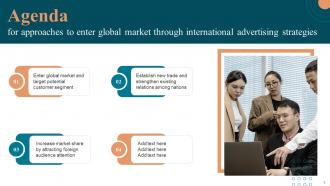
Slide 2: This slide depicts the Agenda of the presentation.
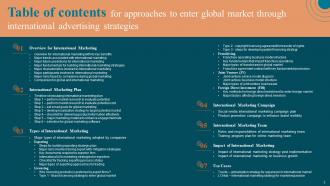
Slide 3: This slide incorporates the Table Of Contents.
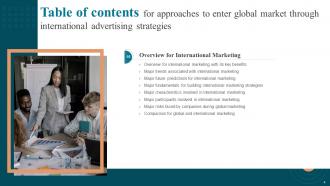
Slide 4: This is yet another slide continuing the Table Of Contents.
Slide 5: This slide highlights the Title for the Topics to be covered further.
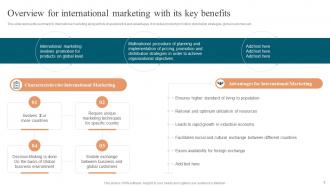
Slide 6: This slide represents summary for international marketing along with its characteristics and advantages.
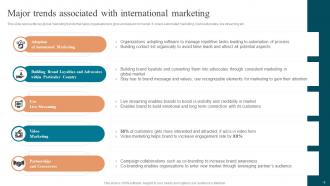
Slide 7: This slide exhibits the Major trends associated with international marketing.
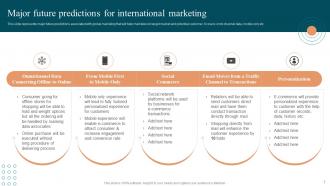
Slide 8: This slide focuses on the Major future predictions for international marketing.
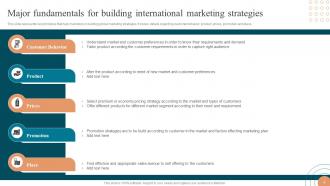
Slide 9: This slide states the Major fundamentals for building international marketing strategies.
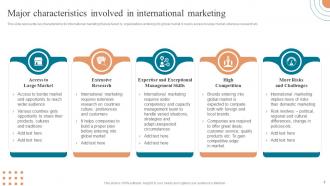
Slide 10: This slide represents key characteristics for international marketing that are faced by organizations entering into global market.
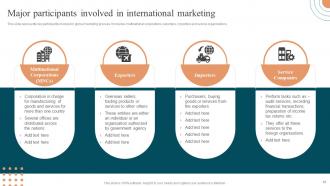
Slide 11: This slide reveals the Major participants involved in international marketing.
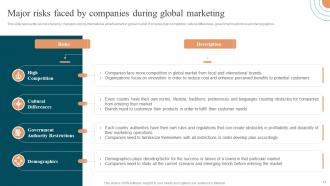
Slide 12: This slide showcases the Major risks faced by companies during global marketing.
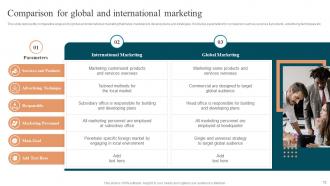
Slide 13: This slide shows the comparative analysis for global and international marketing that helps marketers to develop plans and strategies.
Slide 14: This slide mentions the Heading for the Contents to be discussed further.
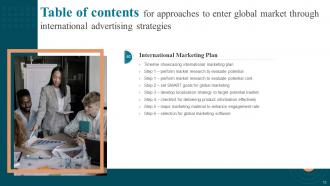
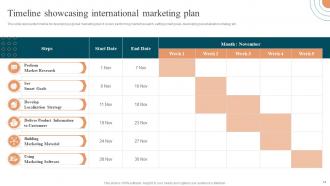
Slide 15: This slide indicates the Timeline showcasing international marketing plan.
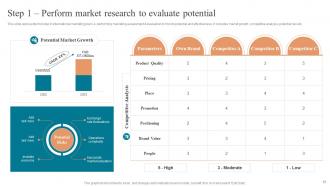
Slide 16: This slide represents first step in international marketing plan i.e. performing marketing assessment & evaluation to find its potential and effectiveness.
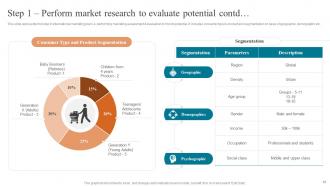
Slide 17: This slide elucidates the first step in international marketing plan i.e. performing marketing assessment & evaluation to find its potential.
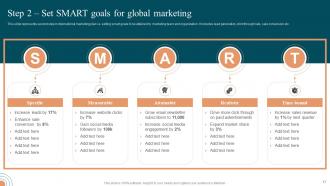
Slide 18: This slide includes the second step in international marketing plan i.e. setting smart goals to be attained by marketing team and organization.
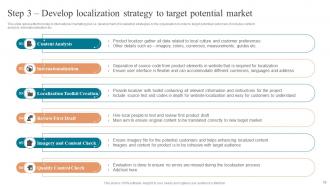
Slide 19: This slide contains the third step in international marketing plan i.e. development of localization strategies by the organization in order to target potential customers.
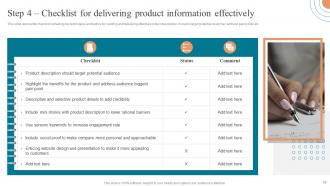
Slide 20: This slide reveals the checklist containing key techniques and tactics for building and delivering effective product description. It covers target potential customer, address pain points etc.
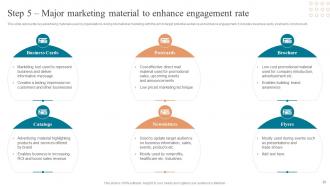
Slide 21: This slide indicates the key advertising materials used by organizations during international marketing with the aim to target potential audience and enhance engagement.
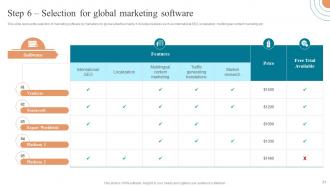
Slide 22: This slide elucidates the selection of marketing software by marketers for global advertisements.
Slide 23: This slide mentions the Title for the Ideas to be discussed further.
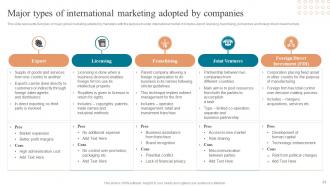
Slide 24: This slide states the five types of major global marketing adopted by marketers with the purpose to enter international market.
Slide 25: This slide incorporates the Heading for the Ideas to be covered in the following template.
Slide 26: This slide highlights the Steps for building exporting strategic plan.
Slide 27: This slide talks about the Major risks involved during export with mitigation strategies.
Slide 28: This slide represents major documents required by exporters for shipment of goods and services.
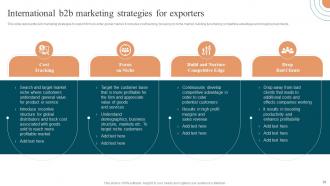
Slide 29: This slide covers the International b2b marketing strategies for exporters.
Slide 30: This slide showcases the Checklist for tracking exporting process status.
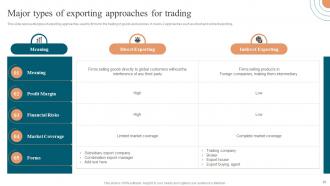
Slide 31: This slide lists the Major types of exporting approaches for trading.
Slide 32: This slide mentions the Title for the Components to be covered in the upcoming template.
Slide 33: This slide presents the major reasons for which export ventures license the products before entering in global market.
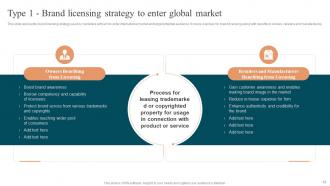
Slide 34: This slide portrays brand licensing strategy used by marketers with aim to enter international market and target potential audience.
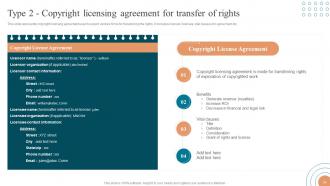
Slide 35: This slide depicts the copyright licensing agreement used by export venture firms for transferring the rights.
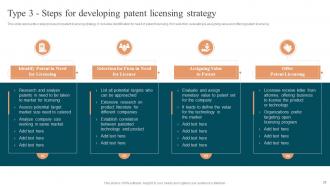
Slide 36: This slide shows the 4 step process for patent licensing strategy.
Slide 37: This slide includes the Heading for the Topics to be discussed in the following template.
Slide 38: This slide deals with the Franchise operating business model structure.
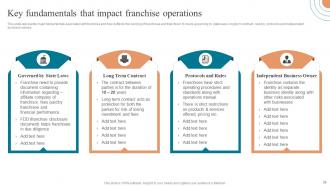
Slide 39: This slide displays the Key fundamentals that impact franchise operations.
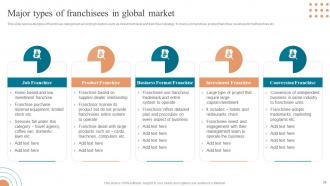
Slide 40: This slide mentions the Major types of franchisees in global market.
Slide 41: This slide talks about the Franchise agreement contract with key fundamental provisions.
Slide 42: This slide indicates the Title for the Topics to be covered next.
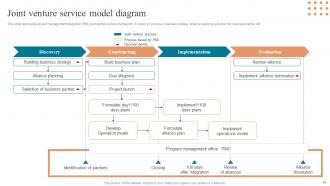
Slide 43: This slide illustrates the Joint venture service model diagram.
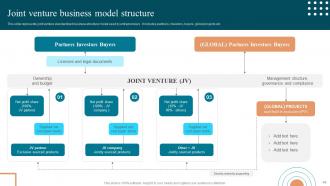
Slide 44: This slide elucidates the Joint venture business model structure.
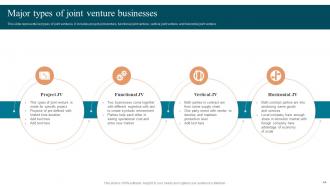
Slide 45: This slide incorporates the Major types of joint venture businesses.
Slide 47: This slide focuses on the Key methods for foreign direct investment to enter foreign market.
Slide 48: This slide presents the Major factors affecting foreign direct investors.
Slide 49: This slide indicates the Heading for the Contents to be covered in the forth-coming template.
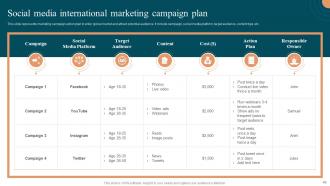
Slide 50: This slide represents marketing campaign action plan to enter global market and attract potential audience.
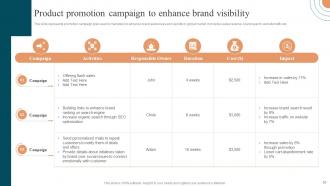
Slide 51: This slide focuses on the Product promotion campaign to enhance brand visibility.
Slide 52: This slide elucidates the Title for the Ideas to be covered next.
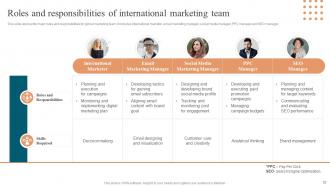
Slide 53: This slide exhibits the Roles and responsibilities of international marketing team.
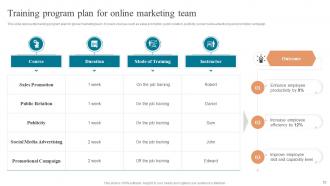
Slide 54: This slide portrays the Training program plan for online marketing team.
Slide 55: This slide depicts the Heading for the Contents discussed in the upcoming template.
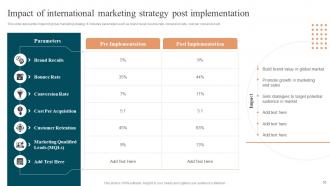
Slide 56: This slide talks about the Impact of international marketing strategy post implementation.
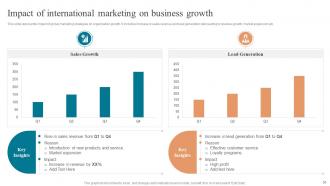
Slide 57: This slide reveals the impact of global marketing strategies on organization growth.
Slide 58: This slide displays the Title for the Components to be discussed next.
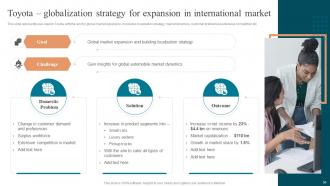
Slide 59: This slide represents use case for Toyota with the aim for global market expansion.
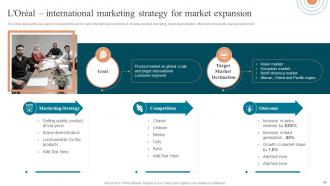
Slide 60: This slide showcases the use case for Loreal with the aim to cater international customers.
Slide 61: This is the Icons slide containing all the Icons used in the plan.
Slide 62: This slide is used for depicting Additional information.
Slide 63: This slide is used for the purpose of Comparison.
Slide 64: This is Our target slide. State your comapny targets here.
Slide 65: This slide presents the organization's vision, mission, and values.
Slide 66: This is Our team slide. State the information related to your team members here.
Slide 67: This slide contains the Post it notes for reminders and deadlines.
Slide 68: This is the Idea generation slide for encouraging innovative ideas.
Slide 69: This slide elucidates the SWOT analysis.
Slide 70: This is the Puzzle slide with related imagery.
Slide 71: This is the Venn diagram slide.
Slide 72: This is the 30 60 90 Days plan slide for efficient planning.
Slide 73: This slide reveals the Mind map of the firm.
Slide 74: This is the Thank You slide for acknowledgement.
Approaches To Enter Global Market Through International Advertising Strategies MKT CD V with all 76 slides:
Use our Approaches To Enter Global Market Through International Advertising Strategies MKT CD V to effectively help you save your valuable time. They are readymade to fit into any presentation structure.























FAQs for Approaches To Enter Global Market Through International Advertising Strategies
International advertising strategies differ through cultural adaptation, localized messaging, regulatory compliance, market-specific media channel selection, and varied consumer behavior analysis across regions. These elements enable global brands to resonate authentically within diverse markets, with companies like McDonald's and Coca-Cola finding that tailored approaches significantly enhance brand acceptance and drive superior market penetration compared to standardized domestic campaigns.
Cultural nuances significantly influence global advertising by shaping language preferences, visual symbolism, color interpretations, religious considerations, and social values across different markets. Successful campaigns adapt messaging tone, imagery selection, and cultural references to resonate locally, with brands like McDonald's and Coca-Cola customizing their approach for diverse regions, ultimately delivering authentic connections and enhanced market penetration.
Market research provides critical insights into cultural preferences, consumer behaviors, competitive landscapes, and regulatory requirements across different international markets. Through comprehensive demographic analysis, cultural studies, and local market assessments, companies can tailor their messaging, choose appropriate channels, and avoid cultural missteps, with many global brands finding that localized research-driven campaigns deliver significantly higher engagement rates and market penetration than standardized approaches.
Brands achieve global-local balance by developing core brand pillars that remain constant while customizing executional elements like language, cultural references, and regional preferences. Through strategic localization frameworks, companies maintain unified brand identity across markets while adapting messaging to resonate with local audiences, ultimately delivering consistent brand experiences that feel authentically relevant to each market's unique cultural context.
Common pitfalls include cultural misinterpretation, inadequate market research, poor translation or localization, inconsistent brand messaging across regions, and ignoring local regulations or consumer behaviors. These challenges often result in campaigns that alienate target audiences, waste marketing budgets, and damage brand reputation, with many companies finding that strategic cultural adaptation and local partnerships significantly enhance campaign effectiveness and market penetration.
Advertising regulations vary significantly across countries, encompassing content restrictions, data privacy laws, sector-specific guidelines, disclosure requirements, and cultural sensitivity standards. These regulatory frameworks present both challenges and opportunities for international brands, with many companies finding that strategic compliance enables enhanced consumer trust, reduced legal risks, and competitive advantage in diverse markets, ultimately delivering streamlined global campaigns.
International social media advertising strategies include platform localization, culturally adapted content creation, influencer partnerships, geo-targeted campaigns, and multilingual customer engagement. These approaches streamline global reach by tailoring messaging to local preferences, leveraging region-specific platforms like WeChat or WhatsApp, and partnering with local influencers, ultimately delivering enhanced brand visibility and customer connections across diverse markets.
Regional advertising medium priorities vary significantly based on infrastructure, demographics, and cultural preferences, with developed markets like North America and Europe heavily favoring digital channels while emerging markets maintain stronger traditional media usage. Asian markets present hybrid approaches combining mobile-first digital strategies with traditional outdoor advertising, while Latin American and African regions balance radio and television with growing social media adoption, ultimately enabling brands to optimize regional resource allocation and maximize local audience engagement.
Effective global advertising metrics include brand awareness lift, cross-market engagement rates, conversion tracking by region, cost per acquisition variations, and cultural sentiment analysis across different demographics. These measurements enable organizations to optimize budget allocation, identify high-performing markets, and adapt messaging strategies, with many multinational brands finding that localized performance data ultimately delivers stronger ROI and competitive market positioning.
Storytelling can be adapted through cultural localization, universal human themes, visual symbolism adjustments, and regional narrative structures that honor local values and communication styles. Companies like Coca-Cola and Nike successfully modify their core brand stories while maintaining consistent messaging, using culturally relevant characters, settings, and emotional triggers that resonate authentically with each market's unique cultural context.
Language translation significantly impacts brand perception by influencing emotional connection, cultural relevance, and message authenticity across international markets. Poor translations can damage credibility and create negative associations, while strategic localization enhances trust, resonates with local values, and strengthens brand positioning, with many global companies finding that culturally adapted messaging delivers higher engagement and market penetration.
Brands can effectively handle cultural backlash through swift acknowledgment, genuine apologies when appropriate, immediate corrective action, and transparent communication with affected communities. Through cultural liaison teams and local partnerships, companies like KFC in China and Coca-Cola across various markets have successfully navigated misunderstandings by demonstrating cultural sensitivity, ultimately strengthening brand trust and loyalty.
Companies can maintain brand identity while localizing content through consistent visual elements, universal brand values, standardized tone guidelines, core message frameworks, and flexible creative templates. This strategic combination enables brands like McDonald's and Coca-Cola to preserve their global recognition while adapting messaging, imagery, and cultural references for local markets, ultimately delivering authentic customer connections and competitive advantage across diverse international segments.
Economic factors significantly influence international advertising strategies through currency fluctuations, purchasing power variations, inflation rates, and market maturity levels across different regions. Companies adapt by adjusting budget allocations, selecting cost-effective media channels, and tailoring messaging to local economic conditions, with many multinational brands finding that flexible, economy-responsive campaigns deliver better ROI and market penetration.
Partnerships with local influencers significantly enhance international advertising effectiveness by providing authentic cultural insights, established audience trust, and native language communication that resonates with regional consumers. These collaborations enable brands to navigate cultural nuances seamlessly while leveraging influencers' deep community connections, ultimately delivering higher engagement rates and more credible market penetration than traditional advertising approaches.
-
Amazing slides! Unique, attractive, and easy to understand.
-
Thanks to SlideTeam, we have an ideal template to present all the info we need to cover. Their slides give our numbers and projections a more clear and enchanting look.