


Apriori Algorithm In Unsupervised Machine Learning Training Ppt




Try Before you Buy Download Free Sample Product
 Impress Your
 Audience
 100%
100% Editable
 Save Hours
 of Time


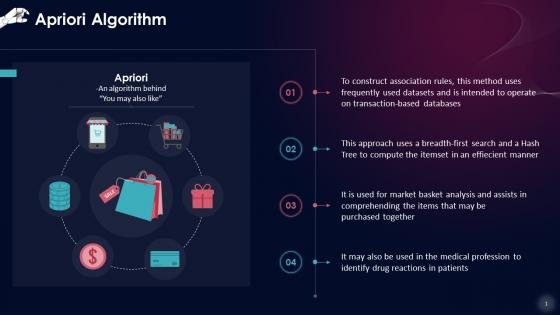
This slide states that Apriori algorithm is used for market basket analysis and assists in comprehending the items that may be purchased together. It may also be used in the medical profession to identify reactions to drugs in patients.
People who downloaded this PowerPoint presentation also viewed the following :
Apriori Algorithm In Unsupervised Machine Learning Training Ppt with all 17 slides:
Use our Apriori Algorithm In Unsupervised Machine Learning Training Ppt to effectively help you save your valuable time. They are readymade to fit into any presentation structure.







FAQs for Apriori Algorithm In Unsupervised Machine
The Apriori algorithm is a fundamental data mining technique that identifies frequent itemsets and association rules within large datasets by systematically examining item combinations. It functions by scanning datasets multiple times, eliminating infrequent itemsets at each level, enabling retailers, banks, and e-commerce platforms to uncover purchasing patterns, optimize inventory management, and enhance customer recommendations through strategic data-driven insights.
The support threshold acts as a filter that determines which itemsets qualify as frequent, directly controlling the algorithm's sensitivity and output volume. Higher thresholds produce fewer, more statistically significant patterns, while lower thresholds capture more granular associations but increase computational complexity, with many retailers and e-commerce platforms finding that strategic threshold adjustment optimizes both performance and actionable insights.
Frequent itemsets are collections of items that appear together in transactions above a predetermined minimum support threshold, forming the foundation for association rule mining. The Apriori algorithm identifies them through iterative scanning, starting with single items, eliminating infrequent candidates, and progressively building larger itemsets, with retailers and e-commerce platforms finding this approach delivers targeted recommendations and optimized inventory management.
Association rules in Apriori algorithms identify relationships between items by analyzing frequent patterns, measuring support, confidence, and lift metrics to determine correlations. These rules enable retailers, healthcare providers, and financial institutions to streamline recommendation systems, enhance cross-selling strategies, and optimize inventory placement, ultimately delivering personalized customer experiences and increased revenue opportunities.
**INPUT**: What are the advantages and limitations of using the Apriori algorithm compared to other data mining techniques? **OUTPUT**: Apriori algorithm advantages include simplicity, interpretable results, scalability across datasets, and proven effectiveness for market basket analysis and association rule mining. While it delivers clear insights for retail recommendations and cross-selling strategies, it can be computationally intensive with large datasets, with many organizations finding that combining it with newer techniques enhances performance. [Word count: 54 words]
The Apriori algorithm is most effectively applied in retail market basket analysis, recommendation systems, web usage pattern analysis, and inventory management optimization. These scenarios benefit from Apriori's ability to identify frequent itemsets and association rules, with retailers like Amazon and grocery chains finding that understanding customer purchase patterns enables cross-selling strategies, improved product placement, and enhanced customer experiences.
The Apriori algorithm handles large datasets through pruning strategies that eliminate infrequent itemsets early, reducing computational overhead, though memory constraints and multiple database scans can present challenges. Organizations leverage optimization techniques like hash-based filtering, transaction reduction, and partitioning approaches, with retail chains and financial institutions finding these methods significantly accelerate market basket analysis and fraud detection processes.
Confidence and lift serve as critical metrics for evaluating association rule quality in Apriori algorithms, measuring rule reliability and statistical significance respectively. Confidence determines the probability of consequent occurrence given antecedent presence, while lift assesses whether associations exceed random chance, with retail chains and e-commerce platforms using these metrics to validate product recommendation strategies and optimize cross-selling campaigns.
The Apriori algorithm can be implemented using Python libraries like mlxtend (which provides apriori function), pandas for data preprocessing, and scikit-learn for additional data manipulation and analysis workflows. These libraries streamline market basket analysis by automating frequent itemset discovery, association rule generation, and confidence threshold filtering, with retail businesses, e-commerce platforms, and recommendation systems finding that this combination delivers faster insights, improved customer targeting, and enhanced cross-selling strategies.
Common Apriori algorithm applications in retail and e-commerce include market basket analysis, cross-selling recommendations, inventory optimization, customer segmentation, and promotional bundling strategies. These implementations enable retailers to identify frequent purchasing patterns, strategically position complementary products, and enhance customer experiences through personalized recommendations, with many e-commerce platforms finding significantly improved conversion rates and average order values.
Optimal Apriori parameters include setting minimum support thresholds based on dataset size, adjusting confidence levels between 0.7-0.9, and implementing pruning strategies to reduce computational overhead. Through careful threshold calibration, organizations in retail and e-commerce streamline market basket analysis, enhance recommendation systems, and accelerate pattern discovery, ultimately delivering faster insights and improved customer targeting strategies.
The Apriori algorithm can be adapted for real-time analysis through incremental learning techniques, sliding window approaches, distributed processing frameworks, and optimized data structures that update association rules dynamically. Financial institutions and e-commerce platforms increasingly leverage these adaptations for fraud detection and recommendation systems, enabling faster response times and continuous pattern discovery while maintaining accuracy in high-velocity data environments.
The Apriori algorithm uses a breadth-first search approach with candidate generation and multiple database scans, while FP-Growth employs a depth-first search with FP-tree construction requiring only two database scans. These algorithmic differences enable FP-Growth to deliver significantly faster processing speeds and reduced memory usage, with many retail and e-commerce organizations finding enhanced performance for large-scale market basket analysis.
Data preprocessing significantly affects Apriori algorithm performance by reducing computational complexity, improving accuracy, and accelerating execution times through data cleaning, normalization, and dimensionality reduction. Through effective preprocessing techniques, organizations streamline transaction analysis, minimize memory requirements, and enhance pattern discovery efficiency, with retail and e-commerce businesses finding that cleaned datasets deliver faster insights and more reliable market basket analyses.
Popular tools for implementing the Apriori algorithm include R packages like arules and arulesViz, Python libraries such as mlxtend and apyori, commercial platforms like SAS Enterprise Miner, and specialized software including Weka and RapidMiner. These technologies streamline market basket analysis, customer segmentation, and recommendation systems by automating pattern discovery, visualizing association rules, and scaling across large datasets, with many retail and e-commerce organizations finding that integrated analytics platforms ultimately deliver faster insights and competitive advantage.
-
The information is visually stunning and easy to understand, making it perfect for any business person. So I would highly recommend you purchase this PPT design now!
-
Editable templates with innovative design and color combination.