

Architecture For Smart Waste Bins And Centralised System IoT Driven Waste Management Reducing IoT SS V




Try Before you Buy Download Free Sample Product
 Impress Your
Audience
 100%
Editable
 Save Hours
of Time


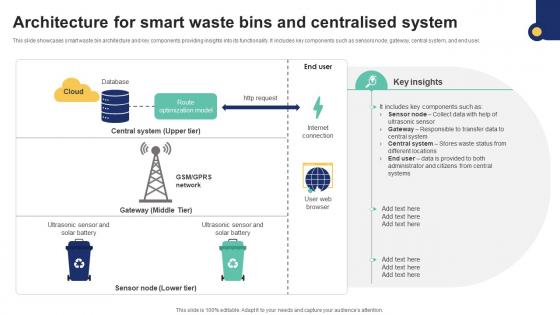
This slide showcases smart waste bin architecture and key components providing insights into its functionality. It includes key components such as sensors node, gateway, central system, and end user.
People who downloaded this PowerPoint presentation also viewed the following :
Architecture For Smart Waste Bins And Centralised System IoT Driven Waste Management Reducing IoT SS V with all 9 slides:
Use our Architecture For Smart Waste Bins And Centralised System IoT Driven Waste Management Reducing IoT SS V to effectively help you save your valuable time. They are readymade to fit into any presentation structure.








FAQs for Architecture For Smart Waste Bins And Centralised System IoT Driven Waste Management Reducing
Key components include IoT sensors for real-time monitoring, GPS-enabled collection vehicles, data analytics platforms, automated sorting systems, and mobile applications for citizen engagement. These technologies streamline operations by optimizing collection routes, predicting bin capacity, and enabling dynamic scheduling, with many municipalities finding that integrated systems reduce operational costs by 20-30% while significantly improving service efficiency.
IoT technology enhances waste monitoring through smart sensors that track fill levels, GPS tracking for route optimization, automated collection scheduling, and data analytics for predictive maintenance. These systems enable waste management companies to reduce operational costs by up to 30%, minimize unnecessary collection trips, and improve service efficiency, with many municipalities finding that real-time monitoring ultimately delivers better resource allocation and enhanced environmental sustainability.
Smart bins play a crucial role in reducing landfill overflow by optimizing collection schedules through fill-level sensors, compacting waste to increase capacity, and enabling route optimization for collection trucks. These intelligent systems help municipalities and waste management companies minimize unnecessary collections, reduce operational costs, and ultimately divert more recyclables from landfills through better sorting capabilities.
Data analytics optimizes waste collection routes by analyzing historical pickup patterns, real-time bin sensor data, traffic conditions, and seasonal variations to create efficient pathways. Through predictive algorithms and GPS tracking, waste management companies reduce fuel costs, minimize collection times, and enhance service reliability, with many municipalities finding that optimized routing delivers 20-30% operational savings while improving customer satisfaction.
Smart waste management solutions deliver significant environmental benefits including reduced greenhouse gas emissions, minimized landfill waste, enhanced recycling rates, decreased fuel consumption from optimized collection routes, and improved air quality. These technologies enable cities and organizations to achieve sustainability goals by streamlining waste sorting, reducing methane emissions from decomposition, and maximizing resource recovery, ultimately delivering cleaner environments and measurable carbon footprint reductions.
Smart waste management contributes to circular economy initiatives by optimizing resource recovery, enabling real-time tracking of waste streams, and automating sorting processes that maximize material reuse. Through IoT sensors and AI-driven analytics, municipalities and corporations streamline recycling operations, reduce landfill dependency, and create new revenue streams from recovered materials, ultimately delivering enhanced sustainability outcomes.
Cities face challenges including high upfront technology costs, integration complexities with existing infrastructure, staff training requirements, data privacy concerns, and citizen adoption resistance. These implementation hurdles often require significant resource allocation and strategic planning, though many municipalities find that phased rollouts, public-private partnerships, and community engagement programs help overcome initial barriers while ultimately delivering operational efficiency and environmental benefits.
Community engagement enhances smart waste management by promoting proper sorting, encouraging participation in recycling programs, and providing valuable feedback on system performance. When residents actively contribute through mobile apps, educational workshops, and neighborhood initiatives, municipalities achieve higher recycling rates, reduced contamination levels, and more efficient collection routes, ultimately delivering cost savings and improved environmental outcomes.
Smart waste management technology presents both upfront capital costs and significant long-term savings through operational efficiency, reduced collection frequency, and optimized route planning. While initial investments in sensors, IoT infrastructure, and software platforms require budget allocation, municipalities and organizations typically see 20-30% cost reductions within two years, with waste management companies finding that automated sorting and predictive analytics ultimately deliver lower labor costs, fuel savings, and enhanced resource recovery revenues.
**INPUT**: Can artificial intelligence predict waste generation patterns, and how? **OUTPUT**: Yes, artificial intelligence predicts waste generation patterns through machine learning algorithms, historical data analysis, weather pattern integration, demographic modeling, and real-time sensor monitoring. These technologies enable municipalities and waste management companies to optimize collection routes, reduce operational costs, and improve service efficiency, with cities like Barcelona and Amsterdam finding that AI-driven predictions enhance resource allocation while minimizing environmental impact. [Word count: 60 words]
Barcelona, Amsterdam, Seoul, and San Francisco have successfully implemented smart waste management through IoT sensors, route optimization algorithms, and data analytics platforms. These cities streamlined collection efficiency by 20-40%, reduced operational costs significantly, and enhanced citizen satisfaction, with many municipalities finding that strategic technology integration delivers competitive urban advantages while minimizing environmental impact.
Smart waste management systems integrate with existing urban infrastructure through IoT sensors, wireless networks, and centralized data platforms that connect to municipal management systems. These technologies seamlessly interface with current waste collection routes, traffic management systems, and city databases, enabling optimized scheduling, reduced operational costs, and enhanced service efficiency while leveraging existing communication networks and administrative frameworks.
Smart waste management privacy concerns include data collection from sensors tracking disposal patterns, location monitoring through smart bins, personal information exposure from RFID tags, potential surveillance overreach, and unauthorized data sharing with third parties. While these technologies streamline waste operations and enhance municipal efficiency, organizations must implement robust data protection protocols, transparent consent mechanisms, and secure storage systems, with many cities finding that balanced privacy frameworks ultimately deliver operational advantages while maintaining citizen trust.
Mobile apps facilitate better waste disposal habits by providing real-time collection schedules, gamifying recycling efforts through rewards systems, and offering educational content about proper sorting techniques. Through push notifications and GPS-enabled features, residents receive timely reminders and locate nearby disposal facilities, while many municipalities find that app-based reporting systems streamline waste management operations and ultimately enhance community engagement.
Smart waste management drives innovations in material recovery facilities through AI-powered optical sorting systems, robotic separators, sensor-based contamination detection, automated quality control mechanisms, and predictive maintenance technologies. These advanced systems streamline operations by increasing sorting accuracy, reducing labor costs, and maximizing resource recovery rates, with many recycling facilities finding that automated sorting delivers significantly higher material purity and operational efficiency.
-
Top Quality presentations that are easily editable.
-
The designs by SlideTeam are honestly the best I have seen so far. Will be definitely coming back for more.