

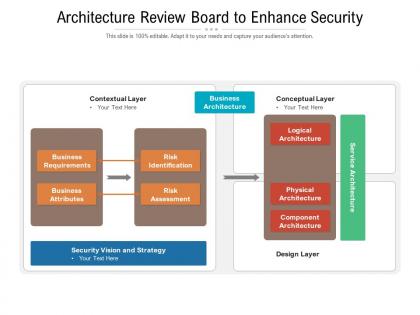
Architecture review board to enhance security




Try Before you Buy Download Free Sample Product
 Impress Your
 Audience
 100%
100% Editable
 Save Hours
 of Time


Our Architecture Review Board To Enhance Security are topically designed to provide an attractive backdrop to any subject. Use them to look like a presentation pro.
People who downloaded this PowerPoint presentation also viewed the following :
Architecture review board to enhance security with all 2 slides:
Use our Architecture Review Board To Enhance Security to effectively help you save your valuable time. They are readymade to fit into any presentation structure.
FAQs for Architecture review board
So ARB basically makes sure your tech choices don't totally clash with business goals and architectural standards. They'll review big system designs and tech picks before you dump resources into building stuff. Honestly, they're like your "does this actually make sense" team - way more strategic though. You won't end up with technical debt nightmares or systems that can't talk to each other. Plus they stop teams from going completely off the rails with random incompatible solutions. Get them involved early on any major projects - trust me, retrofitting their feedback later is such a pain.
So the ARB is basically your checkpoint for any big architectural moves. They'll look at your proposals and make sure you're not just building something shiny that doesn't actually help the business - honestly happens more than you'd think. Plus they keep everyone following the same coding standards and security stuff so your work doesn't break existing systems. Really saves you from spending months on the wrong direction. Just make sure you come prepared with solid business reasons when you present to them. They're pretty good at catching problems early.
Honestly, you'll want people who've actually built big systems before - not just the ones who sound smart in meetings. Mix of deep tech knowledge and folks who can communicate without making everyone's eyes glaze over. Strategic thinkers are key too, the kind who'll push back when something's a terrible idea (trust me, you need those people). Your tech stack matters less than finding people who see the whole picture. Don't stack it with carbon copies of the same senior dev mindset either. Start with maybe 3-5 people and swap some out every couple years so it doesn't get stale.
Honestly, bi-weekly is your best bet for most companies. Weekly gets exhausting fast unless you've got tons of dev teams constantly pitching new stuff. Monthly? Don't even bother - I've watched urgent decisions sit there for weeks while everyone waits around. You'll have enough time to actually review materials without creating bottlenecks. Some teams try the whole "let's just meet when we need to" approach but that falls apart quick. Start bi-weekly and see how it goes. You can always throw in emergency sessions when something critical pops up that can't wait.
So you submit your design first, then it goes through screening and technical review before hitting the board. They'll ask about scalability, security, how it fits with current systems - the usual stuff. Honestly, it feels pretty formal but they're actually trying to catch problems early. Data flow questions always come up, and they love asking about failure scenarios, so prep for those. You might get full approval or "fix this first" with specific notes. Pro tip: don't stress too much about the formality - most reviewers are genuinely helpful once you get past the initial intimidation factor.
So the ARB basically has checklists for stuff like SOX, HIPAA, PCI-DSS - whatever applies to your project. They'll catch compliance issues in your architecture before you start coding, which honestly beats scrambling to fix things later. When you submit proposals, they automatically check them against regulatory requirements. You'll need to explain how your design choices actually support compliance too. Oh and definitely mention any regulatory stuff upfront in your docs - don't just tack it on at the end. Makes the whole approval process way smoother.
So basically you want to watch a few things. Review cycle time is huge - how long from submission to getting approved? Approval rates matter too, plus how many revision rounds each proposal goes through. If people are constantly getting rejected, your guidelines probably suck. Post-implementation defect rates are key because if approved architectures keep breaking in production, that's bad news. Oh and definitely survey stakeholders about satisfaction - nobody wants to work with a board that feels like they're just blocking everything. Start with those four and tweak based on what you're actually seeing.
So basically the ARB sets up this whole structured thing where everyone presents their case with business reasoning. They'll use scoring matrices to weigh stuff like technical debt versus business impact - you know, resource constraints and all that. Honestly? These meetings can get super heated. I've watched product and engineering teams go at it pretty intensely. What works is having transparent criteria that everyone bought into beforehand. Then the board makes calls based on company-wide goals instead of departmental drama. Oh, and definitely come with solid data - know what the company's strategic priorities actually are before you walk in there.
Dude, the ARB lives and dies by documentation - that's literally how they evaluate everything. You'll need solid architecture docs, design rationales, all the technical specs. Poor documentation kills good ideas faster than anything else, trust me on that one. The board uses your docs to figure out system impact, dependencies, whether it fits company standards. They've got their own documentation too - decisions, patterns, guidelines everyone has to follow. My advice? Make your docs super clear from the start. Saves you from going through review hell multiple times later.
Honestly, ARBs speed things up more than slow them down. They set up patterns and standards so your team isn't rebuilding basic stuff from scratch every project. It's like good city planning - gives you structure to be creative within. Short sentences work. The board can also push new tech, help with funding for experimental stuff, and build reusable components that make development faster. Just make sure yours focuses on helping teams rather than being the fun police. Push them to actually publish clear guidelines and keep a solid library of approved tools you can grab.
Dude, ARBs turn into these awful bottlenecks where teams wait forever for approval. Super frustrating. Instead of being the review police, flip it - give teams clear guidelines upfront so they know what's expected. Put architects directly in teams for quick guidance rather than formal meetings. Only review the really risky stuff, not every little decision. Oh, and make sure your board actually knows the current tech stack. I've seen too many boards with people who haven't touched code in like 5 years making decisions about modern frameworks. Document your criteria so there's no guessing game about what'll get approved.
Honestly, get everyone in the room - not just the usual engineering crowd. Security, ops, business people, even finance if they're involved. I've watched teams completely change how they talk to each other once everyone has actual input on architectural stuff. Right now they're probably just tossing requirements back and forth like hot potatoes. Set up regular meetings where people can hash out trade-offs together instead of just nodding along to technical decisions they don't really get. Figure out who actually needs to weigh in on your next big architecture call and start there.
So your ARB is gonna deal with way more stuff now - multi-cloud setups, microservices, containers, all that jazz. Honestly, it's a headache compared to the simple on-premises days. Your board needs to weigh vendor lock-in risks and data sovereignty issues across different providers. Plus there's new governance for DevOps practices and auto-scaling policies. Here's the thing though - if your ARB members don't really get cloud architecture, you'll end up rubber-stamping decisions you can't properly evaluate. That's kinda dangerous.
Honestly, quarterly tech radar sessions are your best bet here. Get board members who actually go to conferences and follow what's happening - someone's gotta stay plugged into the industry noise. Run small pilot programs to test new stuff without breaking everything (learned that one the hard way). You don't want to jump on every shiny trend, but you can't sleep on real shifts either. The tricky part? Balancing innovation with keeping things stable. Quarterly reviews work if you actually stick to them though.
Three things will save your sanity: get templates and clear criteria so reviews aren't all over the place. Timebox those meetings hard - I've seen ARBs turn into 3-hour death spirals. Set up checkpoints beforehand too, nobody likes getting ambushed. Focus on the big architectural stuff, not nitpicky implementation details (easier said than done sometimes). Document decisions simply so teams can actually find them later. But honestly? The real magic happens with informal office hours where people can run ideas by you first. Catches the messy stuff early and makes formal reviews way smoother.
-
Awesome presentation, really professional and easy to edit.
-
Excellent Designs.
-
Graphics are very appealing to eyes.
-
Graphics are very appealing to eyes.
-
Great quality product.