

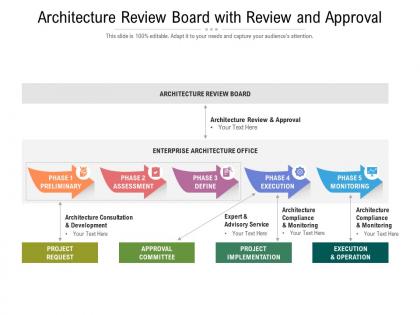
Architecture review board with review and approval




Try Before you Buy Download Free Sample Product
 Impress Your
 Audience
 100%
100% Editable
 Save Hours
 of Time


Our Architecture Review Board With Review And Approval are topically designed to provide an attractive backdrop to any subject. Use them to look like a presentation pro.
People who downloaded this PowerPoint presentation also viewed the following :
Architecture review board with review and approval with all 2 slides:
Use our Architecture Review Board With Review And Approval to effectively help you save your valuable time. They are readymade to fit into any presentation structure.
FAQs for Architecture review board with
Look, it really comes down to knowing who decides what and having clear standards everyone follows. Document your decisions so people aren't constantly guessing what you're thinking - transparency saves everyone headaches. The tricky part is making governance that actually helps teams ship stuff instead of slowing them down (trust me, I've watched companies completely tank this). You'll also need solid risk management and compliance checks. Start by figuring out where your current decision-making process is broken or overlapping weirdly. Stakeholder buy-in matters too, obviously.
So architecture governance is basically your bridge between tech choices and what the business actually wants. Set up some frameworks that guide decisions without being too rigid - like bumpers at a bowling alley, you know? Don't let engineers make all the calls alone though. Get business people on your architecture review boards too, otherwise you're just building cool stuff nobody needs. I'd start by looking at your current decisions and see which ones actually connect to business goals. You'll probably find some gaps pretty quick.
Dude, stakeholder engagement can totally make or break your whole governance thing. Business leaders, dev teams, ops people - they're the ones actually using your architectural decisions, so you need them on board. I've watched so many governance projects crash and burn because architects just sat in their bubble making rules nobody cared about. Show stakeholders how good architecture helps their day-to-day work. Make them feel heard, you know? Oh and definitely identify your key people first, then set up regular check-ins with them. Trust me on this one.
You gotta track the hard numbers - compliance rates, delivery speed, quality improvements. Are teams actually following your standards or just pretending to? Also watch for early vs late issue detection because fixing stuff later is a nightmare and way more expensive. But honestly, the soft stuff matters just as much. Survey your architects and devs regularly - if they're constantly trying to sidestep your framework, something's wrong. People will tell you pretty quickly if governance is actually helping or just creating busywork. Set up quarterly reviews to tweak things. No framework survives contact with reality unchanged.
TOGAF's pretty much the standard framework everyone uses. Most places set up architecture review boards to make the big decisions and keep things on track. For modeling, Sparx Enterprise Architect or Archi work well - though honestly, I've seen teams struggle with keeping documentation current in Confluence or SharePoint. Custom scorecards help track whether projects actually follow the architecture principles (spoiler: they often don't). The methodology's usually stage-gate reviews where projects need architectural approval at major milestones. My advice? Figure out what's actually broken in your org first before you start shopping for tools.
So architecture governance is basically like setting up guardrails for compliance stuff. You create clear standards and review checkpoints that catch regulatory issues before they blow up. Map your technical decisions to specific regulations so architects know which standards apply where. Honestly, it beats scrambling to fix compliance issues after the fact - learned that one the hard way! Build those requirements right into your design process from the start. I'd say figure out which regulations hit your systems hardest first, then bake those requirements directly into your architecture review gates.
Oh man, you're gonna hit resistance from dev teams right away - they think governance is just bureaucratic BS. When deadlines get crazy, everyone's like "we don't have time for this." Honestly the worst part is trying to keep things consistent across different teams. It's total chaos sometimes. Then you've got the tech nightmare of managing multiple stacks plus legacy systems that hate each other. But here's what actually works: pick maybe 2-3 standards to start with. Get some quick wins so people see the point, then slowly add more stuff. Don't go big initially or you'll just piss everyone off.
Look, you've gotta bake flexibility right into your governance from day one. Nobody wants to wait six months for tech approval - that stuff's ancient by then. I'd set up quick pilot programs where teams can mess around safely with new tech. Cross-functional review boards work great if you mix technical people with business folks. Oh, and definitely create clear rules for when experimental stuff graduates to production-ready. The key is scheduling regular reviews to update your standards based on what actually worked in those pilots. Otherwise you're just governing yesterday's problems.
Dude, you NEED to document your architecture decisions - seriously. When people leave (and they will), all that context walks out the door with them. I've watched entire teams spend weeks trying to figure out why something was built a certain way. Good docs help with onboarding, compliance stuff, and honestly? They save your butt when someone questions your choices later. You don't need anything fancy - just write down what you decided and why. Even basic decision logs work. Trust me, future you will thank present you for doing this. It's way better than playing archaeological dig through old code.
Stop bringing people in after you've already made decisions - that's just checkbox theater. Get product, security, ops, and dev folks directly into your architecture review meetings from the start. Each team needs someone who actually gets both their domain AND basic architecture stuff (which honestly can be harder to find than you'd think). I've watched too many companies where the architecture team just sits in a bubble making choices that sound great on paper but fall apart in practice. Create permanent or rotating seats for these stakeholders so they can push back when needed. Trust me, decisions made with real-world input from day one beat having to backtrack later.
Honestly, risk management is what keeps your architecture from falling apart. You're always scanning for potential disasters - security holes, scaling nightmares, compliance issues, tech debt piling up. It's like having radar for problems before they wreck everything. Your governance team uses these risk assessments to figure out what's urgent versus what can sit on the backburner. Document everything though - when deadlines hit and everyone's panicking, you'll need those mitigation strategies to make smart trade-offs instead of just winging it.
Oh man, cultural stuff will totally mess with your architecture governance if you're not careful. Some regions love top-down control while others want everyone weighing in on decisions - it's wild how different teams can be. Risk tolerance varies like crazy too. Plus you've got timezone headaches AND people interpreting your standards completely differently. Honestly, documentation styles alone can cause drama. Your best bet? Map out what each region actually prefers (not what you think they should prefer) and build some wiggle room into your framework. Keep your core principles but let teams adapt the process to fit their vibe.
Dude, you've gotta fix the communication mess first. Regular architecture reviews help - use templates so people know what's coming. Also, write docs that humans can actually read, not those insane 50-page monsters everyone ignores. Half the time teams just talk past each other (been there). Get everyone using the same terms and figure out who makes final calls when things get stuck. Oh, and stop sending technical deep-dives to stakeholders - they want the cliff notes version. Start by figuring out where communication's breaking down right now.
Honestly, if you're dealing with a small team, just keep it super lightweight - maybe some architectural decision records and quick chats with your senior people. Big orgs though? That's a whole different beast. They need the formal review boards, templates, compliance stuff, escalation paths - all that jazz. Small teams can get away with just talking to each other directly since everyone knows what's going on. But when you've got hundreds of people who've never met? Yeah, you need actual documented processes or it's chaos. My advice is start simple and only add more layers when things start falling apart communication-wise.
Yeah, agile totally complicates architecture governance - you can't do that heavy upfront planning anymore. I learned this lesson the hard way last project when we tried forcing traditional reviews into two-week sprints. What a mess. You've gotta bake governance right into your ceremonies instead. Make architecture decisions more collaborative rather than some top-down thing. Focus on lightweight docs and automated compliance checks. Regular architecture reviews are still needed, just don't let them kill your delivery speed. Figure out which decisions can evolve vs. what absolutely needs governance upfront - that's the real trick.
-
Best Representation of topics, really appreciable.
-
Topic best represented with attractive design.