

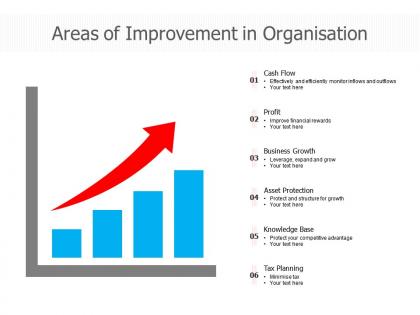
Areas of improvement in organisation




Try Before you Buy Download Free Sample Product
 Impress Your
 Audience
 100%
100% Editable
 Save Hours
 of Time


Get the crowd behind you with our Areas Of Improvement In Organisation. Big gatherings will not deter you.
People who downloaded this PowerPoint presentation also viewed the following :
Areas of improvement in organisation with all 2 slides:
Be the harbinger of change with our Areas Of Improvement In Organisation. Get folks to accept and adapt enthusiastically.
FAQs for Areas of
Key organizational effectiveness metrics include employee engagement scores, productivity ratios, customer satisfaction ratings, financial performance indicators, and operational efficiency measures. These metrics work together to provide comprehensive insights into organizational health, with many companies finding that tracking employee retention, revenue per employee, and process cycle times delivers the clearest picture of overall effectiveness and competitive positioning.
Leadership style significantly impacts organizational effectiveness by influencing employee engagement, decision-making processes, communication patterns, and cultural alignment throughout the company. Different approaches, from transformational leadership in tech startups to collaborative styles in healthcare teams, enable organizations to enhance productivity, streamline operations, and deliver improved performance outcomes, with many finding that adaptive leadership drives sustained competitive advantage.
Employee engagement influences organizational effectiveness by enhancing productivity, reducing turnover costs, improving customer satisfaction, fostering innovation, and strengthening workplace collaboration. Engaged employees deliver higher-quality work, contribute more creative solutions, and provide better customer experiences, with many organizations finding that engaged teams achieve 23% higher profitability and significantly outperform competitors in operational efficiency.
Organizational culture serves as the foundation for effectiveness by shaping employee behaviors, decision-making processes, communication patterns, and overall performance standards. A strong, aligned culture enhances collaboration, accelerates innovation, and streamlines operations, with many organizations finding that cultural alignment ultimately delivers improved productivity, employee engagement, and sustainable competitive advantage.
Effective communication enhances organizational performance by streamlining decision-making processes, reducing operational errors, and fostering collaborative problem-solving across departments. Through clear channels and structured feedback systems, organizations achieve faster project delivery, improved employee engagement, and better customer service outcomes, with many companies finding that strategic communication frameworks ultimately deliver measurable productivity gains and competitive advantage.
Organizations can implement strategies including performance measurement systems, employee engagement initiatives, process optimization, strategic alignment frameworks, and continuous improvement programs. These approaches streamline operations by enhancing communication, reducing inefficiencies, and fostering innovation, with many companies finding that combining technology adoption with leadership development ultimately delivers improved productivity and competitive advantage in increasingly dynamic markets.
Innovation drives organizational effectiveness by enabling faster adaptation to market changes, streamlining operational processes, and creating differentiated value propositions that attract customers. Through strategic innovation initiatives, organizations enhance productivity, reduce costs, and deliver superior customer experiences, with many companies finding that consistent innovation cycles ultimately provide sustainable competitive advantages and improved market positioning.
Common barriers to organizational effectiveness include poor communication channels, inadequate leadership alignment, resistance to change, insufficient resource allocation, and unclear strategic direction. These obstacles often manifest in organizations through siloed departments, conflicting priorities, and outdated processes, with many companies finding that addressing communication and leadership issues first significantly enhances overall operational performance and competitive positioning.
Technology enhances organizational effectiveness by automating routine processes, enabling data-driven decision making, and facilitating seamless communication across departments. Through cloud platforms, AI analytics, and collaboration tools, organizations streamline operations, reduce manual errors, and accelerate project timelines, with many companies finding that strategic technology integration ultimately delivers improved productivity and competitive advantage.
Employee feedback directly enhances organizational effectiveness by identifying operational gaps, improving decision-making processes, and boosting workforce engagement and retention. Through regular feedback mechanisms, companies streamline communication, address performance issues proactively, and foster innovation, with many organizations finding that systematic feedback cultures ultimately deliver higher productivity, reduced turnover, and stronger competitive positioning.
Organizational structures impact effectiveness by determining communication flow, decision-making speed, and resource allocation across different business types. Hierarchical structures work well for manufacturing and banking where standardization matters, while flat structures enhance agility in tech startups and creative agencies, ultimately delivering faster innovation and improved customer responsiveness.
Strategic planning serves as the foundation for organizational effectiveness by establishing clear objectives, allocating resources efficiently, and creating accountability frameworks that guide decision-making across all levels. Through comprehensive strategic planning, organizations streamline operations, enhance cross-departmental coordination, and maintain competitive positioning, with many companies finding that well-executed plans deliver measurable improvements in performance metrics and long-term sustainability.
Organizations can align goals with operational processes through strategic mapping, performance metrics integration, cross-functional collaboration, and regular process audits. This alignment streamlines workflows, reduces redundancies, and ensures every operational activity directly contributes to strategic objectives, with many companies finding that clear goal-to-process connections enhance productivity, accelerate decision-making, and ultimately deliver measurable competitive advantage across all business units.
Decision-making processes affecting organizational effectiveness are influenced by leadership quality, data availability, organizational culture, stakeholder input, and resource constraints. These factors work together to determine outcomes, with companies in sectors like healthcare and manufacturing finding that streamlined decision frameworks, clear communication channels, and balanced risk assessment ultimately enhance operational efficiency and competitive positioning.
External factors significantly impact organizational effectiveness through changing customer expectations, competitive pressures, regulatory requirements, technological disruptions, and economic conditions. Organizations that proactively monitor and adapt to these market trends often streamline operations, enhance strategic planning, and realign resources, ultimately delivering improved performance and sustained competitive advantage in increasingly dynamic business environments.
No Reviews