

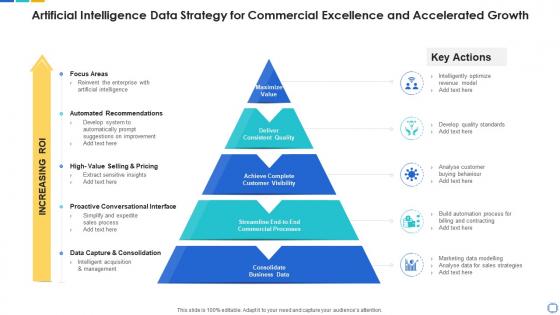
Artificial intelligence data strategy for commercial excellence and accelerated growth




Try Before you Buy Download Free Sample Product
 Impress Your
 Audience
 100%
100% Editable
 Save Hours
 of Time


Our Artificial Intelligence Data Strategy For Commercial Excellence And Accelerated Growth are topically designed to provide an attractive backdrop to any subject. Use them to look like a presentation pro.
People who downloaded this PowerPoint presentation also viewed the following :
Artificial intelligence data strategy for commercial excellence and accelerated growth with all 9 slides:
Use our Artificial Intelligence Data Strategy For Commercial Excellence And Accelerated Growth to effectively help you save your valuable time. They are readymade to fit into any presentation structure.








FAQs for Artificial intelligence data strategy for commercial excellence
So there's basically four things you gotta nail: data quality, governance, infrastructure, and having the right people. Your data needs to be clean and consistent - that whole "garbage in, garbage out" thing is painfully true. Infrastructure has to actually handle what you're throwing at it volume-wise. Oh, and set up proper governance for data access and privacy stuff before it bites you later. Honestly though, the people part might be most crucial - you need folks who get both the tech AND business side. I'd start by just auditing what data you can actually access right now. That'll show you where you're screwed.
First thing - audit your data situation. What do you actually have vs what you need? Most companies are totally blindsided by how much of a mess their data really is, honestly. Check if it's quality stuff, complete, and whether people can even access it without going through like five different departments. Your team's technical skills matter too - are they ready for this? Don't just assume you're good to go. I'd say pick one small pilot project first and see how it goes. That'll show you real quick where the gaps are instead of guessing.
Honestly, think of data governance as the foundation that keeps your AI strategy from falling apart. You're setting up rules for how data gets collected, cleaned, and shared between teams. Without it? Your models will be trash because the data feeding them is messy or incomplete. Plus it keeps you compliant with regulations - nobody wants that headache. The real win though is breaking down those data silos that make everything take forever. I'd start by mapping out your current data flows first. Figure out who actually owns what data. Trust me, you'll find gaps everywhere once you start looking.
Honestly, automated validation pipelines are a lifesaver here - way better than trying to manually check everything (who has time?). Set up checks for duplicates, missing data, and weird outliers before anything hits your models. Data lineage is clutch too so you can actually trace where stuff comes from. Oh, and version control your datasets like you would code. Build these quality checks right into your pipeline from the start rather than bolting them on later. I'd focus on your most critical data sources first since that's where the biggest wins are.
Hey! So with data collection, quality beats quantity every day - clean, representative stuff is way better than huge messy datasets. Get proper consent and document everything obsessively. Storage-wise, go with versioned data lakes that handle both structured and unstructured data. AWS S3 or Google Cloud work great (honestly S3 is pretty bulletproof). Track your data lineage too - trust me, you'll need it when tracing through pipelines later. Oh and set up automated backups right away. Also nail down retention policies from the start or you'll be drowning in old data.
Yeah totally doable, just gotta be strategic about it. Differential privacy is your friend - it adds mathematical noise so you can't pick out individuals but the patterns stay useful. Synthetic data generation is blowing up right now too, basically creating fake datasets that act like the real thing for training. Oh and federated learning is pretty slick - trains models across different locations without moving the actual data around. I'd say start with data minimization though, only grab what you actually need from day one. Way easier than trying to fix privacy issues after you've already built everything, trust me on that one.
Apache Airflow or Azure Data Factory will handle your data pipeline needs pretty well. Cloud storage is a no-brainer - AWS S3 or Google Cloud for sure. Snowflake and BigQuery are solid choices for warehousing, though honestly BigQuery's pricing can get weird with large datasets. MLflow works great for model management. TensorFlow or PyTorch if you're building custom models, otherwise just use cloud ML services. The ecosystem changes constantly which is exhausting tbh. Don't sleep on governance tools like Collibra - data gets messy fast without them. Pick one cloud provider first instead of mixing everything.
Start with outcomes, then figure out your metrics. Don't just say "better customer experience" - be specific like "cut response time by 30%" or hit 85% accuracy. I learned this the hard way on a project last year. Connect each AI use case to KPIs your stakeholders actually give a damn about. Revenue, cost savings, efficiency - whatever matters to your organization. Short sentences work better for this stuff. Also check if you can even track these metrics with your current setup, because there's nothing worse than promising something you can't measure.
Honestly, most companies screw this up by keeping everyone trapped in their own departments. Mix people from IT, business, and analytics into cross-functional teams - that's where the magic happens. Build a centralized data catalog so teams can actually find what others are working with (sounds boring but it's huge). APIs and shared standards make everything accessible without the usual bureaucratic nightmare. The real trick? Change how you measure success. Stop rewarding teams for hoarding their data and start celebrating collaboration instead. Leadership needs to buy into sharing metrics, otherwise you're just fighting uphill battles forever.
Connect your data projects straight to revenue and company goals first. Honestly, I've watched so many teams chase shiny AI projects that look impressive but accomplish nothing meaningful. Don't fall into that trap! Pick stuff that actually moves the business forward or helps people make better decisions. Build a simple scoring system - weigh business impact against how doable it technically is and what resources you'll need. Short timelines work better than ambitious ones, trust me. Most importantly, make sure you're fixing real problems instead of just showing off what your team can build.
So here's the deal - compliance isn't something you slap on later, it's literally the starting point for everything. GDPR, CCPA, HIPAA if you're in healthcare... they all control what data you can grab, how long you keep it, plus users can demand you delete their stuff. Honestly such a headache but way cheaper than getting sued later. Map out your data flows first against whatever regulations hit you, then build your AI around those rules. Don't try doing it backwards - learned that one the hard way. It's annoying but saves you from major disasters down the road.
So AI can auto-fill missing data and pull in external sources to beef up your datasets. Pretty neat stuff. You can use GPT to create text variations or computer vision models for image augmentation - basically like having a tireless research buddy. The data cleaning part is honestly a lifesaver since manual standardization is such a pain. I'd probably start with one incomplete dataset first, just to test how well an enrichment tool actually works. Sometimes these things sound better on paper than they perform, you know? But when they work well, you'll definitely notice the quality boost.
Dude, cloud computing is perfect for AI stuff. You don't need to buy expensive servers upfront - just spin up what you need when training models, then scale down after. Saves so much money. The pre-built AI tools are clutch too, way better than building everything yourself. What I love most is the flexibility though. You can mess around with different storage options and frameworks without committing to pricey hardware. Start with moving your data storage first, then slowly shift your processing work over. Trust me, once you try it you won't go back to traditional setups.
Honestly, partnerships are a game-changer for AI data stuff. You get access to datasets you'd never build yourself - like a retail company teaming up with weather providers for way better context. Sharing costs and tech expertise is huge too, especially when data infrastructure gets pricey. Some partners have cleaning and processing skills that'd take your team forever to figure out. Oh and here's the thing - you want partners whose data actually adds something new, not just more of what you already have. Otherwise you're just paying for redundancy, which is pointless.
Track both the nerdy technical stuff and actual business results - that's where you'll see if this is working. Data quality scores, pipeline uptime, processing speed matter even though they're boring as hell. But honestly, leadership only cares about revenue impact and cost savings, so measure those too. User adoption rates are huge - doesn't matter how good your AI is if nobody uses it. Oh, and time-to-insight metrics. Pick maybe 3-5 that actually connect to your original goals. You'll go crazy trying to track everything.
-
Enough space for editing and adding your own content.
-
Wonderful templates design to use in business meetings.
-
Appreciate the research and its presentable format.
-
The Designed Graphic are very professional and classic.
-
Very well designed and informative templates.
-
Topic best represented with attractive design.
-
Very well designed and informative templates.