

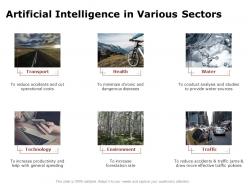
Artificial intelligence in various sectors ppt powerpoint templates





Try Before you Buy Download Free Sample Product
 Impress Your
 Audience
 100%
100% Editable
 Save Hours
 of Time


Most people are visual learners and learn better through the use of graphics than with words. Our Artificial Intelligence In Various Sectors Ppt Powerpoint Templates is a perfect blend of graphics and words to tailored to suit your needs.
People who downloaded this PowerPoint presentation also viewed the following :
Artificial intelligence in various sectors ppt powerpoint templates with all 2 slides:
You use visual aid to stimulate the interest of your audience, help them understand complex data and keep their attention. However, it has to be done right and we do it right with our Artificial Intelligence In Various Sectors Ppt Powerpoint Templates
FAQs for Artificial intelligence in various sectors
Key ethical considerations include algorithmic bias, transparency in decision-making processes, data privacy protection, accountability for automated decisions, and ensuring human oversight remains integral. These considerations become particularly critical in sectors like healthcare, financial services, and criminal justice, where AI-driven decisions significantly impact lives, with many organizations finding that establishing clear ethical frameworks ultimately delivers greater stakeholder trust and regulatory compliance.
Businesses can effectively integrate AI by starting with pilot programs in non-critical areas, ensuring comprehensive staff training, maintaining parallel systems during transitions, and choosing AI solutions that complement existing infrastructure. Through phased implementation, organizations streamline operations gradually while minimizing disruption, with many companies finding that strategic AI adoption ultimately enhances productivity and competitive advantage.
Machine learning enhances e-commerce customer experience through personalized product recommendations, dynamic pricing optimization, intelligent search functionality, chatbot automation, and predictive inventory management. These technologies streamline shopping journeys by analyzing user behavior patterns, anticipating customer needs, and delivering tailored interactions, with many retailers finding significantly improved conversion rates and customer satisfaction.
AI impacts job displacement by automating routine tasks, reshaping traditional roles, and creating demand for new skill sets, while simultaneously generating emerging opportunities in AI management, data analysis, and human-AI collaboration. Organizations can support affected employees through comprehensive retraining programs, strategic reskilling initiatives, and phased transition plans, with many companies finding that proactive workforce development ultimately delivers enhanced productivity and employee loyalty.
The most promising AI applications in healthcare include diagnostic imaging analysis, predictive analytics for patient deterioration, drug discovery acceleration, personalized treatment recommendations, and automated administrative tasks. These technologies enhance patient outcomes by enabling earlier disease detection, reducing diagnostic errors, and streamlining care delivery, with many hospitals finding that AI-powered systems ultimately deliver faster treatment decisions and significantly improved patient safety.
AI-driven analytics transforms small business marketing by identifying customer patterns, predicting purchasing behaviors, optimizing ad spend, and personalizing campaign content across multiple channels. Through machine learning algorithms, retailers and service providers can automate audience segmentation, enhance social media targeting, and improve conversion rates, ultimately delivering cost-effective marketing with measurable ROI increases.
Essential measures include data encryption, access controls, anonymization techniques, regular security audits, and compliance with privacy regulations like GDPR. These protocols work by minimizing data exposure, restricting unauthorized access, and implementing continuous monitoring, with many organizations finding that strategic privacy frameworks ultimately enhance customer trust while delivering competitive advantage in increasingly regulated markets.
AI contributes to sustainability through smart energy management, predictive environmental monitoring, resource optimization algorithms, carbon footprint tracking, and automated waste reduction systems. These technologies streamline conservation efforts by enabling precision agriculture, optimizing supply chains, and predicting climate patterns, with many organizations finding that AI-driven sustainability initiatives deliver both environmental benefits and significant cost savings.
Natural language processing enhances customer service chatbots by enabling accurate intent recognition, contextual understanding, and human-like response generation through advanced algorithms and machine learning models. These capabilities allow chatbots to handle complex queries, maintain conversation flow, and provide personalized solutions across industries like banking and retail, ultimately delivering faster resolution times and improved customer satisfaction.
AI bias challenges include discriminatory training data, lack of diverse development teams, insufficient testing across demographics, algorithmic amplification of existing prejudices, and limited transparency in decision-making processes. These issues can be mitigated through diverse datasets, inclusive development practices, and regular auditing, with many organizations finding that comprehensive bias testing and algorithmic transparency ultimately deliver fairer outcomes and stronger customer trust.
AI enhances supply chain management through predictive analytics, demand forecasting, route optimization, inventory management, and real-time tracking systems. These technologies streamline operations by reducing costs, minimizing waste, and improving delivery times, with many logistics companies finding that AI-powered solutions ultimately deliver faster customer service and significant competitive advantages.
Emerging AI advancements include autonomous decision-making systems, advanced natural language processing, predictive analytics, quantum-enhanced machine learning, and seamless human-AI collaboration platforms. These technologies streamline operations by automating complex processes, enhancing customer interactions, and optimizing resource allocation, with industries like healthcare, finance, and manufacturing finding competitive advantages through faster services and reduced operational costs.
Industries assess AI ROI through sector-specific metrics like cost reduction, efficiency gains, revenue enhancement, and customer satisfaction improvements, with measurement timeframes varying significantly across applications. Financial services track fraud detection accuracy and loan processing speed, while healthcare monitors diagnostic precision and patient throughput, with manufacturing focusing on predictive maintenance savings and production optimization, ultimately delivering measurable competitive advantages.
AI advancements present both challenges and opportunities for regulatory frameworks, with countries adopting varying approaches including comprehensive legislation, sector-specific guidelines, ethical standards, and international cooperation initiatives. While some nations like the EU implement broad AI acts, others focus on industry-specific regulations, with many governments finding that adaptive frameworks balancing innovation with consumer protection deliver competitive advantages in the global AI landscape.
Human-AI collaboration enhances problem-solving by combining human creativity, emotional intelligence, and contextual judgment with AI's data processing speed, pattern recognition, and analytical capabilities. This strategic partnership enables faster decision-making in sectors like healthcare diagnostics and financial risk assessment, while minimizing errors and delivering more innovative solutions than either approach alone.
No Reviews