

Artificial Intelligence Playbook For Business Transformation Powerpoint Presentation Slides






Try Before you Buy Download Free Sample Product
 Impress Your
Audience
 100%
Editable
 Save Hours
of Time


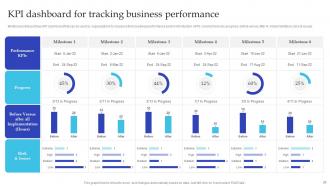
Successful AI transformation needs a proven playbook that aligns solutions to business bottlenecks. Our playbook proposes a series of phases to assist enterprises in implementing AI in their operations. Here is an efficiently designed Artificial Intelligence Playbook for Business Transformation template that will help organizations transform their business operations through AI. The presentation begins with slides titled pilot project canvas, which will assist organizations in providing an in depth overview of the AI transformation project and details about the areas where it will have the most significant impact and the capabilities required for project success. The section Identifying and Understanding AI Suitability includes five stages that will assist businesses in effectively determining AI suitability and integrating the solution into their operations. Finally, the KPI dashboard slide will assist organizations in tracking overall business performance following the integration of AI solutions. Book a free demo with our research team and customize this 100 percent editable playbook template based on your requirements.
People who downloaded this PowerPoint presentation also viewed the following :
Content of this Powerpoint Presentation
Slide 1: This slide introduces Artificial Intelligence Playbook for Business Transformation. State your company name and begin.
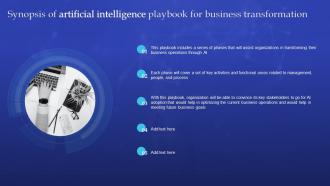
Slide 2: This slide shows Synopsis of artificial intelligence playbook for business transformation.
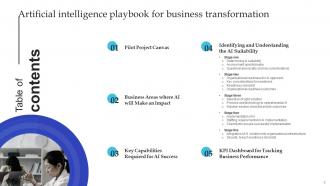
Slide 3: This slide presents Table of Content for the presentation.
Slide 4: This slide highlights title for topics that are to be covered next in the template.
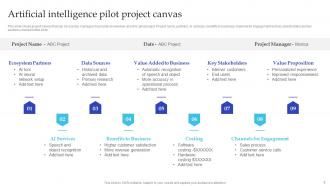
Slide 5: This slide displays Artificial Intelligence Pilot Project Canvas.
Slide 6: This slide represents Business Areas Where AI will Make an Impact.
Slide 7: This slide showcases Key Capabilities Required for AI Success.
Slide 8: This slide highlights title for topics that are to be covered next in the template.
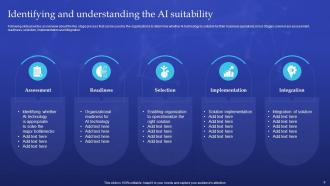
Slide 9: This slide shows Identifying and Understanding the AI Suitability.
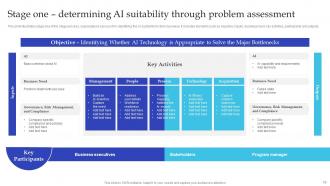
Slide 10: This slide illustrates stage one of five stage process, organizations can use it for identifying the AI suitability.
Slide 11: This slide shows Assessment Questionnaire for Considering AI Approach.
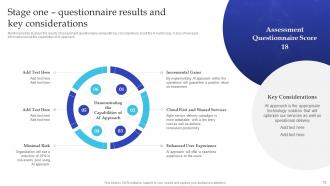
Slide 12: This slide presents Questionnaire Results and Key Considerations.
Slide 13: This slide highlights title for topics that are to be covered next in the template.
Slide 14: This slide displays Ensuring Organizational Readiness for AI Approach.
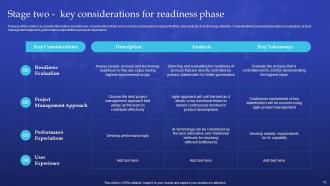
Slide 15: This slide represents key considerations that can be used by businesses to ensure that they are ready for AI technology adoption.
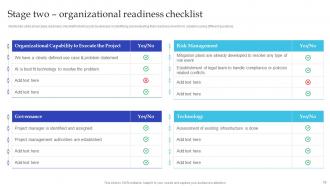
Slide 16: This slide showcases checklist that will assist businesses in identifying and evaluating their readiness.
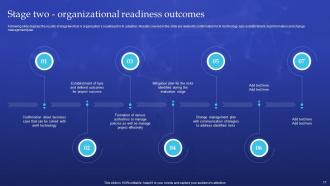
Slide 17: This slide shows results of stage two that is organization’s readiness for AI adoption.
Slide 18: This slide highlights title for topics that are to be covered next in the template.
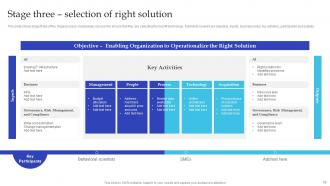
Slide 19: This slide presents three of five stage process, businesses can use it to ensure that they are selecting the best fit technology.
Slide 20: This slide displays information about the process along with technology details that organizations can use.
Slide 21: This slide represents Solution Section Checklist and its Outcomes.
Slide 22: This slide highlights title for topics that are to be covered next in the template.
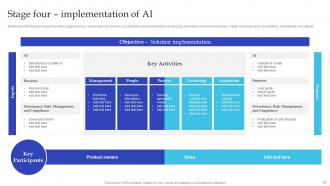
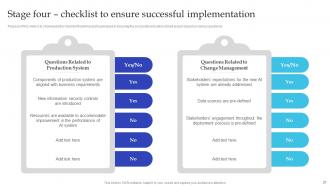
Slide 23: This slide showcases stage four of five stage process, businesses can use it for successfully implementing the AI technology.
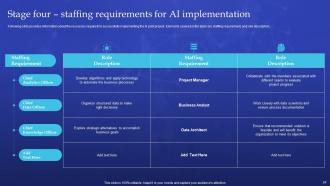
Slide 24: This slide shows Staffing Requirements for AI Implementation.
Slide 25: This slide presents Checklist to Ensure Successful Implementation.
Slide 26: This slide highlights title for topics that are to be covered next in the template.
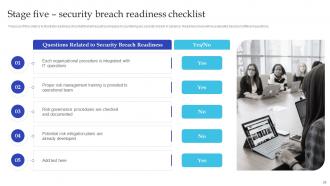
Slide 27: This slide displays Integration of AI Solution into Organizational Infrastructure.
Slide 28: This slide represents readiness checklist that will assist businesses in countering any security breach.
Slide 29: This slide highlights title for topics that are to be covered next in the template.
Slide 30: This slide showcases KPI Dashboard for Tracking Business Performance.
Slide 31: This slide contains all the icons used in this presentation.
Slide 32: This slide is titled as Additional Slides for moving forward.
Slide 33: This slide represents 5 Step Process to Accelerate and Optimize AI Practice.
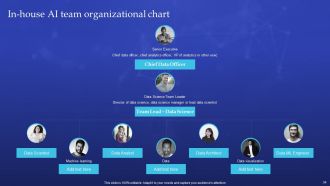
Slide 34: This slide showcases In-house AI Team Organizational Chart.
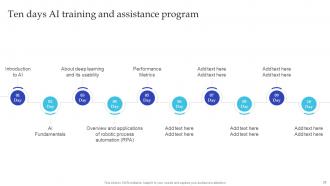
Slide 35: This slide shows Ten Days AI Training and Assistance Program.
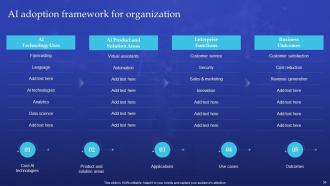
Slide 36: This slide presents AI Adoption Framework for Organization.
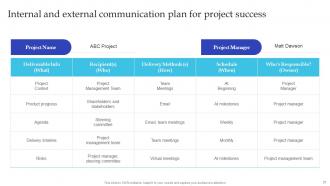
Slide 37: This slide displays Internal and External Communication Plan for Project Success.
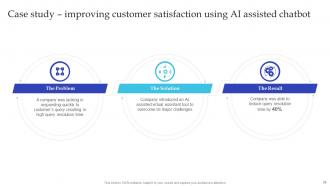
Slide 38: This slide showcases Improving Customer Satisfaction using AI Assisted Chatbot.
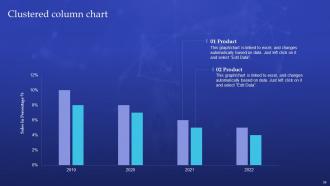
Slide 39: This slide provides Clustered Column chart with two products comparison.
Slide 40: This is About Us slide to show company specifications etc.
Slide 41: This is Our Team slide with names and designation.
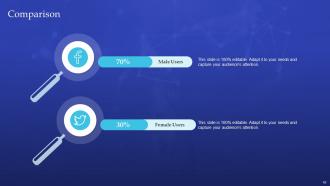
Slide 42: This is a Comparison slide to state comparison between commodities, entities etc.
Slide 43: This slide contains Puzzle with related icons and text.
Slide 44: This slide shows SWOT describing- Strength, Weakness, Opportunity, and Threat.
Slide 45: This slide shows Post It Notes. Post your important notes here.
Slide 46: This is a Timeline slide. Show data related to time intervals here.
Slide 47: This slide depicts Venn diagram with text boxes.
Slide 48: This is a Thank You slide with address, contact numbers and email address.
Artificial Intelligence Playbook For Business Transformation Powerpoint Presentation Slides with all 53 slides:
Use our Artificial Intelligence Playbook For Business Transformation Powerpoint Presentation Slides to effectively help you save your valuable time. They are readymade to fit into any presentation structure.



















FAQs for Artificial Intelligence Playbook For Business Transformation
An effective artificial intelligence strategy includes clearly defined business objectives, comprehensive data governance frameworks, robust infrastructure planning, strategic talent acquisition, and ethical implementation guidelines. These components work together by aligning AI initiatives with business goals, ensuring data quality and accessibility, and building organizational capabilities, ultimately delivering competitive advantage and operational efficiency across all business functions.
Organizations can assess AI readiness by evaluating data quality and infrastructure, technical capabilities, workforce skills, and change management capacity. Through comprehensive audits of existing systems, talent assessments, and pilot program feasibility studies, companies across sectors like healthcare, finance, and manufacturing can identify gaps, prioritize investments, and develop strategic roadmaps that ultimately deliver competitive advantage and operational efficiency.
AI system development requires addressing bias and fairness, data privacy and security, transparency and explainability, accountability for decisions, and human oversight mechanisms. These considerations ensure responsible deployment across sectors like healthcare diagnostics, financial lending, and hiring processes, while maintaining public trust, regulatory compliance, and competitive advantage in an increasingly scrutinized technological landscape.
AI enhances customer experience through personalized recommendations, intelligent chatbots, predictive analytics, sentiment analysis, and automated support systems. These technologies streamline interactions by delivering tailored content, resolving queries instantly, and anticipating customer needs, with many retail and financial services organizations finding that AI-driven personalization ultimately increases satisfaction while reducing operational costs.
Healthcare, financial services, retail, and manufacturing currently lead AI adoption due to their data-rich environments, regulatory pressures, and competitive demands. These industries leverage AI for fraud detection, personalized customer experiences, predictive maintenance, and diagnostic accuracy, with many organizations finding that strategic AI implementation delivers significant operational efficiency and cost reduction while enhancing customer satisfaction.
Small businesses can utilize AI through cloud-based solutions, pre-built software integrations, and affordable SaaS platforms that require minimal technical expertise or infrastructure investment. These accessible AI tools enable small retailers, service providers, and local businesses to automate customer service, streamline inventory management, and enhance marketing campaigns, ultimately delivering competitive advantages previously available only to larger enterprises.
AI ROI measurement frameworks include financial metrics analysis, productivity benchmarking, customer experience scoring, operational efficiency tracking, and risk reduction assessment. These frameworks enable organizations by quantifying cost savings, revenue generation, and performance improvements, with many financial services and healthcare institutions finding that structured measurement approaches deliver clearer investment justification and strategic decision-making advantages.
Data quality and accessibility significantly determine AI implementation success by affecting model accuracy, training effectiveness, and deployment speed. Poor data quality leads to unreliable predictions, while limited accessibility creates bottlenecks, with many organizations finding that investing in robust data governance and integration platforms ultimately delivers faster model development, reduced operational costs, and more trustworthy AI-driven business decisions.
Continuous learning enables AI models to adapt to new data patterns, changing environments, and evolving business requirements, preventing performance degradation over time. This approach allows organizations in healthcare, finance, and retail to maintain model accuracy, reduce prediction errors, and respond to market shifts, ultimately delivering sustained competitive advantage and operational efficiency.
Organizations ensure transparency and accountability in AI decision-making through explainable AI models, comprehensive audit trails, clear governance frameworks, regular algorithmic assessments, and stakeholder documentation processes. These approaches enable companies to track decision pathways, identify potential biases, and maintain regulatory compliance, with many financial institutions and healthcare organizations finding that structured transparency protocols ultimately deliver enhanced trust, reduced risk exposure, and stronger competitive positioning in increasingly regulated markets.
Common pitfalls include inadequate data preparation, lack of stakeholder alignment, unrealistic timeline expectations, insufficient change management, and neglecting ethical considerations. Organizations often underestimate the complexity of integration with existing systems, while successful implementations require comprehensive training, clear governance frameworks, and phased rollouts that allow for iterative improvements and user adaptation.
AI-human collaboration combines analytical processing power with creative problem-solving, emotional intelligence, and contextual judgment to deliver more comprehensive solutions. This strategic partnership enhances decision-making across sectors like healthcare diagnostics, financial risk assessment, and customer service, with many organizations finding that hybrid approaches ultimately streamline operations while maintaining the human insight essential for complex business challenges.
Emerging AI trends businesses should monitor include generative AI for content creation, edge computing for real-time processing, explainable AI for transparency, AI-powered automation, and conversational AI platforms. These technologies streamline operations by reducing manual tasks, enhancing customer interactions, and accelerating decision-making processes, with many organizations finding that strategic AI adoption delivers significant competitive advantages and operational efficiency.
Organizations protect their data while utilizing AI through encryption, access controls, data anonymization, secure cloud environments, and regular audits. These security measures enable companies to leverage AI capabilities while maintaining privacy compliance, with many financial institutions and healthcare providers finding that strategic data governance frameworks deliver both innovation opportunities and regulatory confidence, ultimately enhancing competitive advantage.
Essential AI workforce competencies include data analysis and interpretation, machine learning fundamentals, programming skills, statistical knowledge, and critical problem-solving abilities. Organizations increasingly find that combining technical expertise with domain knowledge, ethical reasoning, and collaborative communication skills enables teams to develop responsible AI solutions, streamline implementation processes, and ultimately deliver competitive advantages across industries like healthcare, finance, and manufacturing.
-
Happy to incorporate such stunning templates in my presentation. Made my presentation look professional and engaging.
-
It saves your time and decrease your efforts in half.