

Artificial intelligence unit economics for ai pitch deck ppt powerpoint presentation ideas





Try Before you Buy Download Free Sample Product
 Impress Your
Audience
 100%
Editable
 Save Hours
of Time


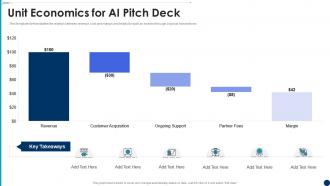
This template demonstrates the relation between revenue, cost and margin and helpful to walk an investor through a typical transections.
People who downloaded this PowerPoint presentation also viewed the following :
Artificial intelligence unit economics for ai pitch deck ppt powerpoint presentation ideas with all 7 slides:
Use our Artificial Intelligence Unit Economics For AI Pitch Deck Ppt Powerpoint Presentation Ideas to effectively help you save your valuable time. They are readymade to fit into any presentation structure.






FAQs for Artificial intelligence unit economics for ai pitch deck ppt
Key components include customer acquisition cost, lifetime value, gross margin per user, computational costs per transaction, and data processing expenses. These metrics enable AI companies to optimize resource allocation, pricing strategies, and infrastructure investments while scaling operations, with many organizations finding that balancing acquisition costs against predictable revenue streams ultimately delivers sustainable competitive advantage.
Businesses can effectively measure AI customer acquisition cost by tracking direct marketing expenses, sales team costs, technology demonstration investments, and educational content creation across acquisition channels. Through detailed attribution analysis, companies calculate total acquisition spending divided by new AI customers acquired, while considering longer sales cycles typical in AI implementations, ultimately enabling more strategic resource allocation and pricing optimization.
Data quality directly impacts AI unit economics by influencing model accuracy, training costs, operational efficiency, and maintenance requirements throughout the solution lifecycle. Poor data quality increases computational expenses, extends development timelines, and reduces prediction reliability, while high-quality datasets enable faster model convergence, lower retraining costs, and improved performance metrics, ultimately delivering better ROI and sustainable competitive advantage for organizations.
AI deployment costs significantly impact tech startup profitability through infrastructure expenses, talent acquisition, and ongoing maintenance requirements, while also creating substantial revenue opportunities through automation and enhanced customer experiences. Many startups find that initial AI investments reduce long-term operational costs by streamlining processes, accelerating product development, and enabling scalable services, ultimately delivering competitive advantages that justify the upfront expenditure.
Customer lifetime value metrics for AI implementations include predictive revenue modeling, churn probability scoring, engagement frequency analysis, cross-selling conversion rates, and retention cost calculations. Through machine learning algorithms, organizations can track behavioral patterns, purchase predictions, and service interaction quality, with many financial services and retail companies finding that AI-enhanced CLV models deliver significantly more accurate forecasting and strategic customer segmentation.
AI model training and maintenance significantly impact unit economics through high computational costs, data storage expenses, specialized talent requirements, and ongoing infrastructure needs. While initial training costs can be substantial, many organizations find that operational efficiency gains, automated decision-making capabilities, and improved customer experiences ultimately deliver cost reductions and competitive advantages at scale.
AI ROI calculations face unique challenges including unpredictable implementation timelines, evolving data quality requirements, indirect value creation through enhanced decision-making, and long-term learning curve costs that traditional models don't account for. Unlike conventional investments with linear returns, AI systems deliver value through compound improvements, network effects, and operational transformations that manifest differently across departments, making it increasingly important to track qualitative metrics alongside financial outcomes.
Companies optimize unit economics through AI scalability by automating repetitive processes, reducing manual labor costs, and improving operational efficiency across larger volumes without proportional cost increases. These AI solutions enable businesses to handle exponentially more transactions, customer interactions, and data processing with minimal additional resources, while enhancing accuracy and speed, ultimately delivering lower per-unit costs and stronger profit margins as operations scale.
AI-driven platforms can reduce churn through personalized engagement algorithms, predictive analytics for early intervention, automated customer success workflows, and continuous model optimization based on user behavior patterns. These strategies enable proactive support by identifying at-risk users before they disengage, while delivering increasingly relevant experiences that enhance retention, with many subscription-based platforms finding that AI-powered personalization significantly improves customer lifetime value.
Pricing models significantly impact AI unit economics by determining revenue per user, cost recovery timelines, and scalability potential. Subscription models enable predictable revenue streams and faster cost amortization, while usage-based pricing aligns costs with value delivery, and enterprise licensing delivers higher margins, with many AI companies finding that hybrid approaches optimize both customer acquisition and long-term profitability.
The competitive landscape significantly impacts AI startup unit economics through pricing pressure, customer acquisition costs, and differentiation requirements. In crowded markets like chatbots or recommendation engines, startups often face margin compression and higher marketing spend, while those in specialized niches like medical AI or industrial automation can command premium pricing, ultimately enabling better unit economics and sustainable growth trajectories.
Open-source AI frameworks significantly reduce initial development costs by eliminating licensing fees, accelerating deployment timelines, and providing access to pre-built models and community-driven innovations. These frameworks enable AI ventures to allocate resources toward customization and scaling rather than foundational development, with many startups and enterprises finding that reduced barriers to entry ultimately enhance profitability while fostering competitive differentiation.
Regulated industries present both challenges and opportunities for AI unit economics, with compliance costs, extended development timelines, and rigorous testing requirements initially increasing investments. However, these sectors like healthcare, banking, and financial services often deliver higher returns through premium pricing, reduced liability risks, and competitive moats, with many organizations finding that regulatory compliance ultimately creates sustainable competitive advantages.
Businesses can leverage partnerships to enhance AI unit economics through shared development costs, specialized expertise access, infrastructure pooling, risk distribution, and accelerated time-to-market strategies. Strategic alliances with cloud providers, AI specialists, and industry partners enable organizations to reduce individual investment burdens while accessing advanced capabilities, ultimately delivering improved cost efficiency and competitive positioning in increasingly complex AI implementations.
Customer feedback loops enhance AI unit economics by enabling continuous model refinement, reducing operational costs, and improving customer retention rates. Through systematic feedback collection, AI companies can optimize their algorithms more efficiently, minimize support overhead, and increase customer lifetime value, with many SaaS platforms finding that integrated feedback mechanisms ultimately deliver 20-30% better unit economics over time.
-
Informative design.
-
Commendable slides with attractive designs. Extremely pleased with the fact that they are easy to modify. Great work!
-
Informative presentations that are easily editable.
-
Commendable slides with attractive designs. Extremely pleased with the fact that they are easy to modify. Great work!
-
Excellent template with unique design.