

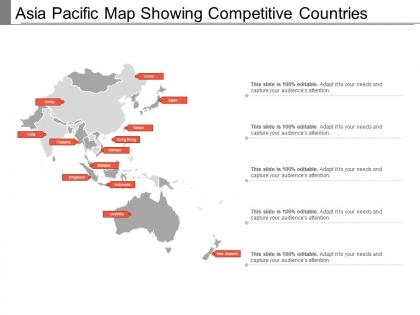
Asia pacific map showing competitive countries




Try Before you Buy Download Free Sample Product
 Impress Your
 Audience
 100%
100% Editable
 Save Hours
 of Time


Give a big boost to your earnings with our Asia Pacific Map Showing Competitive Countries. They enable you to haul it in.
People who downloaded this PowerPoint presentation also viewed the following :
Asia pacific map showing competitive countries with all 5 slides:
Encourage folks to focus on areas of agreement with our Asia Pacific Map Showing Competitive Countries. It helps to get the deal going.




FAQs for Asia pacific map
Key economic drivers include digital transformation initiatives, supply chain diversification strategies, infrastructure development programs, consumer market expansion, and cross-border trade agreements. These factors revolutionize competitive dynamics by enabling faster market entry, reducing operational costs, and enhancing customer reach, with many multinational corporations finding that strategic positioning across these growth corridors delivers sustainable competitive advantage.
Digital technology intensifies competition across the Asia Pacific by accelerating market entry, enabling data-driven decision making, and democratizing access to global customers. Companies in sectors like e-commerce, fintech, and manufacturing leverage AI, cloud computing, and mobile platforms to streamline operations, reduce costs, and deliver superior customer experiences, ultimately creating new competitive advantages.
Government policies significantly shape competitive advantages across Asia Pacific through strategic tax incentives, infrastructure investments, regulatory frameworks, trade agreements, and technology development programs. Countries like Singapore leverage favorable business regulations and innovation hubs, while China emphasizes manufacturing subsidies and Vietnam focuses on export-oriented policies, ultimately enabling nations to attract foreign investment, enhance operational efficiency, and strengthen their positions in global supply chains.
Emerging markets within Asia Pacific are reshaping multinational competitive dynamics through rapid digital adoption, evolving consumer preferences, and increased local innovation capabilities. Companies like Samsung and Alibaba demonstrate how regional players leverage market-specific insights, cost advantages, and agile operations to challenge traditional Western dominance, ultimately forcing multinationals to rethink localization strategies and partnerships.
Technology, financial services, e-commerce, healthcare, and renewable energy are experiencing the most dramatic competitive transformations across Asia Pacific markets. These sectors are being reshaped by digital innovation, regulatory changes, and shifting consumer preferences, with companies like fintech startups disrupting traditional banking and renewable energy firms challenging established utilities, ultimately creating new market leaders.
The competitive landscape in developed Asia Pacific markets like Japan and Singapore emphasizes innovation, premium positioning, and advanced technology integration, while developing markets including Vietnam and Indonesia focus on cost leadership, accessibility, and rapid market penetration strategies. These differences create strategic opportunities for businesses to leverage premium capabilities in mature markets while scaling affordable solutions across emerging economies, ultimately delivering diversified revenue streams and comprehensive regional coverage.
Companies are navigating Asia Pacific trade tensions through supply chain diversification, strategic partnerships with local firms, market hedging across multiple countries, and increased investment in regional production facilities. These approaches enable businesses to minimize tariff exposure, reduce dependency on single markets, and maintain operational flexibility, with many multinational corporations finding that localized manufacturing and cross-border alliances deliver enhanced resilience and competitive positioning.
Sustainability practices are reshaping Asia Pacific competition by driving operational efficiency, attracting eco-conscious consumers, and meeting increasingly stringent regulatory requirements. Companies integrating green technologies, circular economy principles, and carbon reduction strategies gain competitive advantages through cost savings, enhanced brand reputation, and improved market access, with many organizations finding that sustainability initiatives ultimately deliver both environmental impact and superior financial performance.
COVID-19 has reshaped Asia Pacific competition by accelerating digital transformation, shifting consumer behaviors toward e-commerce and contactless services, and creating new market leaders while displacing traditional players. Companies that quickly pivoted to digital-first strategies, enhanced supply chain resilience, and adapted to remote operations gained significant competitive advantages, with many finding that pandemic-driven innovations ultimately strengthened their market positions.
Local startups are disrupting established players through innovative digital solutions, agile business models, localized customer experiences, and strategic use of emerging technologies like AI and fintech. These agile companies streamline traditional processes by offering faster services, lower costs, and culturally relevant products, with many sectors including banking, retail, and logistics finding that startup innovation drives competitive transformation across the region.
**INPUT**: What trends are shaping consumer preferences in the Asia Pacific, and how do they affect competition? **OUTPUT**: Key trends shaping Asia Pacific consumer preferences include digital-first shopping experiences, sustainability consciousness, personalized services, mobile payment adoption, and premium quality demands across diverse markets. These shifts intensify competition by requiring companies to enhance omnichannel capabilities, streamline sustainable operations, and deliver localized experiences, with many organizations finding that strategic adaptation ultimately delivers competitive advantage. [Word count: 55 words]
Supply chain diversification, nearshoring, and digital integration are reshaping competitive strategies across Asia Pacific, with firms prioritizing resilience over pure cost optimization. Manufacturing companies in Vietnam and Thailand are leveraging regional proximity to create faster, more flexible operations, while logistics providers enhance real-time visibility and automation, ultimately delivering competitive advantages through reduced dependencies and improved responsiveness.
Cultural differences significantly shape competitive behaviors across Asia Pacific through varying relationship-building approaches, hierarchical business structures, communication styles, and negotiation tactics. While Japanese companies emphasize long-term consensus-building and Korean firms leverage rapid technological adaptation, Chinese businesses focus on guanxi networks and Southeast Asian markets prioritize community partnerships, ultimately creating diverse competitive landscapes that require culturally-informed strategies for success.
Innovation and R&D are crucial for Asia Pacific competitiveness, enabling companies to differentiate products, adapt to diverse consumer preferences, respond to rapid technological changes, and meet evolving regulatory requirements across markets. Through strategic R&D investments, organizations in sectors like electronics, pharmaceuticals, and automotive can accelerate market entry, reduce operational costs, and capture emerging opportunities, ultimately delivering sustained growth advantage.
Companies across Asia Pacific are strategically forming alliances with local partners, technology providers, regional distributors, and government entities to accelerate market penetration and operational efficiency. Through these partnerships, organizations in sectors like manufacturing, financial services, and retail streamline supply chains, enhance digital capabilities, and navigate regulatory complexities, ultimately delivering faster market entry and sustained competitive advantage in increasingly dynamic regional markets.
-
Awesome use of colors and designs in product templates.
-
Awesome use of colors and designs in product templates.