


Assessing And Optimizing Employee Job Satisfaction Powerpoint Presentation Slides V




Try Before you Buy Download Free Sample Product
 Impress Your
 Audience
 100%
100% Editable
 Save Hours
 of Time


Dont miss out on our valuable resource Assessing and optimizing employee job satisfaction Template. It showcases and enhances employees commitment and enthusiasm for their work, ultimately leading to improved business outcomes. Our Workforce Participation Deck delves into the significant challenges and issues organizations face due to disengaged employees. It presents the findings of an employee engagement survey, providing insights into staff participation and satisfaction rates. Moreover, our Employee Job Satisfaction PPT offers critical industry statistics highlighting the importance of employee engagement. By leveraging this information, companies can develop a robust employee engagement action plan that aligns with their goals and objectives. Furthermore, our Employee Experience module offers proven strategies to boost productivity, retention, satisfaction, and overall employee participation rates. It emphasizes optimizing effective communication practices and achieving a healthy work life balance. Additionally, our HR engagement strategies template explores implementing impactful reward and recognition programs, competitive compensation and benefits packages, etc. Finally, it provides a comprehensive set of metrics enabling organizations to measure their employee engagement initiatives impact accurately. Get access now.
People who downloaded this PowerPoint presentation also viewed the following :
Content of this Powerpoint Presentation
Slide 1: This slide introduces Assessing and Optimizing Employee Job Satisfaction. Commence by stating Your Company Name.
Slide 2: This slide depicts the Agenda of the presentation.
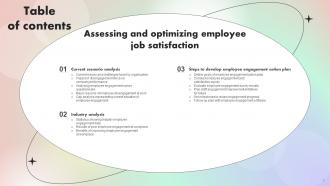
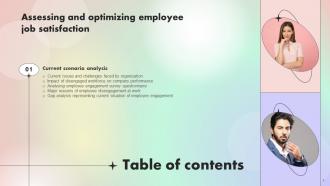
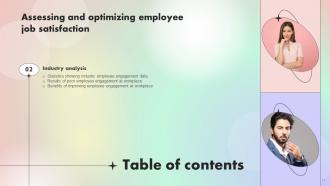
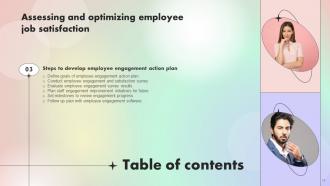
Slide 3: This slide includes the Table of contents.
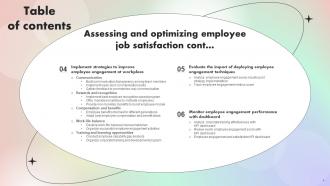
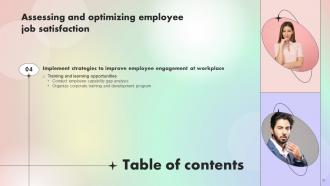
Slide 4: This is yet another slide continuing the Table of contents.
Slide 5: This slide highlights the Title for the Topics to be covered next.
Slide 6: This slide exhibits the Current issues and challenges faced by organization.
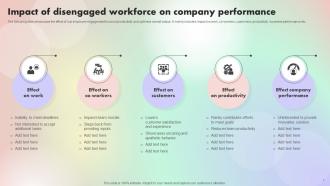
Slide 7: This slide reveals the Impact of disengaged workforce on company performance.
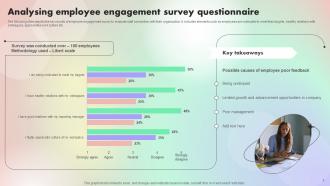
Slide 8: This slide focuses on Analysing employee engagement survey questionnaire.
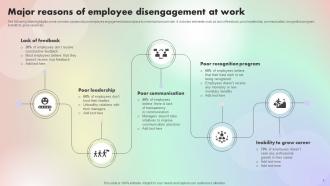
Slide 9: This slide highlights the Major reasons of employee disengagement at work.
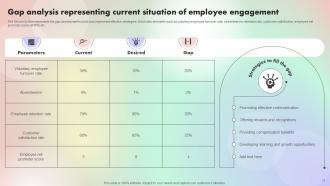
Slide 10: This slide presents the Gap analysis representing current situation of employee engagement.
Slide 11: This slide includes the Heading for the Contents to be discussed further.
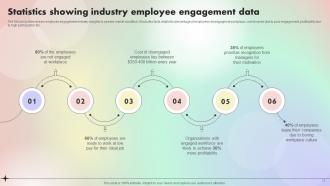
Slide 12: This slide reveals the Statistics showing industry employee engagement data.
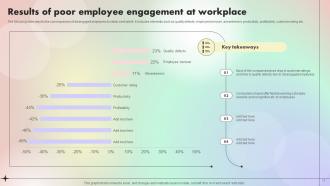
Slide 13: This slide portrays the Results of poor employee engagement at workplace.
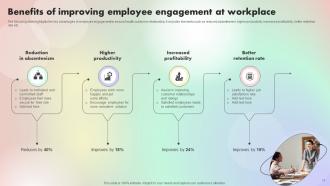
Slide 14: This slide depicts the Benefits of improving employee engagement at workplace.
Slide 15: This slide mentions the Title for the Ideas to be covered in the following template.
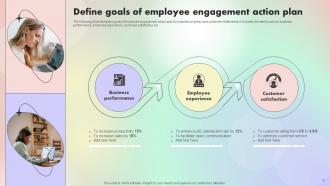
Slide 16: This slide aims to Define goals of employee engagement action plan.
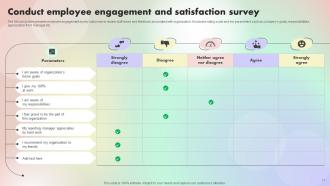
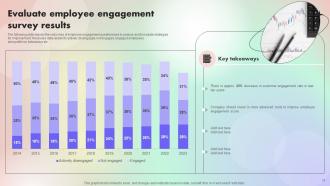
Slide 17: The following slide presents employee engagement survey outcomes to review staff views and feedback associated with organization.
Slide 18: This slide depicts the outcomes of employee engagement questionnaire to analyze and formulate strategies for improvement.
Slide 19: The following slide illustrates some best practices to boost employee engagement at work.
Slide 20: This slide presents some milestones to track and monitor employee engagement status.
Slide 21: The following slide showcases some software to monitor employee productivity and gather their feedback.
Slide 22: This slide includes the Heading for the Ideas to be discussed next.
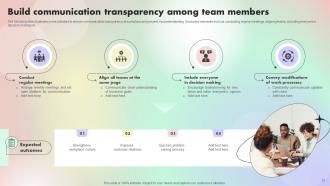
Slide 23: The following slide illustrates some activities to ensure communication transparency at workplace and prevent misunderstanding.
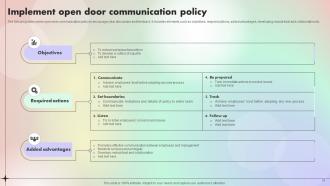
Slide 24: This slide covers open door communication policy to encourage clear discussion and feedback.
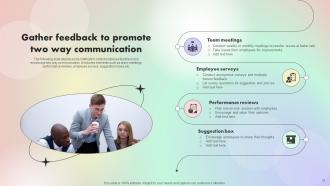
Slide 25: This slide aims to Gather feedback to promote two way communication.
Slide 26: This slide exhibits the Title for the Contents to be covered in the next template.
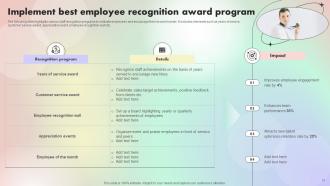
Slide 27: The following slide highlights various staff recognition programs to motivate employees and encourage them to work harder.
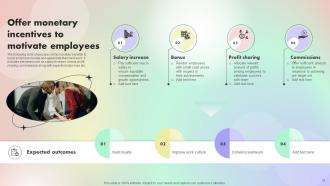
Slide 28: This slide showcases some monetary benefits to boost employee morale and appreciate their hard work.
Slide 29: This slide illustrates some non-financial incentives to upgrade productivity and increase employee satisfaction.
Slide 30: This slide depicts the Heading for the Topics to be discussed in the following template.
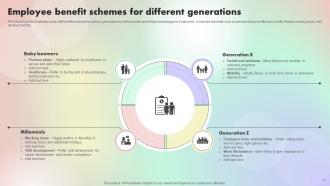
Slide 31: This slide exhibits the Employee benefit schemes for different generations.
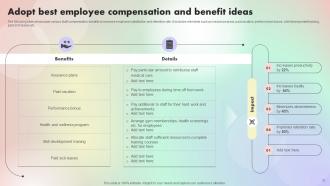
Slide 32: The following slide showcases various staff compensation benefits to increase employee satisfaction and retention rate.
Slide 33: This slide displays the Title for the Topics to be covered in the forthcoming template.
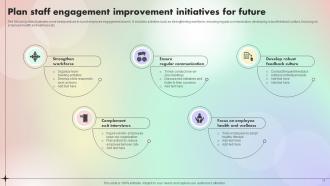
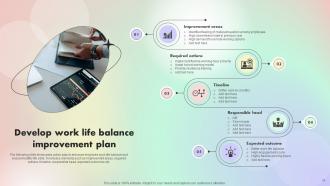
Slide 34: The following slide showcases action plan to enhance employee work life balance and ensure healthy life style.
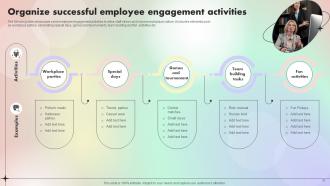
Slide 35: This slide states some employee engagement activities to relive staff stress and improve workplace culture.
Slide 36: This slide incorporates the Heading for the Contents to be discussed further.
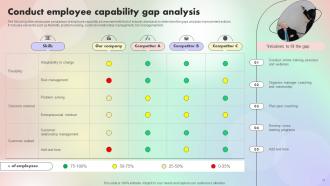
Slide 37: The following slide reveals comparison of employee capability assessment with that of industry standards.
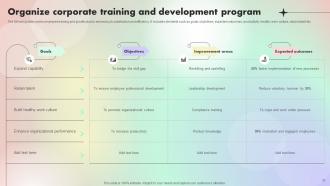
Slide 38: This slide covers employee training and growth plan to enhance job satisfaction and efficiency.
Slide 39: This slide depicts the Title for the Ideas to be covered in the forthcoming template.
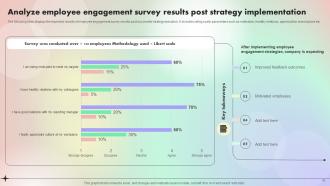
Slide 40: This slide aims to Analyze employee engagement survey results post strategy implementation.
Slide 41: The following slide depicts key performance indicators to review employee engagement progress after executing strategies.
Slide 42: This slide mentions about the Title for the Ideas to be covered in the next template.
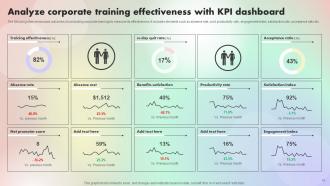
Slide 43: The following slide showcases outcomes of conducting corporate trainings to measure its effectiveness.
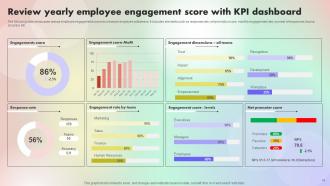
Slide 44: This slide portrays annual employee engagement scores to measure employee activeness.
Slide 45: The following slide showcases employee engagement and satisfaction key performance indicators to encourage healthy team relationships.
Slide 46: This is the Icons Slide containing all the Icons used in the plan.
Slide 47: This slide is used for depicting some Additional information.
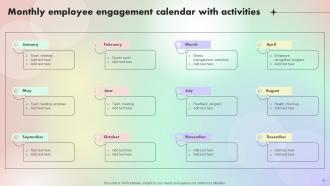
Slide 48: This slide illustrates the Monthly employee engagement calendar with activities.
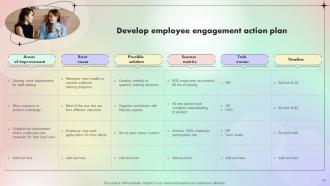
Slide 49: This slide aims to Develop employee engagement action plan.
Slide 50: This slide exhibits the Employee engagement and satisfaction evaluation questionnaire.
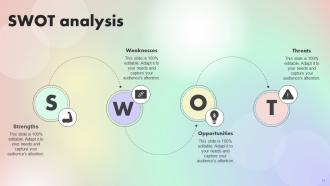
Slide 51: This slide represents the SWOT analysis.
Slide 52: This side displays the organization's vision, mission & goal.
Slide 53: This is the Idea generation slide for encouraging fresh ideas.
Slide 54: This is Our target slide. State your comapny-targets here.
Slide 55: This is Meet our team slide. State your team-related information here.
Slide 56: This slide exhibits the organization's Location across the globe.
Slide 57: This is the Quote slide for motivation.
Slide 58: This slide displays the firm's Timeline.
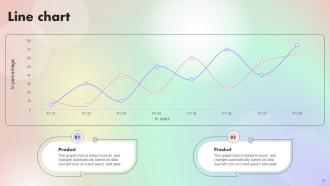
Slide 59: This is the Line chart slide.
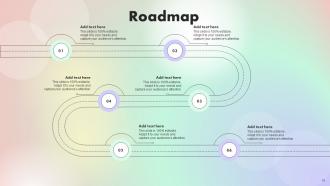
Slide 60: This slide represents the Roadmap.
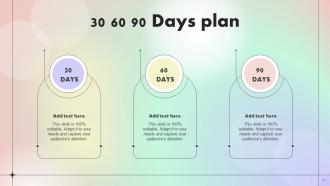
Slide 61: This is the 30 60 90 Days plan slide for effective planning.
Slide 62: This is the Thank You slide for acknowledgement.
Assessing And Optimizing Employee Job Satisfaction Powerpoint Presentation Slides V with all 67 slides:
Use our Assessing And Optimizing Employee Job Satisfaction Powerpoint Presentation Slides V to effectively help you save your valuable time. They are readymade to fit into any presentation structure.




















FAQs for Assessing And Optimizing Employee Job Satisfaction Powerpoint
Key factors influencing employee job satisfaction include flexible work arrangements, competitive compensation, career development opportunities, meaningful work assignments, and positive workplace culture. These elements enhance retention and productivity by fostering employee engagement, reducing turnover costs, and improving team collaboration, with many organizations finding that strategic investment in satisfaction initiatives ultimately delivers stronger performance and competitive advantage.
Organizational culture impacts employee job satisfaction by shaping workplace values, communication patterns, recognition systems, and growth opportunities that directly influence daily experiences. Companies with inclusive, supportive cultures see significantly higher engagement levels, with many organizations finding that strong cultural alignment reduces turnover, enhances productivity, and ultimately delivers competitive advantages through improved employee retention.
Effective communication contributes to employee job satisfaction by fostering transparency, providing clear expectations, enabling regular feedback, and creating trust between management and staff. Through open dialogue and structured communication channels, organizations enhance employee engagement, reduce workplace conflicts, and improve retention rates, with many companies finding that employees feel more valued and connected to their organizational mission.
Job satisfaction can be measured through employee surveys, engagement assessments, exit interviews, performance metrics, and pulse surveys. These tools enable organizations to track satisfaction levels, identify improvement areas, and enhance retention strategies, with many companies finding that regular measurement leads to higher productivity, reduced turnover, and ultimately stronger workplace cultures across all organizational levels.
Employee recognition and appreciation significantly enhances job satisfaction by boosting morale, increasing engagement, and reinforcing positive behaviors that align with organizational goals. When companies implement strategic recognition programs, employees feel valued and motivated, ultimately delivering improved retention rates, higher productivity, and stronger workplace culture, with many organizations finding that consistent appreciation creates lasting competitive advantages.
Work-life balance significantly enhances employee job satisfaction by reducing burnout, improving mental health, increasing productivity, and fostering long-term retention. Organizations implementing flexible schedules, remote work options, and wellness programs find that employees demonstrate higher engagement, creativity, and loyalty, ultimately delivering reduced turnover costs and competitive advantage in talent acquisition.
Job satisfaction levels vary significantly across industries and roles, with technology, healthcare, and financial services typically showing higher satisfaction due to competitive compensation, growth opportunities, and meaningful work. Manufacturing, retail, and hospitality often face lower satisfaction from demanding schedules and limited advancement paths, while executive and specialized roles generally report higher satisfaction than entry-level positions, ultimately reflecting differences in autonomy, recognition, and career development opportunities.
Organizations can implement flexible work arrangements, professional development programs, recognition and rewards systems, improved communication channels, and competitive compensation packages to enhance job satisfaction. These strategies streamline employee engagement by fostering work-life balance, career growth opportunities, and meaningful feedback loops, with many companies finding that satisfied employees deliver higher productivity, reduced turnover, and ultimately stronger organizational performance.
Leadership style significantly influences job satisfaction through communication approaches, decision-making processes, recognition methods, and team dynamics. Transformational leaders who provide clear vision and support often see higher engagement in sectors like healthcare and technology, while micromanagement typically reduces satisfaction, with many organizations finding that empowering leadership styles ultimately deliver better retention and productivity outcomes.
High employee job satisfaction significantly enhances productivity and performance by reducing turnover, increasing engagement levels, and improving quality of work output. Organizations with satisfied employees experience up to 31% higher productivity, with companies like Google and Microsoft finding that satisfied workers demonstrate greater innovation, collaborate more effectively, and ultimately deliver superior customer experiences while reducing operational costs.
Remote work arrangements significantly enhance employee job satisfaction by offering flexible schedules, eliminating commuting stress, and improving work-life balance, while also presenting challenges around isolation and team connectivity. Many organizations find that strategic remote policies deliver higher retention rates, increased productivity, and reduced overhead costs, with employees in sectors like technology, consulting, and financial services reporting greater autonomy and job fulfillment.
Employee job satisfaction and turnover rates share an inverse relationship, where higher satisfaction typically corresponds to lower turnover, reduced recruitment costs, and improved organizational stability. Companies investing in satisfaction initiatives through competitive compensation, career development, and positive work environments often find that enhanced employee retention delivers stronger team cohesion, preserved institutional knowledge, and ultimately significant cost savings compared to frequent rehiring.
Employee training and development enhances job satisfaction by building skills, creating career advancement opportunities, and demonstrating organizational investment in workers' futures. Through structured learning programs, employees gain confidence, feel more valued, and experience reduced workplace stress, with many organizations finding that comprehensive development initiatives ultimately deliver higher retention rates and improved performance outcomes.
Low job satisfaction creates psychological implications including increased stress, anxiety, depression, reduced self-esteem, and burnout among employees. These factors significantly impact mental health by diminishing motivation, creating emotional exhaustion, and fostering feelings of helplessness, with many organizations finding that addressing satisfaction proactively enhances employee wellbeing and reduces turnover costs.
Feedback mechanisms enhance employee job satisfaction by creating open communication channels, providing regular performance insights, recognizing achievements, and addressing concerns promptly. Through structured systems like 360-degree reviews and pulse surveys, organizations streamline employee development, boost engagement levels, and reduce turnover rates, with many companies finding that consistent feedback ultimately delivers stronger workplace morale and competitive talent retention.
-
The pricing page of this website is very sorted. I felt no pain while buying the PPTs.
-
I am not the best at presentations but using SlideTeam’s PPT template made it easier for me. Thank you SlideTeam!