

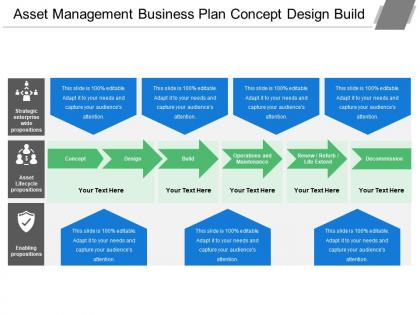
Asset management business plan concept design build




Try Before you Buy Download Free Sample Product
 Impress Your
 Audience
 100%
100% Editable
 Save Hours
 of Time


Fill the interval with our Asset Management Business Plan Concept Design Build. Even the breaks will be entertaining.
People who downloaded this PowerPoint presentation also viewed the following :
Asset management business plan concept design build with all 5 slides:
Depend on our Asset Management Business Plan Concept Design Build to spread the faith. Your words will carry the strength of your conviction.




FAQs for Asset management business plan
Effective asset management strategies include comprehensive asset inventory systems, lifecycle management protocols, predictive maintenance scheduling, performance monitoring tools, and strategic replacement planning. These components work together by maximizing asset utilization, minimizing downtime, and optimizing capital expenditures, with many organizations finding that integrated approaches deliver significant cost savings and enhanced operational efficiency.
Technology enhances asset management through predictive analytics, automated monitoring systems, IoT sensors, blockchain for transparency, and AI-driven portfolio optimization. These digital tools streamline data collection, risk assessment, and performance tracking, with financial institutions and real estate firms finding that automated systems reduce operational costs while delivering faster decision-making and improved asset utilization.
Common asset management challenges include inadequate tracking systems, poor data quality, regulatory compliance complexities, maintenance scheduling inefficiencies, and limited visibility into asset performance across operations. These obstacles can be overcome by implementing integrated management platforms, establishing standardized data protocols, and leveraging predictive analytics, with many organizations finding that strategic automation ultimately delivers enhanced operational efficiency, reduced costs, and improved regulatory compliance.
Regulatory changes significantly reshape asset management practices by requiring enhanced compliance frameworks, modified investment strategies, and updated reporting protocols. These evolving requirements drive firms to strengthen risk management systems, implement new technology solutions, and restructure operational processes, with many asset managers finding that proactive regulatory adaptation ultimately delivers competitive advantage and improved client trust.
Risk assessment serves as the foundation of effective asset management, enabling organizations to identify potential threats, evaluate vulnerabilities, quantify financial impacts, and prioritize protective measures across their portfolio. Through systematic risk analysis, companies can optimize maintenance schedules, allocate resources strategically, and minimize unexpected failures, while enhancing operational efficiency and protecting long-term asset value in increasingly complex business environments.
Sustainability integration involves incorporating environmental, social, and governance (ESG) criteria into investment decisions, risk assessments, and portfolio construction through specialized screening tools and impact measurement frameworks. Asset managers increasingly utilize ESG data analytics, sustainable investment mandates, and climate risk modeling to enhance long-term returns while meeting regulatory requirements, ultimately delivering competitive advantage in an increasingly conscious investment landscape.
Key performance metrics include return on investment (ROI), asset utilization rates, maintenance costs, downtime frequency, and total cost of ownership (TCO). These metrics enable organizations to optimize resource allocation, minimize operational expenses, and maximize asset productivity, with many manufacturing and infrastructure companies finding that comprehensive performance tracking delivers significant competitive advantages and enhanced profitability.
Market trends influence asset allocation decisions by signaling economic shifts, sector performance patterns, and risk-reward opportunities that guide portfolio rebalancing strategies. Investment managers analyze these trends to optimize diversification across equity, fixed income, and alternative investments, with many institutional portfolios finding that trend-responsive allocation enhances returns while managing downside risk effectively.
Active asset management offers potential outperformance, personalized strategies, and tactical adjustments during market volatility, while passive management delivers lower costs, broad diversification, and consistent market exposure. These approaches serve different investor needs, with many institutional portfolios finding that strategic combinations of both styles enhance risk-adjusted returns and operational efficiency across varying market conditions.
Asset managers can effectively communicate value by providing transparent performance reporting, regular market insights, personalized portfolio updates, and clear explanations of investment strategies aligned with client goals. Through comprehensive dashboards, quarterly reviews, and proactive communication during market volatility, managers build trust and demonstrate expertise, with many clients finding that consistent, educational dialogue ultimately strengthens relationships and reinforces long-term investment confidence.
Diversification significantly reduces portfolio risk by spreading investments across different asset classes, sectors, geographic regions, and investment vehicles, enabling more stable long-term returns. Through strategic allocation, asset managers can minimize volatility while optimizing performance, with many institutional portfolios finding that diversified approaches deliver enhanced risk-adjusted returns and greater resilience during market downturns.
Asset management benefits from data analytics through predictive maintenance, portfolio optimization, risk assessment, performance monitoring, and operational efficiency improvements. These analytics capabilities enable organizations to reduce equipment downtime, enhance investment returns, and streamline resource allocation, with many financial institutions and infrastructure companies finding that data-driven insights ultimately deliver significant cost savings and competitive advantage.
Geopolitical events significantly impact global asset management through increased market volatility, shifting regulatory frameworks, currency fluctuations, and altered investment flows across regions. These developments require portfolio diversification strategies, enhanced risk assessment protocols, and dynamic asset reallocation approaches, with many financial institutions finding that geopolitical awareness ultimately delivers more resilient investment outcomes.
Best practices for managing alternative assets include thorough due diligence, diversified portfolio allocation, regular performance monitoring, robust risk assessment frameworks, and strategic liquidity planning. These approaches enhance returns by minimizing operational risks, optimizing asset allocation, and ensuring adequate liquidity buffers, with many institutional investors finding that disciplined alternative investment strategies deliver superior long-term portfolio performance.
Asset managers ensure compliance with ethical standards through robust governance frameworks, regular compliance training, transparent reporting practices, and independent oversight mechanisms. These approaches streamline regulatory adherence by establishing clear ethical guidelines, monitoring investment decisions, and maintaining fiduciary responsibilities, with many financial institutions finding that comprehensive compliance programs ultimately deliver enhanced client trust and competitive advantage.
-
Awesome presentation, really professional and easy to edit.
-
Unique and attractive product design.