

Assets Utilization PowerPoint Presentation Slides





Try Before you Buy Download Free Sample Product
 Impress Your
Audience
 100%
Editable
 Save Hours
of Time


Our Assets Utilization PowerPoint Presentation Slides are topically designed to provide an attractive backdrop to any subject. Use them to look like a presentation pro.
People who downloaded this PowerPoint presentation also viewed the following :
Content of this Powerpoint Presentation
Slide 1: This slide introduces ASSETS UTILIZATION. State Your Company Name and begin.
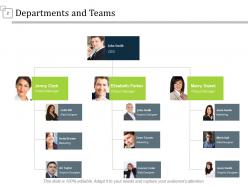
Slide 2: This slide is titled as Departments and Teams with names, designation and department of employees.
Slide 3: This slide shows Future Capacity Planning with tasks, working hours, start and finish dates etc.
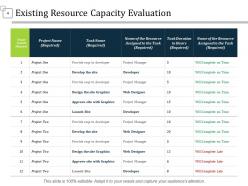
Slide 4: This slide presents Existing Resource Capacity Evaluation with project name, task name, task duration etc.
Slide 5: This slide displays Monitoring the Resource Utilization describing- Scheduled Utilization, Actual Utilization, Projected Revenue and Total hours.
Slide 6: This is another slide on Monitoring the Resource Utilization describing resources as- Booked, Not Booked, Total Availability, Waiting List, Utilization.
Slide 7: This slide is titled as Additional Slides for moving forward.
Slide 8: This is a Target slide. Show your targets here.
Slide 9: This is a Comparison slide to state comparison between commodities, entities etc.
Slide 10: This is Our Team slide with names and designation.
Slide 11: This slide shows Mind Map for representing entities.
Slide 12: This is Our Mission slide with imagery and text boxes.
Slide 13: This is Idea Bulb slide to state a new idea or highlight specifications, information etc.
Slide 14: This is a Venn slide with text boxes to show information.
Slide 15: This is a Thank You slide with address, contact numbers and email address.
Assets Utilization PowerPoint Presentation Slides with all 15 slides:
Use our Assets Utilization PowerPoint Presentation Slides to effectively help you save your valuable time. They are readymade to fit into any presentation structure.




FAQs for Assets Utilization
Key asset utilization metrics include asset turnover ratio, capacity utilization rate, return on assets (ROA), equipment effectiveness, and inventory turnover. These measurements enable organizations to optimize resource allocation, identify underperforming assets, and streamline operational efficiency, with many manufacturing and retail companies finding that comprehensive tracking ultimately delivers cost reductions and enhanced competitive advantage.
Effective asset utilization directly enhances business profitability by maximizing revenue generation from existing resources, reducing idle capacity costs, and improving operational efficiency across all business functions. Through strategic asset management, organizations streamline workflows, minimize waste, and accelerate return on investment, with many manufacturing and retail companies finding that optimized utilization delivers significantly higher profit margins.
Technology enhances asset utilization by providing real-time monitoring, predictive analytics, IoT sensors, automated scheduling systems, and data-driven optimization tools. Through these digital solutions, organizations streamline maintenance schedules, minimize downtime, and maximize equipment productivity, with manufacturing plants and logistics companies finding that smart sensors and AI-driven insights ultimately deliver significant cost reductions and operational efficiency.
Companies identify underutilized assets through asset tracking software, performance analytics, utilization rate monitoring, equipment audits, and IoT sensors that provide real-time data. These technologies streamline visibility by analyzing operational patterns, measuring downtime, and benchmarking capacity usage, with many manufacturers and logistics companies finding that systematic tracking delivers significant cost reductions and enhanced operational efficiency.
Common asset utilization challenges include poor visibility into asset performance, inadequate maintenance scheduling, underused capacity, inefficient resource allocation, and lack of real-time tracking systems. These issues result in higher operational costs, unexpected downtime, and reduced productivity, with many organizations finding that implementing comprehensive asset management platforms significantly enhances efficiency and competitive advantage.
Asset utilization strategies vary significantly across industries based on operational requirements, with manufacturing focusing on equipment efficiency and predictive maintenance, healthcare optimizing bed occupancy and medical equipment scheduling, and retail maximizing inventory turnover and space allocation. These sector-specific approaches enable organizations to streamline resource allocation, reduce operational costs, and enhance competitive advantage through strategic asset management tailored to their unique operational demands.
Organizations can enhance asset utilization through predictive maintenance programs, real-time monitoring systems, strategic asset sharing across departments, lifecycle management protocols, and performance analytics dashboards. These practices streamline operations by reducing downtime, optimizing resource allocation, and maximizing equipment lifespan, with many manufacturing and logistics companies finding that comprehensive asset strategies deliver 15-20% efficiency improvements and significant cost reductions.
Asset lifecycle management enhances utilization by tracking performance from acquisition through disposal, scheduling predictive maintenance, and optimizing replacement timing. Through comprehensive monitoring systems, organizations streamline operational efficiency, minimize unexpected downtime, and maximize asset value, with many manufacturing and infrastructure companies finding that strategic lifecycle planning delivers significantly lower total costs and improved productivity.
Data analytics for asset management delivers predictive maintenance capabilities, optimized resource allocation, enhanced operational efficiency, improved decision-making accuracy, and reduced downtime costs. Through real-time monitoring and machine learning algorithms, organizations across manufacturing, healthcare, and energy sectors can anticipate equipment failures, streamline maintenance schedules, and maximize asset lifecycles, ultimately achieving significant cost savings while enhancing competitive advantage.
Effective maintenance practices significantly enhance asset utilization rates by minimizing unplanned downtime, extending equipment lifespan, and optimizing operational performance through predictive scheduling and proactive interventions. Manufacturing facilities and transportation companies increasingly find that strategic maintenance programs deliver improved availability, reduced repair costs, and enhanced productivity, ultimately enabling higher throughput and competitive advantage.
Employee training influences asset utilization by enhancing operational competency, reducing equipment downtime, and improving maintenance practices across organizations. Through comprehensive skill development programs, companies achieve faster equipment setup times, minimize costly errors, and extend asset lifecycles, with manufacturing and healthcare sectors finding that well-trained staff increases productivity while reducing operational costs.
Adherence to sustainability principles enhances asset utilization by extending equipment lifecycles, reducing waste, and optimizing resource consumption through circular economy practices. Organizations implementing sustainable frameworks streamline operations, minimize environmental costs, and maximize asset value retention, with many manufacturing and energy companies finding that sustainable asset management ultimately delivers both operational efficiency and competitive advantage.
Asset utilization and inventory management are directly interconnected, as inventory represents a significant portion of working capital assets that must be optimized for maximum efficiency. Effective inventory management enhances asset utilization by reducing carrying costs, minimizing stockouts, and accelerating cash flow cycles, with many retail and manufacturing organizations finding that strategic inventory optimization delivers improved ROI and operational efficiency.
Companies balance asset utilization with risk management by implementing diversified asset portfolios, establishing clear risk tolerance thresholds, and utilizing predictive analytics to monitor performance indicators. Through strategic asset allocation and regular risk assessments, organizations in manufacturing, finance, and logistics optimize operational efficiency while minimizing exposure, ultimately delivering sustainable growth and competitive advantage.
COVID-19 fundamentally reshaped asset utilization strategies by accelerating digital transformation, remote work infrastructure, and flexible resource allocation models. Organizations pivoted from fixed asset models to dynamic approaches, with many companies finding that hybrid operations, cloud-based solutions, and scalable technologies deliver greater resilience and operational efficiency in uncertain environments.
-
Easily Understandable slides.
-
Wonderful templates design to use in business meetings.