

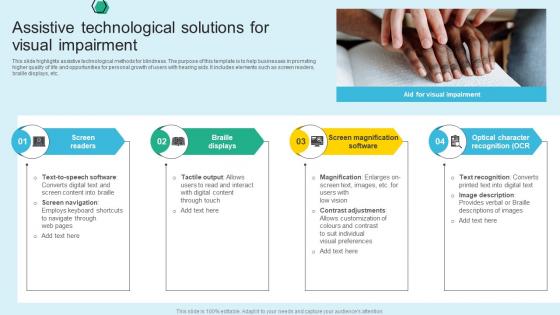
Assistive Technological Solutions For Visual Impairment




Try Before you Buy Download Free Sample Product
 Impress Your
Audience
 100%
Editable
 Save Hours
of Time


This slide highlights assistive technological methods for blindness. The purpose of this template is to help businesses in promoting higher quality of life and opportunities for personal growth of users with hearing aids. It includes elements such as screen readers, braille displays, etc.
People who downloaded this PowerPoint presentation also viewed the following :
Assistive Technological Solutions For Visual Impairment with all 9 slides:
Use our Assistive Technological Solutions For Visual Impairment to effectively help you save your valuable time. They are readymade to fit into any presentation structure.









FAQs for Assistive Technological Solutions
Common assistive technologies in education include text-to-speech software, screen readers, speech recognition tools, communication devices, and adaptive keyboards. These technologies streamline learning by enhancing accessibility, personalizing instruction, and supporting diverse learning needs, with many schools finding that strategic implementation ultimately delivers improved student outcomes and greater educational inclusion across all ability levels.
Assistive technology enhances learning experiences by providing customized communication tools, adaptive software, specialized input devices, and personalized learning platforms that accommodate diverse disabilities. Through screen readers, speech recognition software, and interactive applications, students with visual, auditory, or mobility challenges access curriculum content more effectively, participate actively in classroom discussions, and demonstrate knowledge through alternative methods, ultimately delivering improved academic outcomes and greater educational independence.
Assistive technology enables individuals with disabilities to perform daily tasks, communicate effectively, navigate environments, access information, and participate in work or education independently. These tools streamline personal routines, enhance social interactions, and facilitate professional opportunities, with many users finding that mobility aids, communication devices, and adaptive software ultimately deliver greater autonomy and improved quality of life.
Schools can effectively implement assistive technology through comprehensive staff training, individualized student assessments, gradual integration with existing curricula, and ongoing technical support systems. Through strategic planning and collaboration with special education specialists, educational institutions streamline learning accessibility, enhance student engagement, and deliver personalized educational experiences, with many districts finding that systematic implementation approaches ultimately improve academic outcomes across diverse learning needs.
Educators face challenges including limited training on assistive technology tools, insufficient funding for devices and software, lack of technical support, time constraints for learning new systems, and difficulty matching specific technologies to individual student needs. These obstacles often result in underutilization of available resources, with many schools finding that comprehensive professional development and dedicated IT support significantly enhance successful implementation and student outcomes.
Assistive technology varies significantly by disability type, with visual impairments requiring screen readers, magnifiers, and braille displays, while learning disabilities benefit from text-to-speech software, organizational apps, and comprehension tools. These specialized solutions enhance accessibility by addressing specific functional challenges, cognitive processing needs, and sensory limitations, ultimately enabling individuals across different disability categories to achieve greater independence and workplace productivity.
Current trends in assistive technology include AI-powered communication devices, smart home integration systems, advanced prosthetics with neural control, voice-activated navigation tools, and adaptive learning software. These innovations streamline accessibility by enhancing independence, reducing barriers, and personalizing user experiences, with healthcare institutions, educational organizations, and employers increasingly finding that strategic integration delivers improved outcomes and competitive advantage.
Parents and caregivers increasingly recognize assistive technology as transformational for their children's independence, communication abilities, academic performance, and social integration. Through devices like speech-generating tablets, mobility aids, and learning software, families witness enhanced confidence, improved classroom participation, and greater autonomy in daily activities, with many finding that these tools unlock their children's potential while reducing caregiver stress.
Adopting assistive technology involves initial hardware and software investments, ongoing maintenance costs, staff training expenses, and potential infrastructure upgrades. However, organizations often find these costs offset by increased productivity, reduced accommodation expenses, improved retention rates, and enhanced compliance with accessibility regulations, ultimately delivering long-term financial benefits and competitive advantages.
Assistive technology can be tailored through customizable interfaces, adjustable settings, modular components, personalized software configurations, and adaptive hardware modifications. These personalized solutions enable individuals with diverse abilities to optimize their workflows, enhance communication capabilities, and improve daily task management, with many healthcare facilities and educational institutions finding that individualized technology approaches deliver significantly better user outcomes and increased independence.
Ethical considerations include user privacy and data protection, informed consent for technology implementation, ensuring equitable access across socioeconomic groups, maintaining user autonomy and dignity, and preventing technology dependence. These principles guide responsible development by prioritizing transparency, affordability, and user empowerment, with many healthcare institutions and educational organizations finding that ethical frameworks ultimately enhance trust and improve outcomes.
Assistive technology supports non-verbal communication through speech-generating devices, communication apps, eye-tracking systems, switch-activated tools, and symbol-based interfaces. These technologies enable individuals to express thoughts, participate in conversations, and engage socially by converting text to speech, tracking eye movements for selection, and providing customizable communication boards, ultimately delivering greater independence and meaningful social connections.
Resources for training educators in assistive technology include online certification programs, specialized workshops, institutional training modules, peer mentoring networks, and vendor-provided technical support sessions. These comprehensive training approaches enable teachers to effectively integrate accessibility tools across diverse learning environments, with many educational institutions finding that structured professional development significantly enhances student engagement and academic outcomes.
Assistive technology impact can be effectively assessed through standardized performance metrics, user satisfaction surveys, task completion rates, independence levels, and comparative before-and-after analyses. These comprehensive evaluation methods enable healthcare providers, educational institutions, and rehabilitation centers to measure improvements in daily functioning, productivity, and quality of life, ultimately delivering data-driven insights for optimizing technology selections and user outcomes.
Emerging innovations like AI-powered navigation systems, brain-computer interfaces, haptic feedback devices, smart prosthetics, and voice-controlled environments show tremendous promise for accessibility enhancement. These technologies streamline daily tasks by providing intuitive interaction methods, personalized assistance, and seamless integration with existing systems, ultimately delivering greater independence and improved quality of life for users across diverse accessibility needs.
-
I've been looking for a good template source for some time. I'm happy that I discovered SlideTeam. Excellent presentations must try!
-
“There is so much choice. At first, it seems like there isn't but you have to just keep looking, there are endless amounts to explore.”