

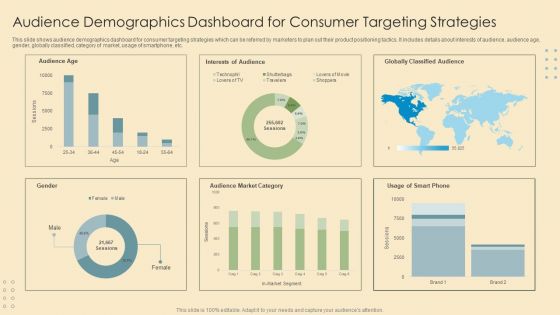
Audience Demographics Dashboard For Consumer Targeting Strategies




Try Before you Buy Download Free Sample Product
 Impress Your
 Audience
 100%
100% Editable
 Save Hours
 of Time


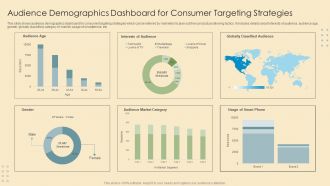
This slide shows audience demographics dashboard for consumer targeting strategies which can be referred by marketers to plan out their product positioning tactics. It includes details about interests of audience, audience age, gender, globally classified, category of market, usage of smartphone, etc.
People who downloaded this PowerPoint presentation also viewed the following :
Audience Demographics Dashboard For Consumer Targeting Strategies with all 7 slides:
Use our Audience Demographics Dashboard For Consumer Targeting Strategies to effectively help you save your valuable time. They are readymade to fit into any presentation structure.





FAQs for Audience Demographics Dashboard For
Key demographic factors include age, professional background, education level, cultural context, and industry experience, as these directly influence communication preferences and comprehension styles. Understanding these elements enables presenters to tailor content complexity, visual design, and messaging approach accordingly, with many organizations finding that demographic-aligned presentations deliver significantly higher engagement rates and more effective knowledge transfer across diverse business audiences.
Understanding age demographics enhances presentation effectiveness by enabling tailored communication styles, relevant examples, appropriate technology integration, and generational preference alignment. Different age groups respond to varying presentation formats, visual designs, and interaction levels, with millennials preferring digital engagement while baby boomers favor traditional approaches, ultimately delivering improved audience connection and message retention.
Education level significantly influences audience engagement and comprehension by determining appropriate vocabulary complexity, depth of technical detail, and preferred presentation formats. Professionals with advanced degrees often expect data-driven insights and industry-specific terminology, while broader audiences benefit from simplified concepts and visual storytelling, with many presenters finding that tailoring content complexity to educational backgrounds ultimately delivers higher engagement rates and clearer message retention.
Geographic location significantly influences presentation preferences through cultural communication styles, visual aesthetics, hierarchical expectations, and content organization patterns. Middle Eastern audiences often prefer formal, relationship-focused approaches, while Scandinavian cultures favor minimalist designs and egalitarian structures, and Asian markets typically emphasize detailed data and respectful hierarchies, ultimately requiring presenters to adapt their strategic messaging for maximum cultural resonance and business impact.
Gender demographics significantly influence visual selection, example choices, color schemes, representation balance, and cultural sensitivity to ensure inclusive messaging that resonates across diverse audiences. Strategic presenters increasingly customize imagery, case studies, and scenarios to reflect their audience composition, while incorporating varied perspectives and avoiding stereotypical representations, ultimately delivering more engaging content and stronger audience connection.
Marketers can tailor presentations by adjusting messaging complexity, visual aesthetics, product positioning, and value propositions to align with different income segments' purchasing power and priorities. Through targeted content strategies, luxury brands emphasize exclusivity and premium features for higher-income audiences, while value-focused companies highlight affordability and practical benefits for budget-conscious segments, ultimately delivering more relevant experiences and improved conversion rates.
Strategies for diverse audiences include tailored messaging across age groups, culturally relevant content, multi-channel communication approaches, inclusive visual representation, and flexible format options like videos, infographics, and interactive elements. These approaches enhance engagement by addressing varied learning preferences, cultural contexts, and communication styles, with many organizations finding that demographic-specific customization ultimately delivers broader reach and stronger audience connection.
Larger audiences with diverse demographics require slower pacing, clearer visual aids, and universal examples that resonate across age groups, industries, and experience levels. Strategic presenters adjust their delivery by incorporating varied communication styles, simplifying complex concepts, and allowing additional processing time, ultimately ensuring comprehensive understanding while maintaining engagement across heterogeneous professional audiences.
Psychographics complement demographic data by revealing values, attitudes, interests, lifestyle choices, and personality traits that demographics alone cannot capture. While demographics show who your audience is, psychographics explain why they make decisions, enabling marketers to create more targeted messaging, predict purchasing behaviors, and develop emotional connections that ultimately drive higher engagement and conversion rates.
Presenters can adapt their rhetoric by adjusting communication styles, reference points, technology integration, and value emphasis to resonate with different generational preferences within their audience. Through strategic language choices, relevant examples spanning decades, and varied engagement methods, speakers effectively connect with Baby Boomers, Gen X, Millennials, and Gen Z simultaneously, ultimately delivering more impactful presentations.
**INPUT**: What tools or platforms are best for analyzing audience demographics prior to delivering a presentation? **OUTPUT**: Effective demographic analysis platforms include Google Analytics, LinkedIn Audience Insights, Facebook Analytics, SurveyMonkey, and registration system data analytics. These tools streamline audience understanding by revealing age ranges, professional backgrounds, and engagement preferences, with many presenters finding that combining multiple data sources ultimately delivers more targeted content and significantly enhanced audience connection rates. [Word count: 56 words]
Understanding occupational backgrounds enables presenters to calibrate content complexity, terminology, and depth appropriately for maximum comprehension and engagement. Technical professionals like engineers or IT specialists can handle detailed specifications and industry jargon, while executives prefer strategic overviews and business implications, ultimately ensuring presentations resonate with audience expertise levels and deliver targeted value.
Ethical considerations include obtaining informed consent, ensuring data privacy and security, avoiding discriminatory targeting practices, maintaining transparency about data usage, and respecting user preferences for data control. These principles enable organizations to build trust with customers while delivering personalized experiences responsibly, with many companies finding that ethical data practices ultimately enhance brand reputation and customer loyalty in an increasingly privacy-conscious marketplace.
Demographic shifts significantly influence organizational presentation strategies through updated messaging frameworks, revised visual approaches, and adapted delivery channels that resonate with evolving audience preferences. Organizations increasingly tailor content for multigenerational workforces, diverse cultural backgrounds, and varied digital consumption patterns, with many finding that demographic-responsive presentations enhance engagement rates, improve knowledge retention, and ultimately deliver more effective outreach outcomes.
**INPUT**: What are some case studies that illustrate successful presentations tailored to specific demographics? **OUTPUT**: Successful demographic-tailored presentations include Airbnb's millennial-focused visual storytelling, IBM's data-heavy enterprise presentations for C-suite executives, and healthcare companies using simplified visuals for patient education. These approaches enhance engagement by aligning content complexity, visual design, and messaging tone with audience preferences, ultimately delivering higher conversion rates and stronger stakeholder buy-in across diverse organizational settings. **Word count: 56 words**
-
I faced no difficulty while searching for the slide I wanted. Honestly, the website’s interface is easy to use and can be navigated easily!
-
Great product with effective design. Helped a lot in our corporate presentations. Easy to edit and stunning visuals.