

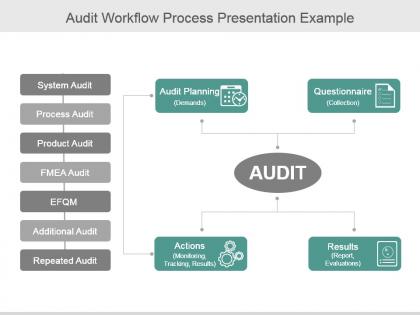
Audit workflow process presentation example




Try Before you Buy Download Free Sample Product
 Impress Your
 Audience
 100%
100% Editable
 Save Hours
 of Time


Our Audit Workflow Process Presentation Example have a glorious appearance. Enjoy their effect from every angle.
People who downloaded this PowerPoint presentation also viewed the following :
Audit workflow process presentation example with all 5 slides:
Cruise along with our Audit Workflow Process Presentation Example. Your thoughts will really start to travel.

FAQs for Audit workflow
Key stages in an effective audit workflow process include planning and risk assessment, fieldwork execution, evidence collection and analysis, findings documentation, and reporting with recommendations. These stages streamline audit operations by establishing clear timelines, ensuring comprehensive coverage, and maintaining quality control standards, with many organizations finding that structured workflows reduce audit cycles by 30-40% while enhancing accuracy and stakeholder confidence.
Technology enhances the audit workflow process by automating data collection, enabling real-time risk assessment, and streamlining documentation through cloud-based platforms and AI-powered analytics. These digital solutions significantly reduce manual tasks, improve accuracy in financial reviews, and accelerate reporting timelines, with many accounting firms finding that automated workflows deliver faster client services and enhanced competitive advantage.
Risk assessment fundamentally shapes audit workflow by identifying high-risk areas, determining resource allocation priorities, and establishing testing procedures and timelines. This strategic evaluation enables auditors to focus efforts where material misstatements are most likely, streamlining fieldwork phases and documentation requirements, ultimately delivering more efficient audits and enhanced assurance quality.
Organizations determine audit scope by analyzing risk assessments, regulatory requirements, stakeholder concerns, operational complexity, and available resources within their workflow processes. Through systematic evaluation, companies like financial institutions and healthcare providers prioritize high-risk areas, critical controls, and compliance obligations, while balancing audit depth with timeline constraints, ultimately ensuring comprehensive coverage that delivers meaningful insights and regulatory adherence.
Common audit workflow execution challenges include inadequate documentation, poor communication between teams, resource allocation issues, technology integration problems, and tight deadline pressures. These obstacles often result in delayed timelines, inconsistent quality standards, and increased compliance risks, with many organizations finding that streamlined digital workflows and clear accountability frameworks significantly enhance audit efficiency and accuracy.
Communication during an audit can be optimized through centralized platforms, regular status meetings, standardized reporting templates, automated notifications, and clear escalation protocols. These approaches streamline information flow by ensuring real-time updates, reducing miscommunications, and maintaining transparency across all parties, with many organizations finding that structured communication ultimately delivers faster audit completion and enhanced stakeholder confidence.
Audit workflow software includes automated testing platforms, data analytics tools, document management systems, risk assessment applications, and collaborative reporting solutions. These technologies streamline audits by reducing manual processes, enhancing data accuracy, and improving team coordination, with many accounting firms and internal audit departments finding that integrated platforms deliver faster completion times and more comprehensive risk coverage.
Auditors should document findings through standardized templates, real-time digital notation systems, evidence cataloging with cross-references, and structured risk assessment matrices that maintain clear audit trails. This systematic approach enables audit teams in financial services and healthcare to streamline review processes, ensure regulatory compliance, and facilitate seamless knowledge transfer, ultimately delivering faster audit completion and enhanced accountability.
**INPUT**: What measures can be taken to ensure compliance during the audit workflow? **OUTPUT**: Compliance measures include standardized documentation protocols, automated regulatory checks, continuous monitoring systems, role-based access controls, and real-time audit trails throughout the workflow process. These controls streamline compliance by reducing manual errors, ensuring regulatory adherence, and maintaining comprehensive documentation, with many financial institutions and healthcare organizations finding that automated compliance tracking ultimately delivers faster audit cycles and enhanced regulatory confidence. [Word count: 60 words]
Organizations improve audit workflows by analyzing previous audit findings, documenting inefficiencies, standardizing procedures, and implementing technology solutions that address recurring bottlenecks. Through lessons learned from past engagements, companies streamline documentation processes, enhance communication protocols, and automate routine tasks, with many financial institutions and healthcare organizations finding that these refinements reduce audit timelines by 30-40% while improving accuracy.
Assigning roles and responsibilities in audit workflows ensures accountability, prevents task duplication, and maintains quality control throughout the process. This structured approach enables teams to track progress efficiently, meet regulatory deadlines, and reduce errors, with many financial institutions and corporations finding that clear role definition ultimately delivers faster audit completion and enhanced compliance outcomes.
Continuous auditing principles integrate into workflow processes through real-time data monitoring, automated risk assessment tools, exception-based reporting systems, and embedded control checkpoints throughout operations. These technologies streamline compliance by providing immediate anomaly detection, reducing manual review cycles, and enabling proactive risk management, with many financial institutions and healthcare organizations finding that automated continuous monitoring delivers faster audit cycles and enhanced regulatory transparency.
Best practices for establishing audit timelines include defining clear project phases, setting realistic deadlines based on scope complexity, building in buffer periods for unexpected issues, coordinating with client availability, and establishing regular milestone checkpoints. These practices streamline audit efficiency by preventing bottlenecks, ensuring adequate resource allocation, and maintaining quality standards, with many accounting firms finding that structured timeline management ultimately delivers faster completion rates and enhanced client satisfaction.
Data analytics transforms audit decision-making by providing real-time insights, identifying patterns and anomalies, and enabling risk-based prioritization throughout the workflow process. Through advanced analytics tools, auditors can quickly assess large datasets, detect potential compliance issues, and allocate resources more strategically, ultimately delivering faster, more accurate audits with enhanced risk detection capabilities.
Internal audit workflows focus on operational efficiency, risk management, compliance monitoring, and process improvement within the organization, while external audit workflows emphasize financial statement verification, regulatory compliance, and independent assurance for stakeholders. Internal audits operate continuously throughout the year with broader scope flexibility, whereas external audits follow structured annual cycles, with many organizations finding that combining both approaches delivers comprehensive risk mitigation and enhanced stakeholder confidence.
-
Use of different colors is good. It's simple and attractive.
-
The Designed Graphic are very professional and classic.