

Automating Manufacturing Procedures For Increased Productivity Powerpoint Presentation Slides





Try Before you Buy Download Free Sample Product
 Impress Your
Audience
 100%
Editable
 Save Hours
of Time


Manufacturing automation is the development process of mechanized production in which manual control and monitoring of tasks are transferred to instruments and automated technologies. Its purpose is to optimize labor efficiency and manufacture product quality by optimally utilizing automated resources. Therefore, our team has crafted this Automating Manufacturing Procedures for Increased Productivity PPT to provide detailed insight into the manufacturing automation industry. The PPT slides provide a comparative assessment of production costs within the industry along with its major trends, statistics, and gap analysis. Also, the PPT deck highlights numerous automated technologies, benefits, and framework deployment for manufacturing automation. Additionally, this PowerPoint provides access to an automatic manufacturing process implementation timeline. Moreover, it includes multiple strategies for improving and mechanizing manufacturing processes such as workflow automation, enterprise resource planner ERP, industrial IoT, robotic process automation RPA, computer-aided engineering CAD, artificial intelligence AI, visual inspection system, and procurement automation. Furthermore, this deck includes members, the training program, and the RACI matrix of the automated manufacturing process team. The complete deck also contains the overall budget, ERP software selection, and automated systems costs calculation implementing and managing production automation. Lastly, it provides KPI dashboards, monthly performance reports, and impact analysis to measure the effectiveness of automation on the manufacturing process. Get access now.
People who downloaded this PowerPoint presentation also viewed the following :
Content of this Powerpoint Presentation
Slide 1: This slide introduces Automating Manufacturing Procedures for Increased Productivity. State your company name and begin.
Slide 2: This slide states Agenda of the presentation.
Slide 3: This slide shows Table of Content for the presentation.
Slide 4: This is another slide continuing Table of Content for the presentation.
Slide 5: This slide highlights title for topics that are to be covered next in the template.
Slide 6: This slide presents Current manufacturing process challenges faced by company.
Slide 7: This slide displays Comparative assessment of production costs in industry.
Slide 8: This slide represents Gap analysis of existing manufacturing processes.
Slide 9: This slide showcases Manufacturing sector statistics with key trends.
Slide 10: This slide highlights title for topics that are to be covered next in the template.
Slide 11: This slide shows Automated technologies which can be implemented.
Slide 12: This slide presents Major benefits of manufacturing process automation.
Slide 13: This slide displays Deploying feasible manufacturing automation framework.
Slide 14: This slide highlights title for topics that are to be covered next in the template.
Slide 15: This slide showcases automation implementation timeline for automating existing production process.
Slide 16: This slide highlights title for topics that are to be covered next in the template.
Slide 17: This slide shows Existing production and operations management issues.
Slide 18: This slide presents Defining real time process of production automation.
Slide 19: This slide displays Workflow and task automation through ERP.
Slide 20: This slide represents Impact of automation on production and operations.
Slide 21: This slide highlights title for topics that are to be covered next in the template.
Slide 22: This slide showcases Current issues faced pre implementation of iot.
Slide 23: This slide shows Automated industrial IOT for enhanced efficiency.
Slide 24: This slide presents Computer aided engineering for manufacturing processes.
Slide 25: This slide demonstrates usage of artificial intelligence for predictive maintenance of production processes.
Slide 26: This slide displays Impact of implementing iot in manufacturing process.
Slide 27: This slide highlights title for topics that are to be covered next in the template.
Slide 28: This slide represents Existing issues of QA in manufacturing process.
Slide 29: This slide showcases Data integrated mechanism for manufacturing quality control.
Slide 30: This slide shows Visual inspection system for quality control.
Slide 31: This is another slide continuing Visual inspection system for quality control.
Slide 32: This slide showcases impact of automated quality inspection strategies on manufacturing process.
Slide 33: This slide highlights title for topics that are to be covered next in the template.
Slide 34: This slide shows Current issues in supply chain management.
Slide 35: This slide presents Streamlining supply chain and logistics through automation.
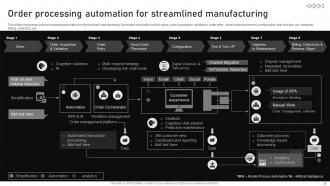
Slide 36: This slide displays Order processing automation for streamlined manufacturing.
Slide 37: This slide represents Automating Procurement To Improve Purchase Efficiency.
Slide 38: This slide showcases Impact of supply chain automation on major KPIs.
Slide 39: This slide highlights title for topics that are to be covered next in the template.
Slide 40: This slide shows Key members of manufacturing process team.
Slide 41: This slide presents RACI matrix highlighting major responsibilities.
Slide 42: This slide displays Automation adoption training to manufacturing employees.
Slide 43: This slide highlights title for topics that are to be covered next in the template.
Slide 44: This slide represents Overall budget for automated manufacturing process.
Slide 45: This slide showcases Selecting suitable ERP software for manufacturing process.
Slide 46: This slide shows Calculating costs of automated systems for manufacturing process.
Slide 47: This slide highlights title for topics that are to be covered next in the template.
Slide 48: This slide presents Impact of automation on current manufacturing process.
Slide 49: This slide displays Annual budget analysis of manufacturing department.
Slide 50: This slide highlights title for topics that are to be covered next in the template.
Slide 51: This slide represents Supply chain and logistics RPA management dashboard.
Slide 52: This slide showcases Manufacturing process performance management dashboard.
Slide 53: This slide contains all the icons used in this presentation.
Slide 54: This slide is titled as Additional Slides for moving forward.
Slide 55: This is About Us slide to show company specifications etc.
Slide 56: This slide provides 30 60 90 Days Plan with text boxes.
Slide 57: This slide shows SWOT describing- Strength, Weakness, Opportunity, and Threat.
Slide 58: This is Our Team slide with names and designation.
Slide 59: This is a Quotes slide to convey message, beliefs etc.
Slide 60: This slide depicts Area chart with two products comparison.
Slide 61: This is a Thank You slide with address, contact numbers and email address.
Automating Manufacturing Procedures For Increased Productivity Powerpoint Presentation Slides with all 66 slides:
Use our Automating Manufacturing Procedures For Increased Productivity Powerpoint Presentation Slides to effectively help you save your valuable time. They are readymade to fit into any presentation structure.









FAQs for Automating Manufacturing Procedures For Increased Productivity
So the big players right now? AI and machine learning are huge, plus those collaborative robots - cobots - that can actually work next to people without safety cages. Pretty cool stuff. IoT sensors are everywhere too, tracking temps, vibrations, you name it. Digital twins let you test your whole production line virtually first, which honestly saves so much headache later. Oh, and AI's getting scary good at predicting when machines'll break down. My take? Start with IoT sensors - they're cheap and you'll need that data for everything else anyway.
Dude, automation is a game changer - most places see 20-40% productivity boosts. Your cycle times get way faster and quality stays consistent. No more random human errors slowing everything down either. Workers can actually do interesting stuff instead of mind-numbing assembly tasks, which honestly makes everyone happier. The data tracking is solid too, so you'll catch problems before they become headaches. Oh and machines work 24/7 without complaining about overtime lol. My advice? Test it on just one line first to see your ROI, then expand from there.
Honestly, compatibility issues are gonna be your worst nightmare. Most legacy equipment just doesn't play nice with new automation systems - we're talking costly retrofits or full replacements that'll blow your budget. Your team will need retraining too, which takes time nobody has. Production gets messy during rollouts. Start with one small pilot program instead of going crazy and automating everything. Perfect that first, then expand from there. Trust me, the "rip the bandaid off" approach sounds tempting but it's brutal in practice.
Dude, automotive and electronics are killing it with automation right now. Those industries have crazy high volumes and repetitive stuff that robots are perfect for. Aerospace is massive too - they need that precision for safety parts, and honestly robots just don't mess up like people do. Oh, and food processing is huge because of all the hygiene requirements. Way less contamination when machines handle everything. If you're in any of these areas, I'd definitely start looking at some pilot projects to test the waters first.
So you scatter sensors across your production line to track stuff like vibration, temperature, performance data. Machine learning analyzes all that to predict when equipment's about to crap out. Then you fix things before they actually break - way better than either waiting for failures or doing unnecessary scheduled maintenance. Honestly, the predictions get scary accurate once you feed it enough data. I'd start with your most critical machines first, then expand. The cost savings from avoiding just a couple major breakdowns usually pays for the whole system. Pretty neat tech, actually.
So AI is like giving your manufacturing setup a really smart brain. Sensors and cameras feed it tons of data, then it spots patterns to predict equipment failures and optimize schedules. Quality issues get caught early too - saves you from expensive headaches later. The system actually learns and improves over time, which is pretty wild when you think about it. Real-time adjustments happen automatically when materials or conditions change. Honestly, I'd start with predictive maintenance on whatever equipment would hurt most if it broke down. Much easier than trying to do everything at once.
Look, automation's gonna wipe out a lot of manual jobs - that's just reality. But here's the thing: new roles pop up in programming, maintenance, and overseeing quality control. The shift happens crazy fast once you pull the trigger. You'll end up with fewer employees overall, but they'll need way more technical skills and get paid better for it. My advice? Start figuring out which of your current people have a knack for learning tech stuff. The transition period can make or break your whole operation if you don't handle it right.
Here's the thing - bigger companies get their money back way faster, like 2-3 years, because they're pumping out massive volumes. Us smaller guys? We're looking at 4-6 years typically, which honestly sucks but everyone's doing it now so you kinda have to. Don't go crazy trying to automate everything at once though. Pick your most boring, repetitive stuff first - whatever you're doing tons of or where quality's been an issue. I learned this the hard way, but starting simple actually works better anyway. You can always add more later once you see how it goes.
Honestly, you gotta think about growth from the start or you'll hate yourself later. Build everything modular so you can just plug in new lines without tearing apart what's already working. Cloud control systems are way better than keeping everything on-site - trust me on this one. Make sure whatever equipment you buy uses standard protocols too, otherwise you're married to one vendor forever and that gets expensive fast. I'd map out where you think you'll be in 3-5 years, then double it. Better to have extra capacity than get stuck doing a massive overhaul when business picks up.
Definitely go with multiple protection layers - emergency stops, safety interlocks, physical barriers around the dangerous stuff. Light curtains are amazing for catching when someone wanders into a hazard zone, and pressure-sensitive mats too. Lockout/tagout for maintenance is non-negotiable. Your system should fail safely when things go sideways (and they will). Good ventilation if you've got fumes or particles floating around. Honestly, the biggest thing? Plan for people doing dumb stuff. I've seen operators bypass safety features because they're "in a hurry" - your design needs to handle that kind of unpredictability plus regular equipment failures.
Honestly, the biggest win is just cutting out human error - you'll get way more consistent results. Sensors and cameras catch defects instantly, unlike Dave who's mentally checked out by 3pm on Friday. Your reject rates will drop big time since machines don't have bad days. What's really cool is you can fix problems in real-time instead of discovering you've made 500 defective pieces. I'd say look at wherever your team does manual inspections first. Those spots are usually goldmines for automation wins.
Honestly, automation is a game-changer for supply chains. You'll get real-time updates on inventory, production schedules, all that stuff. Your forecasting gets way better too since computers can crunch way more data than we can. The system can automatically reorder stock, tweak production runs, even reroute shipments when things go sideways. Everything connects from suppliers straight to customers - it's pretty slick. I'd start with the boring repetitive stuff first, like tracking inventory or generating purchase orders. Those are usually the biggest headaches anyway. Build from there once you get comfortable.
Honestly, your automated stuff is sitting on a goldmine of info. Look at cycle times, error rates, equipment performance - but track them over weeks, not just day-to-day snapshots. The patterns will jump out at you. Set up dashboards that ping you when things dip below normal. That predictive maintenance thing actually works too - way better than waiting for stuff to break. Oh, and don't go crazy trying to monitor everything at once. Pick maybe 3 key metrics first. I've seen companies catch quality problems super early this way, which saves tons of headaches later.
Automation's actually pretty great for the environment. Your systems get way more precise, so less material waste and fewer defective products hitting landfills. Energy usage drops too since equipment only runs when it needs to. Better process control means you're not burning through raw materials like before. It's kinda nice when something that saves you money also helps the planet, you know? Oh, and definitely look at your messiest processes first - that's where you'll see the biggest impact. Resource efficiency alone makes it worth considering.
Honestly, you gotta loop people in right from the start - don't just spring it on them. Most folks freak out thinking they'll get replaced, so explain upfront how automation makes their work easier, not obsolete. Leadership always screws this up by making big announcements without context! Get employees trained early and actually ask what they think about rolling it out. Oh, and try it in just one department first so everyone can see it's not scary. When people feel included instead of blindsided, they won't fight you on it. Trust me on this one.
-
The quality of the templates is as fine as it could get. It was a purchase well made!
-
Wow! The design and quality of templates on SlideTeam are simply the best.