

Automobile Manufacturing Company Executive Summary





Try Before you Buy Download Free Sample Product
 Impress Your
Audience
 100%
Editable
 Save Hours
of Time


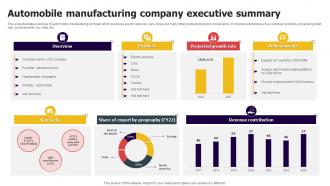
This slide illustrates overview of automobile manufacturing company which produces electric vehicles, cars, bikes and many other products for public convenience. It includes elements such as overview, products, projected growth rate, achievements, key stats, etc.
People who downloaded this PowerPoint presentation also viewed the following :
Automobile Manufacturing Company Executive Summary with all 7 slides:
Use our Automobile Manufacturing Company Executive Summary to effectively help you save your valuable time. They are readymade to fit into any presentation structure.






FAQs for Automobile Manufacturing
Honestly, electric powertrains are flipping everything upside down - assembly lines built for engines just don't work anymore. Autonomous driving and AI manufacturing are huge too. Tesla's basically showing everyone how flexible production should work, which is pretty smart if you ask me. Companies are using machine learning for quality control and supply chain stuff now. Oh, and there's this whole sustainable materials thing happening. Smart factories can actually adjust themselves based on demand patterns, which still blows my mind. Robotics are getting crazy advanced too. You should definitely watch how the disruptors approach manufacturing.
So basically, EVs turned car manufacturing upside down. You're not dealing with engines and transmissions anymore - it's more like assembling a giant smartphone with wheels. Way fewer parts overall, but now you need people who can handle battery packs and high-voltage stuff safely. The whole supply chain changed too since companies are scrambling for lithium instead of just steel. It's honestly like switching from making pizza to sushi - completely different ingredients and skills. Once factories actually retool though, production gets way smoother and faster.
Dude, automation is seriously the secret sauce for car manufacturing these days. Robotic arms can weld and paint cars non-stop without getting tired or sloppy - honestly kind of scary how good they've gotten. Workers end up doing way cooler stuff like troubleshooting problems instead of doing the same boring task 500 times a day. What's really smart is how these systems can quickly switch between making different car models on one line. My buddy works at a plant and says they always look at their most repetitive processes first when upgrading. Makes total sense if you think about it.
Honestly, start with an audit of where you're at environmentally - that'll show you the biggest wins. Switch your facilities to renewable energy if possible. The EV shift is massive right now, but don't sleep on just reducing waste in your current processes too. Circular economy stuff works great - basically reusing and recycling materials instead of tossing them. Work with suppliers who actually care about this stuff, not just ones who greenwash. Invest in cleaner production tech when you can. Oh, and redesign components so they're easier to recycle down the line.
Dude, semiconductor shortages are still killing everyone - crazy how one tiny chip can wreck your whole line. Raw materials are all over the place too, especially lithium for EVs. Geopolitical stuff keeps messing with suppliers, plus you've got the usual headaches like strikes and shipping delays. Single-source dependencies will bite you hard when things go sideways (learned that one the hard way). Honestly? Start spreading your suppliers around now and get some visibility tools so you can actually see problems coming. Better to overprepare than scramble later.
Dude, materials science is totally changing car manufacturing right now. You've got these crazy strong composites and high-strength steels that weigh way less but are actually safer. Carbon fiber isn't just for supercars anymore - it's showing up in regular vehicles too. Aluminum bodies are pretty much standard now. What's cool is designers can get way more creative with shapes since these materials are so flexible to work with. Oh, and if you're doing any vehicle stuff, definitely loop in the materials people early. They'll probably have some wild alternatives that'll cut both weight and costs. Trust me on that one.
Honestly, globalization's been brutal for local car companies. They either team up with the big international players or find their own niche - otherwise they're toast. Cheap imports are killing tons of local manufacturers who can't keep up. But here's the thing - some countries figured it out. Look at South Korea, they went from making total garbage cars to actually decent ones by getting access to better tech and supply chains. Oh and export opportunities too, which is huge. If you're dealing with this stuff, don't try competing on price alone. You'll lose every time. Focus on what makes your local production special instead.
So car companies are basically rebuilding everything from scratch around software and connectivity now. Ford and GM are throwing billions at electric platforms that can handle over-the-air updates and all that fancy driver assistance stuff. Tesla really screwed everyone over by setting the bar so high, honestly. Instead of doing it all themselves, they're partnering with tech giants - Google, Apple, Amazon. Production lines now include whole phases just for software testing and cybersecurity checks. Oh, and if you're following this stuff, partnership announcements are your best bet for figuring out where each company's headed with their smart car plans.
NHTSA sets all the federal safety rules you'll need to hit - airbags, seatbelts, crash tests, rollover stuff. Pretty intense honestly. Each model has to pass their specific tests before you can sell anything. The regulations change constantly too, which is kind of annoying but whatever. Your manufacturing needs solid quality control so every car performs the same safety-wise. Definitely bookmark their Federal Motor Vehicle Safety Standards database. Oh and set up alerts for updates that affect your vehicle types - trust me on that one.
So they've got checkpoints all through the process, not just at the end. Material gets inspected when it comes in, then during assembly they randomly pull cars off the line to test things. Final inspection happens before shipping too. Quality teams actually work right on the factory floor - which makes sense when you think about it. They use this statistical tracking thing to watch for patterns over time. The data side is honestly pretty cool. If you ever tour a plant, definitely ask to see their control room where they monitor everything. It's way more systematic than most people realize.
Dude, 3D printing is a game changer for car parts. You can prototype stuff super fast without retooling whole production lines - saves tons of money. The crazy part is printing complex shapes that regular manufacturing can't even touch, like internal cooling channels or those lightweight lattice designs. No more storing massive inventory either since you just print parts on demand. Honestly, the aerospace guys figured this out years ago. Start with small prototype runs and specialty parts first - don't jump into mass production right away. You'll be shocked how much faster design iterations become.
Honestly, the biggest pain points are gonna be your old equipment not playing nice with new AI systems - that integration is a nightmare and costs way more than you think. Your team will need major retraining too, and let's be real, some people hate change. Clean data is crucial but yours is probably scattered everywhere across different platforms. Oh, and once you connect everything to networks, security becomes this whole other beast. My advice? Test it out somewhere small first where if things go sideways, it won't kill your whole operation.
Dude, auto plants are like economic gold mines for towns. They hire tons of people directly - assembly workers, engineers, all that. But here's the thing that's actually cooler: they create this whole ecosystem around them. Suppliers pop up everywhere, logistics companies expand, even random service businesses thrive. That coffee truck outside the plant? Probably making bank lol. These jobs pay decent too without needing a college degree. If you're thinking investment-wise, don't just look at the main facility. Check out what supplier network develops - that's where the real money multiplies over time.
Look, R&D is everything in auto manufacturing right now. Consumer tastes shift constantly and tech moves crazy fast - you've gotta stay ahead or you're toast. Companies need breakthrough research for new powertrains and safety tech, plus all that autonomous driving stuff everyone's obsessing over. Honestly, just look at how Tesla shook up the whole industry. Without proper R&D investment, your cars become irrelevant in like 3-4 years max. The tricky part? You can't just do pie-in-the-sky research - it needs to actually work in real vehicles people will buy.
So basically, you can track bottlenecks as they happen and predict when your equipment's about to crap out. Predictive maintenance is huge - fix stuff before it breaks instead of scrambling when everything goes to hell. You'll see patterns in quality issues, waste, and which shifts are actually pulling their weight. The trick is connecting all your sensors so you get the full picture. Oh, and definitely start with just one line first - don't go crazy trying to do everything at once. Once you see how much money it saves, then roll it out everywhere else.
-
Easily Understandable slides.
-
The presentations are very helpful. I am always able to get appropriate templates for the different topics related to my profession.