

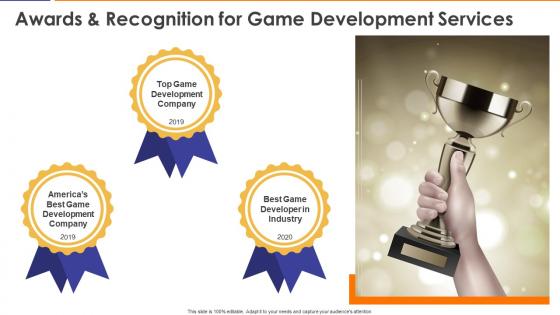
Awards and recognition for game development services ppt slides model




Try Before you Buy Download Free Sample Product
 Impress Your
 Audience
 100%
100% Editable
 Save Hours
 of Time


Our Awards And Recognition For Game Development Services Ppt Slides Model are topically designed to provide an attractive backdrop to any subject. Use them to look like a presentation pro.
People who downloaded this PowerPoint presentation also viewed the following :
Awards and recognition for game development services ppt slides model with all 9 slides:
Use our Awards And Recognition For Game Development Services Ppt Slides Model to effectively help you save your valuable time. They are readymade to fit into any presentation structure.








FAQs for Awards and recognition for game development services
Key criteria for awarding excellence in game design include innovative gameplay mechanics, visual and audio quality, narrative depth, user experience design, and technical achievement. These elements work together by creating immersive player experiences, demonstrating creative problem-solving, and pushing industry boundaries, with many gaming organizations finding that award-winning titles ultimately deliver memorable engagement and lasting cultural impact.
Game development awards impact indie developers by providing crucial visibility, credibility, and networking opportunities that can dramatically accelerate growth, while larger studios primarily gain marketing validation and industry prestige. For indie developers, awards like the Independent Games Festival or IndieCade deliver transformative outcomes through media coverage, publisher interest, and consumer awareness, whereas established studios leverage awards to enhance franchise value and reinforce market position, ultimately creating different but significant competitive advantages.
Recent award-winning games reveal key trends including innovative storytelling through interactive narratives, accessibility-focused design, cross-platform integration, immersive technologies like VR and AR, and sustainable development practices. These approaches enhance player engagement by delivering personalized experiences, broader market reach, and inclusive gameplay, with many developers finding that combining creative innovation with technical excellence ultimately drives both critical recognition and commercial success.
Awards significantly influence consumer perceptions by establishing credibility, signaling quality, and reducing purchase risk through third-party validation. Recognition from prestigious ceremonies like The Game Awards or BAFTA Games Awards enhances visibility, drives sales momentum, and creates competitive advantage, with many developers finding that award-winning titles achieve broader market penetration and sustained consumer trust.
Storytelling serves as a critical differentiator in game development awards, with judges evaluating narrative depth, character development, emotional engagement, and innovative storytelling techniques. Games like "The Last of Us" and "God of War" demonstrate how compelling narratives elevate gameplay experiences, with many award-winning titles finding that strong storytelling creates lasting player connections and critical acclaim.
Game developers can effectively showcase their projects by creating comprehensive portfolios with gameplay videos, technical documentation, player testimonials, and clear narratives highlighting innovation and impact. Through strategic presentation focusing on unique mechanics, artistic vision, and community engagement, developers demonstrate measurable success metrics like player retention and critical reception, ultimately positioning their work competitively within increasingly prestigious industry recognition programs.
Diversity in game development award nominations ensures recognition spans various creative perspectives, cultural backgrounds, and innovative approaches, ultimately enriching the industry's storytelling and design landscape. It enables broader representation of global gaming communities, encourages underrepresented developers to pursue creative excellence, and delivers more inclusive gaming experiences that resonate with increasingly diverse audiences worldwide.
Multiplayer games increasingly compete alongside single-player experiences at award shows, with titles like "It Takes Two" and "Among Us" winning major categories traditionally dominated by narrative-driven single-player games. While single-player experiences often excel in storytelling and artistic achievement categories, multiplayer games gain recognition for innovation, community engagement, and social impact, with many award committees finding that cooperative and competitive experiences deliver unique cultural significance and lasting player engagement.
Recent game development awards have celebrated ray tracing for realistic lighting, AI-driven procedural generation, cloud gaming platforms, advanced physics engines, and virtual reality integration. These technologies enhance player immersion by delivering cinematic visuals, dynamic world creation, and seamless cross-platform experiences, with many studios finding that strategic innovation ultimately drives competitive advantage in an increasingly sophisticated gaming market.
Game development awards differ significantly across regions through varying cultural preferences, platform priorities, technological focuses, and evaluation criteria. While Western awards often emphasize technical innovation and visual excellence, Asian ceremonies frequently prioritize mobile gaming achievements and social engagement metrics, with many international developers finding that understanding these regional distinctions enhances their global market positioning and cultural resonance.
Developers can integrate award jury feedback by conducting post-submission reviews, analyzing scoring criteria, identifying recurring themes across multiple submissions, and documenting specific technical or creative suggestions. This feedback becomes invaluable for refining game mechanics, narrative structures, and user experience design, with many studios finding that systematic feedback integration significantly enhances their competitive positioning and development processes.
Awards serve as powerful marketing tools by providing third-party validation, generating media coverage, creating social proof for potential buyers, and differentiating titles in crowded marketplaces. Through strategic award positioning, game developers enhance brand credibility, attract publisher attention, and boost consumer confidence, with many studios finding that award recognition significantly increases visibility, drives sales conversions, and establishes competitive advantage in increasingly saturated gaming markets.
Fan votes enhance award legitimacy by incorporating genuine player experiences and community perspectives, while also presenting challenges around popularity bias and demographic representation. These votes enable awards ceremonies to capture authentic market reception and player engagement, with many gaming organizations finding that balanced voting systems combining fan input with industry expertise deliver the most credible and comprehensive recognition.
VR and AR technologies will likely create specialized award categories recognizing immersive storytelling, spatial design innovation, haptic feedback integration, and cross-platform accessibility achievements. These emerging fields enable developers to pioneer entirely new interactive experiences, with gaming studios, educational institutions, and entertainment companies finding that immersive technologies demand distinct evaluation criteria, ultimately delivering competitive advantages through revolutionary user engagement and experiential depth.
Common pitfalls include submitting incomplete or poorly polished builds, missing submission deadlines, failing to meet specific category requirements, and inadequate presentation materials. Many developers underestimate the importance of compelling trailers, comprehensive documentation, and clear value propositions, with successful submissions typically combining technical excellence with strategic storytelling that resonates with judges.
-
Awesome presentation, really professional and easy to edit.
-
Great designs, really helpful.