

B2B Marketing Agency Communication Plan Rollout




Try Before you Buy Download Free Sample Product
 Impress Your
 Audience
 100%
100% Editable
 Save Hours
 of Time


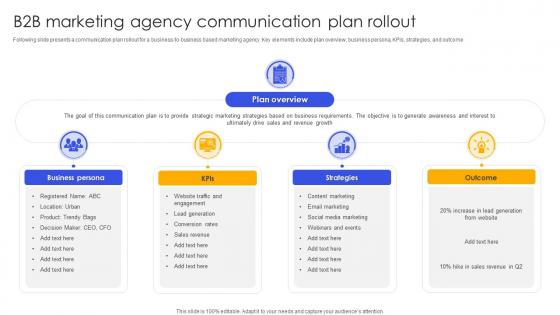
Following slide presents a communication plan rollout for a business-to-business based marketing agency. Key elements include plan overview, business persona, KPIs, strategies, and outcome
People who downloaded this PowerPoint presentation also viewed the following :
B2B Marketing Agency Communication Plan Rollout with all 6 slides:
Use our B2B Marketing Agency Communication Plan Rollout to effectively help you save your valuable time. They are readymade to fit into any presentation structure.





FAQs for B2B Marketing Agency
Key components include target audience segmentation, messaging framework, channel strategy, content calendar, budget allocation, and performance metrics. These elements work together by aligning marketing efforts across touchpoints, ensuring consistent brand messaging, and optimizing resource allocation, with many B2B organizations finding that integrated approaches deliver higher lead quality and faster sales cycles.
Businesses can segment their target audience through demographic analysis, behavioral patterns, purchasing history, company size, industry verticals, and geographic location. This strategic segmentation enables organizations to craft personalized messaging, optimize resource allocation, and deliver more relevant content across different sectors, with many companies finding that tailored approaches significantly enhance engagement rates and conversion outcomes.
Content marketing serves as the foundation of B2B marketing communication plans by building thought leadership, nurturing leads through educational materials, and supporting sales conversations with valuable resources. Through strategic content like whitepapers, case studies, and industry insights, organizations enhance credibility, accelerate buyer journeys, and differentiate themselves in competitive markets, ultimately delivering qualified leads and stronger customer relationships.
Social media enhances B2B marketing communication by enabling thought leadership content sharing, direct engagement with decision-makers, and targeted advertising to specific industries and job roles. Platforms like LinkedIn facilitate relationship building with prospects, while companies increasingly find that consistent social presence accelerates lead generation, builds brand credibility, and creates competitive advantages in crowded markets.
Key metrics include lead quality scores, conversion rates throughout the sales funnel, customer acquisition cost, lifetime value, engagement rates across channels, and revenue attribution from specific campaigns. These measurements enable organizations to optimize resource allocation, demonstrate ROI to stakeholders, and refine messaging strategies, with many B2B companies finding that integrated tracking delivers clearer insights and enhanced competitive advantage.
Businesses ensure sales-marketing alignment by establishing shared goals, unified messaging frameworks, and regular cross-team communication channels throughout their planning process. Through integrated CRM systems and collaborative content development, organizations streamline lead handoffs, maintain consistent customer touchpoints, and optimize conversion rates, with many finding that aligned teams deliver significantly higher revenue growth and improved customer experiences.
**INPUT**: What are the best practices for creating impactful email campaigns in a B2B context? **OUTPUT**: Best practices for B2B email campaigns include personalized subject lines, targeted segmentation, value-driven content, clear calls-to-action, and strategic timing optimization. These approaches enhance engagement by delivering relevant industry insights, addressing specific pain points, and nurturing prospects through sales funnels, with many organizations finding that segmented campaigns generate significantly higher conversion rates and stronger client relationships.
Storytelling enhances B2B marketing communication by creating emotional connections, simplifying complex solutions, and demonstrating real-world value through customer success narratives, case studies, and problem-solution frameworks. Companies like IBM and Salesforce leverage compelling narratives to transform technical features into relatable business outcomes, ultimately building trust, credibility, and stronger prospect engagement across industries.
**INPUT**: What tools or software are most effective for managing B2B marketing communications? **OUTPUT**: Effective B2B marketing communication tools include CRM platforms like Salesforce, marketing automation software such as HubSpot and Marketo, email marketing solutions, social media management platforms, and analytics tools like Google Analytics. These technologies streamline lead nurturing, content distribution, and campaign tracking, with many organizations finding that integrated platforms deliver enhanced customer engagement, improved conversion rates, and ultimately stronger ROI across their marketing initiatives. **Word count: 60 words**
Industry trends and insights significantly shape B2B marketing communication plans by informing messaging strategies, channel selection, content priorities, and audience targeting approaches. These insights enable marketers to anticipate customer needs, adapt to emerging technologies, and position solutions strategically, with many organizations finding that trend-driven communication delivers enhanced relevance, stronger engagement, and sustainable competitive advantage.
B2B marketing communications must address data privacy regulations like GDPR and CCPA, intellectual property rights, truthful advertising standards, anti-spam laws, and industry-specific compliance requirements. These legal frameworks ensure transparent customer interactions, protect sensitive business information, and maintain competitive integrity, with many organizations finding that proactive compliance ultimately delivers stronger client trust and sustainable market positioning.
Businesses use webinars and virtual events to generate qualified leads, demonstrate product expertise, nurture prospect relationships, and establish thought leadership within their industries. These platforms enable companies to reach global audiences cost-effectively, deliver personalized content experiences, and capture valuable attendee data, with many B2B organizations finding that interactive virtual formats significantly enhance engagement while streamlining their sales funnel processes.
Personalization enhances B2B marketing communication by delivering targeted content, customized messaging, and relevant solutions based on specific client needs, industry challenges, and business objectives. Through advanced data analytics and segmentation strategies, organizations streamline lead nurturing, accelerate sales cycles, and strengthen client relationships, with many B2B companies finding that personalized approaches ultimately deliver higher engagement rates and improved conversion outcomes.
Client feedback informs marketing communication plans by revealing message effectiveness, channel preferences, content gaps, and audience pain points through surveys, interviews, and engagement analytics. This intelligence enables marketers to refine messaging strategies, optimize channel selection, and personalize content approaches, with many B2B organizations finding that feedback-driven iterations significantly enhance lead quality and conversion rates.
B2B marketing communication faces challenges including longer sales cycles, multiple decision-makers, complex product messaging, limited audience reach, and measuring ROI across touchpoints. These obstacles can be overcome by developing targeted content for each buyer persona, implementing account-based marketing strategies, and leveraging marketing automation platforms, with many organizations finding that integrated multi-channel approaches ultimately streamline engagement and accelerate conversion rates.
-
I’m not a design person, so I couldn’t make a presentation to save my life. Thankfully, they have all kinds of templates that I regularly use for my work.
-
I came across many PowerPoint presentations with excellent creatives and I believe they would be beneficial to my work.