

Bake House Business Plan Powerpoint Presentation Slides





Try Before you Buy Download Free Sample Product
 Impress Your
Audience
 100%
Editable
 Save Hours
of Time


The Bakery Business is engaged in the production and sale of flour based food products such as bread, rolls, cookies, pastries, muffins, and pizza, catering to customers with a craving for delectable baked goods. The primary objective of creating a Bake House Business Plan is to analyze the global bakery industry, encompassing market size, trends, growth opportunities, success factors, and key challenges. This PowerPoint presentation provides a comprehensive overview, starting with an executive summary, mission statement, vision, goals, and a summary of startup costs. It further includes a market gap analysis, outlining the range of products offered by the bakery startup. The presentation also presents essential statistics pertaining to the US bakery industry, along with the target market and buyer persona, incorporating TAM, SAM, and SOM analysis. It showcases an attribute based comparison of major players in the bakery industry, along with a SWOT analysis and Porters five forces model. Additionally, the PowerPoint showcases a marketing plan encompassing sales, distribution, and promotional strategies to establish business credibility, pricing strategy, and customer journey. The operational and financial plans, including financial assumptions, revenue generation model, break even analysis, profit and loss account, cash flow statement, balance sheet, scenario analysis, and discounted cash flow, are also featured in the presentation. Finally, the PowerPoint concludes with a management summary, exit strategies, and key abbreviations relevant to the bakery business.
People who downloaded this PowerPoint presentation also viewed the following :
Content of this Powerpoint Presentation
Slide 1: This slide presents Bake House Business Plan cover slide.
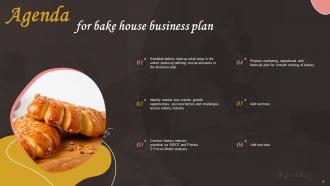
Slide 2: This slide presents Agenda of Bakery business plan.
Slide 3: This slide presents Table of Contents.
Slide 4: This slide presents Table of Contents.
Slide 6: This slide showcases the executive summary of bakery business plan which includes company summary such as strength, marketing strategies, etc. It also includes entity such as web address, incorporation date, location, products, etc
Slide 7: This slide represents the mission and vision of the start-up bakery business, which shows the future desired position of the business. It also covers goals such as maintaining high sanitation, expanding business, increasing customer base, training the workforce, etc
Slide 8: This slide showcases the start up summary of bakery business which includes start up expenses such as equity capital, licensing & lease security deposit, fixed assets, essential supplies, cash buffer, etc
Slide 9: This slide covers the market gap analysis to provide effective solution which includes concern such as customized cake orders and no online ordering service. It also shows business solution such as offering customized orders.
Slide 10: This slide focuses on products offered by bakery start up to customers such as breads, cookies, pastries, muffins, desserts and pizza.
Slide 11: This slide shows key success factors of bakery industry such as team collaboration, competitive advantage, excellent customer service, qualified employees and offer free samples
Slide 12: This slide presents Table of Contents.
Slide 13: This slide showcases the global market analysis of bakery industry which includes projected market size during the period of 2021 to 2028.
Slide 14: This slide focuses on bakery market growth across United States which includes market value, highest share in North America region, economic impact, etc
Slide 15: This slide covers the key market trends shaping global bakery industry which includes gluten-free products, reduced sugar trend, longer shelf life, plant-based diet, enhanced nutrition in baked goods, etc
Slide 16: This slide showcases the major challenges faced by bakery industry which includes shelf-life management, fluctuating consumer preferences, emerging competition, supply chain disruption, hygiene practices, etc
Slide 17: This slide covers the growth drivers for bakery industry which includes increased demand for convenient food products, rising urbanization, increased women empowerment, rising prominence of in-store bakeries, etc
Slide 18: This slide shows the statistics associated with bakery industry across United States which includes bakery segment by revenue share such as commercial and retail
Slide 19: This slide presents Table of Contents.
Slide 20: This slide represents the target market of bakery retail store which includes upper and middle income people, tourists, households & residents, working class people, students, etc
Slide 21: This slide showcases the buyer persona of bakery business which includes demographics, key concern & pain points, personality traits, spending habits, factors affecting purchase behavior, eyc
Slide 22: This slide showcases the TAM, SAM and SOM analysis of bakery shop target market which includes global bakery market value, US market size and serviceable obtainable market
Slide 23: This slide presents Table of Contents.
Slide 24: This slide covers the comparison of major bakery industry players on the basis of different attributes such as founding date, headquarters, website, revenue, qualified bakers, target market, etc
Slide 25: This slide presents Table of Contents.
Slide 26: This slide showcases the strengths, weakness, opportunities and threats to evaluate competitive position of bakery which includes experience staff, high prices, economic recession, etc
Slide 27: This slide presents Table of Contents.
Slide 28: This slide showcases the Porter’s five forces model for bakery industry which includes competitive rivalry, bargaining power of buyers & suppliers, threat of new entrants, etc
Slide 29: This slide presents Table of Contents.
Slide 30: This slide represents the sales and distribution strategy for start up bakery business which includes provide nutrition information for products, unique packaging, offer free samples and remain active on social media
Slide 31: This slide showcases the promotional strategies to establish business credibility which includes social media marketing, website development and email marketing along with description and initiatives
Slide 32: This slide showcases the pricing strategy to establish best price for bakery products which includes expenses by US households, implementing pricing strategy, basis for calculating future prices, etc
Slide 33: This slide shows the customer journey through sales funnel which includes awareness, conversion, loyalty and retention which helps company to track how well they are doing to acquire potential leads
Slide 34: This slide presents Table of Contents.
Slide 35: This slide shows the quarterly milestone roadmap for successful business growth which includes pre-launch checklist, marketing strategies and additional milestones
Slide 36: This slide presents Table of Contents.
Slide 37: This slide represents the key financial assumptions for bakery start up which includes baking expenses, balance sheet adjustments, etc. The computations are based on market trends and conditions prevailing in the
Slide 38: This slide covers the revenue generation model for bakery shop start up which includes revenue projection for different products such as breads & rolls, cookies, pastries, muffins, desserts and pizza
Slide 39: This slide shows the break even analysis of company to determine cost structure which includes average revenue, contribution per year, discount rate, payback period, etc
Slide 40: This slide showcases the projected profit and loss statement prepared by company to monitor financial results which includes revenue, direct costs, operating expenses, EBITDA, earning before and after tax
Slide 41: This slide showcases the graphical representation of projected profit and loss statement prepared by company to monitor financial results which includes revenue, direct costs, operating expenses, EBITDA, earning before and
Slide 42: This slide covers the projected cash flow statement to determine business performance which shows inflow and outflow of cash from operating, investing and financing activities
Slide 43: This slide covers the graphical representation of projected cash flow statement to determine business performance which shows inflow and outflow of cash from operating, investing and financing activities along with closing
Slide 44: This slide represents the projected balance sheet to analyze the financial position of the company which includes assets and liabilities for five years from 2023 to 2027
Slide 45: This slide represents the graphical representation of projected balance sheet to analyze the financial position of the company which includes total assets for five years from 2023 to 2027
Slide 46: The purpose of this slide is to examine the effects of potential future events on the bakery start-up performance by considering numerous different outcomes, including optimistic, pessimistic, and nominal case scenarios.
Slide 47: This slide shows the effects of potential future events on the bakery start-up performance by considering numerous different outcomes, including optimistic, pessimistic, and nominal case scenarios.
Slide 48: This slide showcases the discounted cash flow for the valuation of investment which includes WACC, NPV value, free cash flow to firm, DCF valuation, etc
Slide 49: This slide presents Table of Contents.
Slide 50: This slide represents the organizational structure of bakery start up company which includes owner, general manager, bakery chef leader, cashier, wait staff, sales staff, pie baker, bread maker, etc
Slide 51: This slide shows the professional summary of bakery store start-up founder which includes educational qualification and skills such as sales & marketing, team communication, decision making, etc
Slide 52: This slide covers the roles and responsibilities of bakery management team to ensure effectiveness and efficiency in operations. It also helps the company in avoiding repetition of tasks
Slide 53: This slide covers the roles and responsibilities of bakery management team to ensure effectiveness and efficiency in operations.
Slide 54: This slide presents Table of Contents.
Slide 55: This slide showcases the exit strategies for bakery business which includes mergers, acquisitions, private offerings, and venture capital
Slide 56: This slide presents Table of Contents.
Slide 57: This slide showcases the key abbreviations used in bakery business plan which includes CEO, US, CAGR, FCFF, SEO and SEC
Slide 58: This is the Icons slide.
Slide 59: This slide presents Additional Slides/
Slide 60: This is the About us slide.
Slide 61: This slide presents Our mission.
Slide 62: This is the Idea generation slide that can be used present new ideas.
Slide 63: This is the Roadmap slide that can be used to present series of events.
Slide 64: This is 30 60 90 days plan that can be used to create robust plans.
Slide 65: This is the Puzzle slide that can be used to present creative thinking.
Slide 66: This is Post it notes slide that can be used to present important information.
Slide 67: This is a Thank You slide for acknowledgment.
Bake House Business Plan Powerpoint Presentation Slides with all 72 slides:
Use our Bake House Business Plan Powerpoint Presentation Slides to effectively help you save your valuable time. They are readymade to fit into any presentation structure.











FAQs for Bake House Business Plan
Honestly, start with figuring out who's gonna buy your stuff - check out the local demographics and scope out your competition. The money side is huge too. Map out startup costs, monthly bills, and be realistic about how much you'll actually make (not just wishful thinking). Location matters more than people think, plus you need to nail down equipment and hiring plans. What's gonna make people choose you over that cute cafe across town? That's your hook right there. Marketing strategy, permits, all that boring legal stuff - get it sorted. But seriously, just sketch out a one-pager first to see if this whole thing makes sense before you go crazy with details.
Dude, you absolutely have to research where your customers actually hang out before picking a spot. Check out foot traffic, see what competitors are nearby, and figure out if locals match your target demo. Honestly, location can totally make or break a bakery - like, nobody's driving across town for a muffin, right? Also look at parking (super important but easy to overlook), peak hours, and whether the vibe fits your pricing. Your research will show you if people want quick grab-and-go stuff or if they're looking to sit and chill. Don't go with your gut on this one.
Start with the big stuff - commercial ovens, mixers, proofing cabinets, fridges. Work tables and measuring tools are obvious, but you'll blow through sheet pans and loaf pans faster than you think. Ingredients get expensive quick. Flour, yeast, butter, eggs - it adds up. The packaging costs always catch people off guard too, which is annoying but whatever. Business basics: POS system, display cases, cleaning supplies for health inspectors. Restaurant supply companies usually do package deals for newbies, so definitely get quotes from a few. Way better than buying piecemeal.
Honestly, just figure out who's actually buying your stuff first. Check out the demographics - busy parents, office workers, weekend coffee people? They all want different things. Location is huge too, way more than most people think. Daily coffee customers aren't the same as someone ordering a birthday cake, you know? I'd say survey your area and watch what competitors are doing. Maybe test a few products to see what hits. Focus on like 2-3 clear customer types instead of trying to please everyone - that never works anyway.
Look, your bakery's brand is basically its whole personality - that's what separates you from every other place selling cupcakes down the street. Think logo, colors, your whole story about why you bake the way you do. Most people totally underestimate this stuff when they're just starting. But honestly? Strong branding lets you charge more, keeps customers coming back, and makes your marketing actually work because people know what you're about. Oh, and consistency is key - your Instagram should feel like the same place as your actual storefront. Start by figuring out what makes you different, then just run with that vibe everywhere.
Look at what other bakeries around you are doing first, then find what they're missing. Maybe it's gluten-free stuff, staying open late, or doing crazy custom cakes. Honestly the bakery game is tough - you're competing with grocery stores that sell decent stuff for cheap. Pick ONE thing you'll be known for instead of trying to do everything. Your grandma's secret recipes? All local ingredients? I'd definitely test whatever idea you have with real people before you invest too much. Their reactions will tell you if you're onto something or if you need to pivot. Focus on solving a problem they actually have.
For financing your bakehouse, I'd honestly start with SBA loans - the rates are solid if you can get approved. Equipment financing is clutch since those commercial ovens are stupid expensive, but at least the gear acts as collateral. Personal savings obviously helps, plus friends and family if they're willing. Crowdfunding works too if you've got local buzz already. Some people bring in investors but then you're sharing decisions, which can get messy. Oh, and don't sleep on regular small business loans either. My advice? Get pre-approved somewhere first to see what you're working with, then figure out the rest.
Look around your area first - see what's missing, then build from there. Morning pastries are solid for the early crowd, plus you'll need some artisan breads for the health nuts. Custom cakes are where the real money is though, honestly. Grab-and-go stuff works great for busy people rushing to work. Oh, and you basically have to do gluten-free and vegan options now - everyone expects it. Seasonal specials keep things interesting too. Just don't try to do everything at once or you'll go crazy.
Bulk buying is your best friend - get flour, sugar, all that stuff from wholesale suppliers. The savings are insane when you're burning through inventory daily. Track waste like crazy because tossing unsold pastries hurts so bad. Train your team on storage and do day-old discounts instead of the trash can. Honestly, I'd rather sell cheap than waste food entirely. Price everything by calculating real costs plus labor, then your margin on top. Push those specialty cakes hard - way better profit than basic muffins. Coffee upsells don't hurt either.
Don't put all your eggs in one basket with suppliers - you need backups. Research local farms, specialty distributors, and wholesale places nearby. Visit them in person if you can! I know it's extra work, but you'll get a way better feel for how they actually run things. Look for quality certifications that match your brand - organic, non-GMO, whatever fits. Here's the thing though: cheapest isn't always best. Make yourself a simple evaluation sheet comparing quality, reliability, pricing, and delivery stuff. Trust me, it'll save you headaches later when you're not scrambling because your main supplier flaked.
Instagram's your best bet - bakeries do insanely well on there with good photos. Partner up with local coffee shops too, they're always looking for pastries. Farmers markets are gold for meeting people face-to-face. Honestly, nothing beats word-of-mouth though, so your stuff has to actually taste amazing or you're screwed. Free samples work like crazy. Maybe do a loyalty card thing? Seasonal items keep it interesting. Oh, and make sure you show up on Google Maps - sounds obvious but you'd be surprised how many places mess that up. Just pick like two things and get good at them first.
Honestly, just be consistent and actually remember people - their names, usual orders, whatever. Ask how they're doing. Social media helps tons too, so post those 5am croissant-making videos (they're weirdly addictive) and actually reply to comments fast. When someone complains, don't get defensive - fix it and check back later. A basic punch card works great, like free coffee after 10 visits or something. Oh, and definitely keep track of your regulars somehow. Making them feel special is literally half the battle. Trust me, people notice when you genuinely care vs just going through the motions.
Dude, start with your city's business licensing office and health department ASAP - some permits take forever to process. You'll need the basic business license, food handler's permit, and commercial kitchen certification. Health inspections are mandatory. The FDA labeling stuff is super specific too, honestly kind of a pain. If you're hiring anyone, workers' comp insurance is required. General liability coverage too, obviously. Oh and the fire department has to approve your commercial ovens - learned that one the hard way from my cousin's bakery disaster. Retail permits might be needed depending on your setup. It's a lot but you literally can't open without them.
Seasonal specials are total game-changers, trust me. They create that urgency factor that gets people coming back more often. You can jump on holidays, weather shifts, local events - pumpkin everything in fall, those cheesy Valentine's heart treats, refreshing fruit tarts when it's stupid hot outside. Limited-time stuff also kills it on social media since people love posting their special finds. Oh, and definitely plan your seasonal calendar like 3 months out so you're not scrambling for ingredients last minute. I'd start mapping next quarter's specials right now if I were you.
Okay so track your gross margin per product and daily revenue trends first - those are gonna tell you the most. Food waste percentage is huge too, I learned that the hard way when I was helping my cousin with her cafe. Customer retention and how much people spend per visit matter way more than you'd think. Production efficiency keeps your costs down. Oh and seasonal stuff - rainy days can totally kill foot traffic for bakeries. Display placement literally makes or breaks your average sale amount, it's wild. Start simple with these basics, then you can get fancy with more detailed tracking later.
-
The designs by SlideTeam are honestly the best I have seen so far. Will be definitely coming back for more.
-
This visual representation is stunning and easy to understand. I like how organized it is and informative it is.