

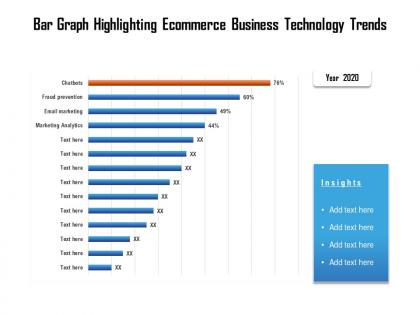
Bar graph highlighting ecommerce business technology trends




Try Before you Buy Download Free Sample Product
 Impress Your
Audience
 100%
Editable
 Save Hours
of Time


Our Bar Graph Highlighting Ecommerce Business Technology Trends are explicit and effective. They combine clarity and concise expression.
People who downloaded this PowerPoint presentation also viewed the following :
Bar graph highlighting ecommerce business technology trends with all 2 slides:
Give your audience a fulfilling experience. They will find our Bar Graph Highlighting Ecommerce Business Technology Trends elevating.


FAQs for Bar graph highlighting ecommerce
The most significant ecommerce technology trends include artificial intelligence for personalization, augmented reality shopping experiences, voice commerce, mobile-first design, and automated customer service chatbots. These technologies streamline operations by enhancing customer engagement, reducing cart abandonment, and accelerating purchase decisions, with many retailers finding that strategic implementation delivers measurably higher conversion rates and competitive advantage.
Artificial intelligence transforms online shopping through personalized product recommendations, intelligent chatbots, dynamic pricing algorithms, visual search capabilities, and predictive inventory management. These AI technologies streamline customer journeys by analyzing browsing patterns, automating customer service interactions, and optimizing product discovery, with many retailers finding that AI-driven personalization increases conversion rates and customer satisfaction significantly.
Chatbots enhance ecommerce customer service by providing instant 24/7 support, handling multiple inquiries simultaneously, and offering personalized product recommendations based on customer data. Through AI-powered automation, retail platforms streamline order tracking, process returns efficiently, and resolve common issues without human intervention, ultimately delivering faster response times and improved customer satisfaction while reducing operational costs.
Augmented reality transforms online shopping by enabling customers to virtually try products, visualize items in their actual spaces, and interact with 3D models before purchasing. Through AR technology, retailers reduce return rates, increase customer confidence, and enhance engagement, with furniture stores, fashion brands, and cosmetics companies finding that immersive experiences drive higher conversion rates.
Payment technologies are evolving through biometric authentication, AI-powered fraud detection, contactless payments, blockchain integration, and real-time processing systems. These innovations streamline checkout experiences by reducing transaction times, minimizing security vulnerabilities, and enhancing customer trust, with many ecommerce platforms finding that faster, more secure payments significantly boost conversion rates and customer satisfaction.
Big data analytics revolutionizes ecommerce inventory management by enabling predictive demand forecasting, optimizing stock levels, and reducing carrying costs through real-time analysis of customer behavior patterns. Through advanced algorithms, retailers can minimize stockouts, prevent overordering, and automate reorder points, while enhancing supply chain efficiency, ultimately delivering improved cash flow and customer satisfaction across seasonal fluctuations.
Businesses leverage machine learning for personalized marketing by analyzing customer behavior patterns, segmenting audiences dynamically, and automating content recommendations across multiple touchpoints. Through predictive analytics and real-time data processing, retailers and service providers deliver targeted campaigns, optimize pricing strategies, and enhance customer experiences, ultimately increasing conversion rates and customer lifetime value.
Headless commerce architecture delivers enhanced flexibility, faster page loading speeds, improved mobile experiences, seamless omnichannel integration, and simplified third-party integrations. This approach enables retailers to customize front-end experiences while maintaining robust back-end functionality, with many ecommerce businesses finding that headless systems reduce development time and ultimately deliver superior customer experiences across multiple touchpoints.
Subscription models drive ecommerce growth by providing predictable revenue streams, enhancing customer lifetime value, and reducing acquisition costs through improved retention rates. Companies like Dollar Shave Club and meal kit services demonstrate how recurring billing, personalized experiences, and inventory predictability enable businesses to scale efficiently while delivering consistent customer satisfaction and stronger profit margins.
Mobile commerce trends hold significant importance for future online retail strategies as they drive personalization, seamless payment integration, social commerce expansion, and omnichannel experiences. With mobile sales increasingly dominating retail transactions, businesses are leveraging these trends to enhance customer engagement, streamline checkout processes, and deliver competitive advantages through faster, more intuitive shopping experiences.
Social commerce innovations integrate with traditional ecommerce platforms through API connections, embedded shopping features, unified inventory management, and cross-platform analytics systems. These integrations enable retailers to streamline product discovery across social media, synchronize inventory between channels, and create seamless checkout experiences, with many fashion and electronics brands finding that integrated approaches deliver higher conversion rates and enhanced customer engagement.
Blockchain technology significantly enhances transparency and trust in online transactions by creating immutable transaction records, eliminating intermediaries, and providing real-time verification capabilities. Through distributed ledger systems, ecommerce platforms enable customers to track product authenticity, payment processing, and supply chain movements, while retailers reduce fraud risks and chargebacks, ultimately delivering enhanced customer confidence and operational efficiency.
Voice commerce is transforming product discovery by enabling hands-free searches, personalized recommendations through AI analysis, and seamless integration with smart home devices. This technology streamlines purchasing decisions by reducing friction in the buying process, with many retailers finding that voice-activated shopping increases customer convenience and drives repeat purchases, ultimately delivering competitive advantage in an increasingly digital marketplace.
Environmental considerations in ecommerce include sustainable packaging solutions, carbon-neutral delivery options, energy-efficient data centers, circular economy integrations, and green supply chain technologies. These sustainability-focused innovations help retailers reduce environmental impact while meeting consumer demand for eco-conscious practices, with many companies finding that green initiatives ultimately deliver cost savings and enhanced brand loyalty.
Logistics technology advancements enhance delivery through AI-powered route optimization, automated warehouse systems, predictive analytics, and real-time tracking capabilities. These innovations enable faster order processing, reduced shipping costs, and proactive delivery updates, with many ecommerce companies finding that strategic technology integration ultimately delivers competitive advantage while significantly improving customer experiences and operational efficiency.
No Reviews