

Benefits Of An Effective Internal Control System Powerpoint Presentation Slides




Try Before you Buy Download Free Sample Product
 Impress Your
 Audience
 100%
100% Editable
 Save Hours
 of Time


The internal control framework provides a set of guidelines, regulations, and procedures that the company implements to provide guidance, improve productivity, and enhance policy enforcement. The system of internal control is one of the basic and essential factors for productive and effective management. Check out our professionally designed presentation on Benefits of an effective Internal Control System and Risks in Implementing Internal Control System Policies. Initially, the deck focuses on the need and objectives of an effective internal control system in the company, study the various types of internal control systems and methods. Utilize it to talk about the need of an effective internal control system in the company. This internal control system PowerPoint presentation throws light on the internal control system integrated framework and series of steps involved in updating the internal control system. This presentation provides the details on internal control system need, objectives, characteristics, elements and governing principles, and types of internal control system. Additionally, it talks about the methods to evaluate internal control, and reasons to perform an internal control system review etc. Further, it covers details on components of an internal control system, internal control system integrated framework and provisions of internal control framework for management and stakeholders. Also, the presentation provides details on steps to update internal control system, benefits of an effective internal control system, risks involved in implementing effective internal control system policies and limitations of an effective internal control system. Get access to this template now.
People who downloaded this PowerPoint presentation also viewed the following :
Content of this Powerpoint Presentation
Slide 1: This slide introduces Benefits of an effective Internal Control System.. State Your Company Name and begin.
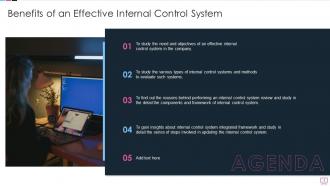
Slide 2: This slide states Agenda of the presentation.
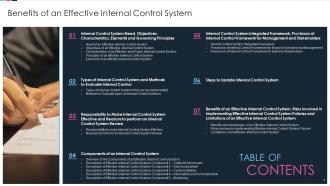
Slide 3: This slide presents Table of Content for the presentation.
Slide 4: This slide highlights title for topics that are to be covered next in the template.
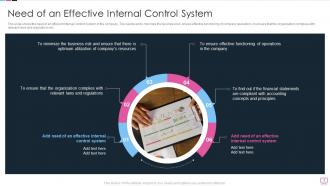
Slide 5: This slide shows the need of an efficient Internal Control System in the company.
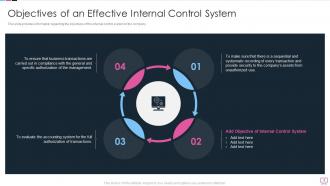
Slide 6: This slide provides information regarding the objectives of the internal control system in the company.
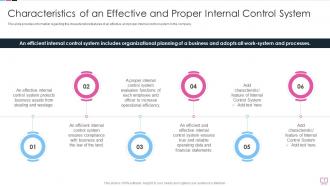
Slide 7: This slide provides information regarding the characteristics/features of an effective and proper internal control system in the company.
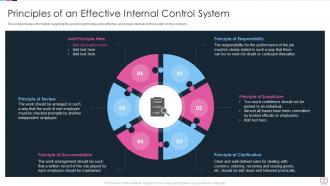
Slide 8: This slide provides information regarding the governing principles of an effective and proper internal control system in the company.
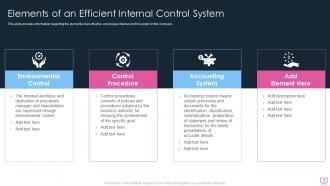
Slide 9: This slide provides information regarding the elements of an effective and proper internal control system in the company.
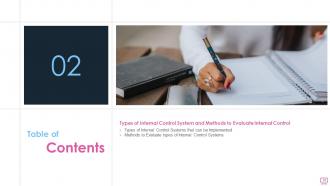
Slide 10: This slide highlights title for topics that are to be covered next in the template.
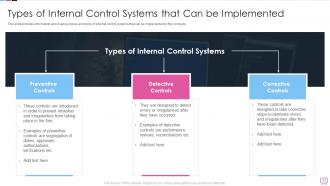
Slide 11: This slide provides information about various types and kinds of internal control systems that can be implemented by the company.
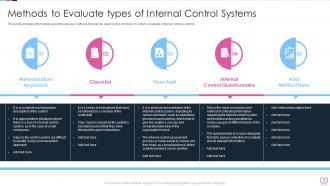
Slide 12: This slide provides information about the various methods that can be used by the company in order to evaluate internal control systems.
Slide 13: This is a Table of Contents slide for Effective Internal Control System to minimize Business Risks & increase Operational Efficiency & Effectiveness
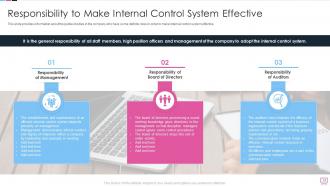
Slide 14: This slide provides information about the parties/bodies in the company who have some definite roles in order to make internal control system effective.
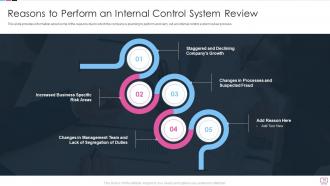
Slide 15: This slide provides information about some of the reasons due to which the company is planning to perform and carry out an internal control system review process.
Slide 16: This slide highlights title for topics that are to be covered next in the template.
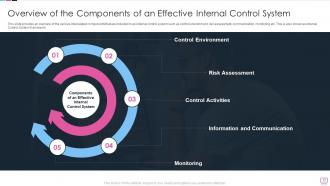
Slide 17: This slide provides an overview of the various interrelated components that are included in an internal control system.
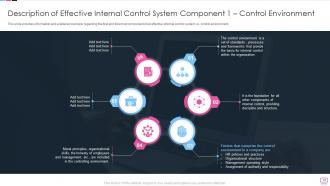
Slide 18: This slide provides information and a detailed overview regarding the first and foremost component of an effective internal control system i.e. control environment.
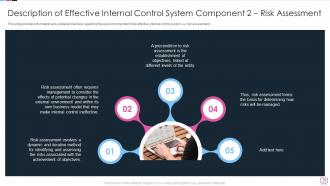
Slide 19: This slide provides information and a detailed overview regarding the second component of an effective internal control system i.e. risk assessment.
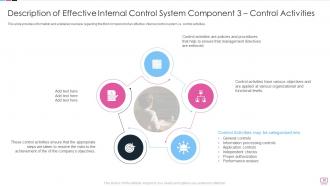
Slide 20: This slide provides information and a detailed overview regarding the third component of an effective internal control system i.e. control activities.
Slide 21: This slide provides information and a detailed overview regarding the fourth component of an effective internal control system i.e. information and communication.
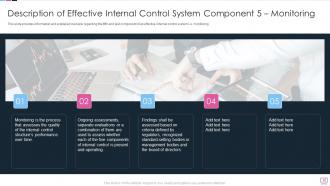
Slide 22: This slide provides information and a detailed overview regarding the fifth and last component of an effective internal control system i.e. monitoring.
Slide 23: This slide presents Internal Control System Integrated Framework, Provisions of Internal Control Framework for Management and Stakeholders
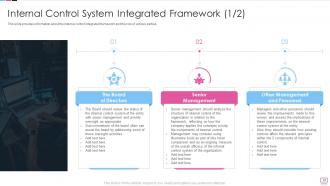
Slide 24: This slide provides information about the internal control integrated framework and the role of various parties.
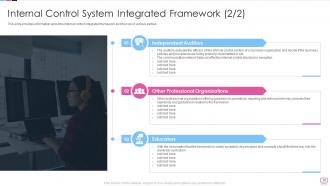
Slide 25: This slide provides information about the internal control integrated framework and the role of various parties.
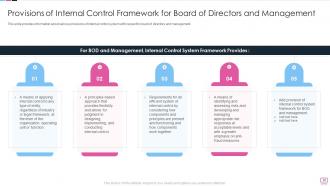
Slide 26: This slide provides information about various provisions of internal control system with respect to board of directors and management.
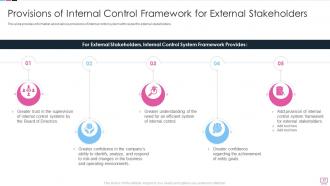
Slide 27: This slide provides information about various provisions of internal control system with respect to external stakeholders.
Slide 28: This slide presents Steps to Update Internal Control System
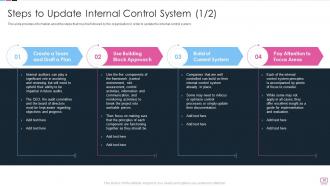
Slide 29: This slide provides information about the steps that must be followed by the organization in order to update the internal control system.
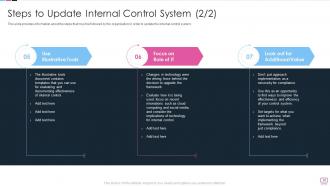
Slide 30: This slide provides information about the steps that must be followed by the organization in order to update the internal control system.
Slide 31: This slide showcases Benefits of an Effective Internal Control System, and Risks involved in implementing Effective Internal Control System Policies.
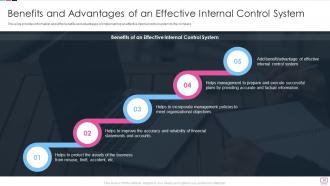
Slide 32: This slide provides information about the benefits and advantages of implementing an effective internal control system to the company.
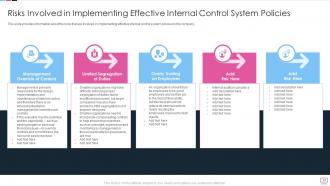
Slide 33: This slide provides information about the risks that are involved in implementing effective internal control system policies to the company.
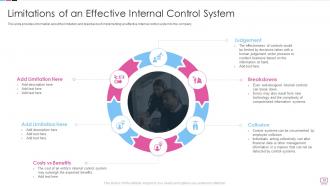
Slide 34: This slide provides information about the limitation and drawbacks of implementing an effective internal control system to the company.
Slide 35: This slide displays Icons for Benefits of an effective Internal Control System.
Slide 36: This slide is titled as Additional Slides for moving forward.
Slide 37: This slide shows Post It Notes. Post your important notes here.
Slide 38: This slide contains Puzzle with related icons and text.
Slide 39: This is an Idea Generation slide to state a new idea or highlight information, specifications etc.
Slide 40: This slide showcases Magnifying Glass to highlight information, specifications, etc.
Slide 41: This slide depicts Venn diagram with text boxes.
Slide 42: This is Our Target slide. State your targets here.
Slide 43: This slide provides 30 60 90 Days Plan with text boxes.
Slide 44: This is a Thank You slide with address, contact numbers and email address.
Benefits Of An Effective Internal Control System Powerpoint Presentation Slides with all 49 slides:
Use our Benefits Of An Effective Internal Control System Powerpoint Presentation Slides to effectively help you save your valuable time. They are readymade to fit into any presentation structure.












FAQs for Benefits Of An Effective Internal Control System
The primary objectives of an internal control system include safeguarding assets, ensuring accurate financial reporting, promoting operational efficiency, maintaining regulatory compliance, and preventing fraud. These comprehensive frameworks enhance organizational transparency, streamline processes, and minimize risks across departments, with many companies finding that robust internal controls ultimately deliver improved decision-making capabilities and sustained competitive advantage.
An effective internal control system enhances financial reporting accuracy by implementing segregation of duties, automated verification processes, and regular reconciliation procedures that minimize human error and fraud risks. These systematic controls enable organizations to detect discrepancies early, maintain consistent accounting standards, and ensure regulatory compliance, ultimately delivering more reliable financial statements and increased stakeholder confidence.
Internal control systems help prevent and detect fraud through segregation of duties, authorization protocols, regular audits, documentation requirements, and monitoring mechanisms. These controls create multiple checkpoints that make fraudulent activities difficult to execute and conceal, with many organizations finding that robust internal controls significantly reduce financial losses while enhancing operational transparency and regulatory compliance.
Internal controls contribute to operational efficiency by standardizing processes, reducing errors, and streamlining workflows across departments. These systems enable businesses to automate routine tasks, minimize redundancies, and accelerate decision-making through clear protocols, with many organizations finding that structured controls ultimately deliver faster processing times, reduced operational costs, and enhanced resource allocation.
Risk assessment serves as the foundation for designing internal control systems by identifying potential threats, evaluating their likelihood and impact, and prioritizing control measures accordingly. This systematic approach enables organizations to allocate resources strategically, design targeted controls for high-risk areas, and create layered defenses that address operational, financial, and compliance vulnerabilities, ultimately delivering more effective risk mitigation and enhanced organizational resilience.
Technology strengthens internal control systems by automating compliance monitoring, implementing real-time transaction tracking, and providing advanced analytics for risk detection. Through cloud-based platforms and AI-powered tools, organizations streamline audit processes, enhance data accuracy, and minimize human error, while delivering faster reporting and improved regulatory compliance across all operational levels.
A weak internal control system erodes stakeholder trust through increased fraud risk, financial reporting errors, regulatory non-compliance, and operational inefficiencies that signal poor governance. These vulnerabilities ultimately lead to damaged investor confidence, reduced credit ratings, higher borrowing costs, and potential regulatory sanctions, with many organizations finding that rebuilding stakeholder trust requires significantly more resources than maintaining robust controls.
Regular review and testing of internal controls enhances their effectiveness by identifying gaps, ensuring compliance with evolving regulations, and adapting to changing business processes. Through systematic audits and monitoring, organizations can detect weaknesses before they become costly problems, streamline operational efficiency, and maintain stakeholder confidence, ultimately delivering stronger risk management and competitive advantage.
Preventive controls stop issues before they occur through authorization requirements, segregation of duties, and access restrictions, while detective controls identify problems after they happen using reconciliations, reviews, and monitoring systems. Corrective controls address identified issues through error correction procedures, disciplinary actions, and process improvements, with many organizations finding that combining all three types creates comprehensive risk management and operational efficiency.
An internal control system facilitates regulatory compliance by establishing standardized procedures, automated monitoring processes, and comprehensive documentation trails that align with regulatory frameworks. These systems enable organizations to consistently track transactions, generate accurate reports, and identify potential violations before they occur, while streamlining audit preparations and ultimately reducing compliance costs and regulatory risks.
Companies should establish clear governance structures, define roles and responsibilities, implement robust policies and procedures, create comprehensive risk assessment frameworks, and foster a strong ethical culture. Through regular training, transparent communication channels, and consistent monitoring mechanisms, organizations streamline operations, enhance compliance, and minimize operational risks, with many finding that systematic internal controls ultimately deliver improved financial accuracy and competitive advantage.
Employee training enhances internal control effectiveness by building awareness of policies, improving risk identification skills, and ensuring consistent procedure implementation across departments. Through comprehensive training programs, organizations strengthen compliance culture, reduce human error rates, and empower staff to recognize potential control weaknesses, ultimately delivering stronger governance and operational efficiency.
Internal control system success metrics include control deficiency rates, audit findings frequency, compliance scores, process efficiency ratios, and error detection timelines. These benchmarks enable organizations to measure operational effectiveness, regulatory adherence, and risk mitigation capabilities, with many financial institutions and healthcare organizations finding that regular metric tracking delivers enhanced transparency, reduced operational costs, and stronger stakeholder confidence.
Internal controls adapt to business environment changes by implementing flexible frameworks, conducting regular risk assessments, and maintaining continuous monitoring systems. Through scalable technologies and cross-functional collaboration, organizations can quickly adjust control mechanisms for new markets, regulatory requirements, and operational shifts, while automated monitoring enables real-time detection of emerging risks, ultimately delivering enhanced responsiveness and sustained compliance.
Organizations face challenges including resource allocation constraints, employee resistance to new processes, complex regulatory compliance requirements, technology integration difficulties, and ongoing monitoring demands. While these obstacles can be significant, many companies find that systematic implementation approaches, comprehensive staff training, and strategic automation investments ultimately streamline operations and deliver enhanced transparency, regulatory compliance, and competitive advantage.
-
The quality of PowerPoint templates I found here is unique and unbeatable. Keep up the good work and continue providing us with the best slides!
-
“There is so much choice. At first, it seems like there isn't but you have to just keep looking, there are endless amounts to explore.”