


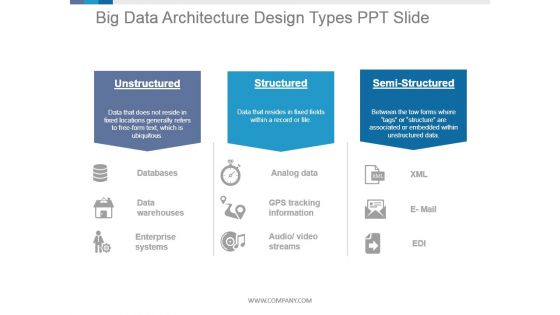
Big data architecture design types ppt slide





Try Before you Buy Download Free Sample Product
 Impress Your
 Audience
 100%
100% Editable
 Save Hours
 of Time


Our Big Data Architecture Design Types Ppt Slide are an enviable collection. They will make you feel genuinely glad.
People who downloaded this PowerPoint presentation also viewed the following :
Big data architecture design types ppt slide with all 5 slides:
Embellish your thoughts by using our Big Data Architecture Design Types Ppt Slide. They will help you illustrate the brilliance of your ideas.
FAQs for Big data architecture design
Primary components of big data architecture include data ingestion layers, distributed storage systems, processing frameworks, analytics engines, and visualization tools. These technologies streamline operations by enabling real-time data capture, scalable storage solutions, and advanced analytics capabilities, with organizations across retail, healthcare, and finance finding that integrated architectures deliver faster insights and enhanced decision-making processes.
Different big data architecture types significantly impact processing speed through varied approaches: batch processing delivers high throughput for large datasets, stream processing enables real-time analysis, lambda architecture combines both for comprehensive coverage, and hybrid models optimize specific workloads. Financial institutions increasingly leverage stream processing for fraud detection while manufacturers use batch processing for quality analytics, ultimately delivering faster insights and competitive advantage.
Distributed file systems serve as the foundational storage layer in big data architecture, enabling scalable data storage, fault tolerance, and parallel processing across multiple nodes. They facilitate seamless data distribution, replication, and retrieval while supporting frameworks like Hadoop and Spark, with organizations in retail, finance, and healthcare leveraging these systems to process vast datasets efficiently and maintain competitive advantage.
The choice between SQL and NoSQL databases significantly influences big data architecture by determining scalability approaches, data consistency models, and processing capabilities. SQL databases deliver structured transaction processing and complex queries with ACID compliance, while NoSQL enables horizontal scaling and flexible schema design, with many organizations finding that hybrid architectures combining both approaches optimize performance across diverse data workloads and business requirements.
Lambda architecture delivers real-time processing capabilities alongside comprehensive batch analytics, enabling organizations to handle both immediate insights and historical data analysis simultaneously. This dual-processing approach streamlines operations by providing low-latency responses for time-sensitive applications while maintaining data accuracy through batch corrections, ultimately delivering enhanced decision-making speed and operational efficiency.
Streaming data architectures process information in real-time as it arrives, enabling immediate analysis and responses, while batch processing architectures collect and analyze data in scheduled intervals or large chunks. Through streaming systems, organizations like financial institutions detect fraud instantly, retailers personalize customer experiences dynamically, and manufacturers monitor equipment continuously, ultimately delivering faster decision-making and competitive advantages over traditional batch approaches.
**INPUT**: What considerations should be taken into account when designing for scalability in big data architecture? **OUTPUT**: Scalability considerations include horizontal scaling capabilities, data partitioning strategies, load balancing mechanisms, storage elasticity, and processing framework selection. These architectural decisions enable organizations to handle growing data volumes seamlessly, with many enterprises finding that strategic combinations of cloud infrastructure, distributed computing, and automated resource allocation ultimately deliver cost-effective expansion and sustained performance. **Word count: 55 words**
Cloud-based solutions transform traditional big data architectures by enabling scalable storage, on-demand processing power, and seamless integration across distributed systems. These platforms streamline data management through automated scaling, reduced infrastructure costs, and enhanced accessibility, with organizations in retail, healthcare, and financial services finding significantly faster deployment times and improved operational efficiency.
Critical security measures include data encryption at rest and in transit, robust access controls and authentication protocols, network segmentation, data masking techniques, and comprehensive audit logging systems. These security frameworks work together by protecting sensitive information across distributed environments, ensuring compliance with regulatory requirements, and enabling real-time threat detection, with many financial services and healthcare organizations finding that layered security approaches ultimately deliver both data protection and operational confidence.
Microservices architecture enhances big data applications by enabling independent scaling of components, facilitating fault isolation, and allowing technology diversity across services. This approach streamlines data processing workflows through modular deployment, reduces system-wide failures, and accelerates development cycles, with many organizations finding that decoupled services ultimately deliver greater operational flexibility and faster innovation.
Data ingestion varies significantly across architectures, with batch processing collecting data in scheduled intervals, real-time streaming processing data continuously, and hybrid models combining both approaches. Lambda architectures separate batch and stream processing paths, while Kappa architectures use unified streaming, with many organizations finding that choosing the right ingestion method ultimately determines system performance and business responsiveness.
ETL processes data before loading into storage systems, ensuring data quality but requiring longer processing times, while ELT loads raw data first then transforms it within the target system, offering faster ingestion and scalability. ELT particularly benefits cloud-based environments and real-time analytics, with many organizations finding that modern data warehouses deliver better performance for complex transformations, ultimately enabling faster insights.
Real-time data analytics significantly changes big data architecture requirements by demanding low-latency processing, continuous data ingestion, and immediate response capabilities rather than traditional batch processing approaches. This shift necessitates streaming technologies like Apache Kafka and Storm, in-memory computing solutions, and distributed processing frameworks, with many financial services and e-commerce companies finding that these architectures enable instant fraud detection, dynamic pricing, and personalized customer experiences, ultimately delivering competitive advantage through immediate business insights.
Data governance plays a foundational role in shaping big data architecture by establishing data quality standards, security protocols, compliance frameworks, and access controls that directly influence architectural design decisions. These governance requirements drive organizations to implement specific storage solutions, processing workflows, and integration patterns, with many financial services and healthcare institutions finding that robust governance frameworks ultimately enable faster regulatory compliance, improved data reliability, and enhanced operational efficiency.
Big data architectures adapt to industry requirements through specialized security protocols, compliance frameworks, and processing methodologies tailored to sector-specific regulations like HIPAA for healthcare or SOX for finance. Banks leverage real-time fraud detection architectures, while healthcare institutions utilize batch processing for patient analytics and retail companies implement hybrid models for inventory optimization, ultimately delivering regulatory compliance and competitive advantage across diverse operational environments.
-
Excellent work done on template design and graphics.
-
Nice and innovative design.