

Big data types information technology ppt sample





Try Before you Buy Download Free Sample Product
 Impress Your
 Audience
 100%
100% Editable
 Save Hours
 of Time


Your brilliance becomes evident due to our Big Data Types Information Technology Ppt Sample. It helps highlight your exceptional ability.
People who downloaded this PowerPoint presentation also viewed the following :
Big data types information technology ppt sample with all 5 slides:
Create better facilities for development with our Big Data Types Information Technology Ppt Sample. They always aim to empower.

FAQs for Big data types information
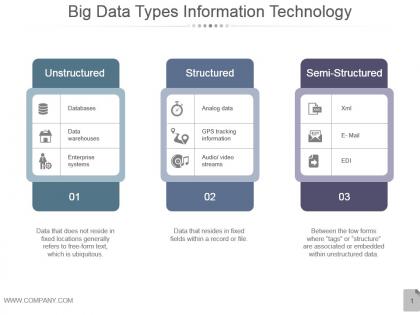
The three main types of big data are structured data (organized in databases and spreadsheets), semi-structured data (XML, JSON files with some organization), and unstructured data (emails, videos, social media content). These types differ significantly in their organization and processing requirements, with structured data being easiest to analyze while unstructured data, though more complex, often delivers the richest insights for customer behavior and market trends.
Structured data significantly enhances data analysis effectiveness by enabling faster processing, automated analysis, and seamless integration with traditional analytical tools and databases. Through consistent formats and predefined schemas, organizations across sectors like retail, finance, and healthcare can quickly generate reports, perform statistical analysis, and derive actionable insights, ultimately delivering improved decision-making speed and operational efficiency.
Unstructured data plays a pivotal role in modern business intelligence by providing deeper customer insights, predictive analytics capabilities, and competitive intelligence through sources like social media, emails, and customer feedback. Organizations across retail, healthcare, and financial services increasingly leverage text analytics and machine learning to transform this data into actionable insights, ultimately enhancing decision-making and operational efficiency.
Semi-structured data includes JSON files, XML documents, email messages, web logs, and social media posts that contain organizational tags but lack rigid database schemas. This data type proves crucial for big data analytics because it bridges structured databases and unstructured content, enabling organizations to extract valuable insights from diverse sources like customer interactions, website behavior, and IoT sensors, ultimately delivering enhanced business intelligence and competitive advantage.
Big data variety significantly impacts storage solutions by requiring hybrid architectures, specialized databases, and flexible schemas to accommodate structured, semi-structured, and unstructured formats. Organizations increasingly deploy multi-tiered storage systems, cloud-native solutions, and data lakes, with many financial services and healthcare institutions finding that diverse storage strategies ultimately enhance analytics capabilities while optimizing costs.
Processing unstructured data presents challenges including inconsistent formats, lack of standardization, complex extraction requirements, scalability issues, and integration difficulties with existing systems. While these obstacles require sophisticated analytics tools and specialized expertise, organizations in healthcare, finance, and retail are increasingly finding that strategic investments in advanced processing technologies ultimately deliver competitive advantages and deeper customer insights.
Data types significantly influence framework selection, with Hadoop excelling at batch processing structured data and large-scale storage, while Spark optimizes real-time processing of unstructured data through in-memory computing. Organizations handling mixed data types increasingly adopt hybrid approaches, with financial services leveraging Spark for real-time fraud detection and Hadoop for historical analysis, ultimately delivering faster insights and operational efficiency.
Real-time data types enable businesses in fast-paced industries to make immediate decisions, detect anomalies instantly, and respond to market changes within seconds rather than hours or days. Through streaming analytics and real-time processing, organizations in trading, healthcare, and retail deliver faster customer responses, minimize operational risks, and maintain competitive advantages in increasingly dynamic markets.
Big data types significantly impact governance and compliance by creating complex regulatory requirements across structured financial records, unstructured communications, and real-time transaction streams. Organizations must implement type-specific retention policies, access controls, and audit trails, with financial institutions and healthcare providers finding that structured governance frameworks enable regulatory compliance while streamlining data management processes.
**INPUT**: What tools and technologies are best suited for working with different types of big data? **OUTPUT**: Big data tools include Hadoop for distributed storage, Spark for real-time processing, NoSQL databases for unstructured data, Apache Kafka for streaming, and machine learning platforms like TensorFlow. These technologies streamline analytics by handling volume, velocity, and variety challenges, with many organizations finding that strategic combinations ultimately deliver faster insights and competitive advantage. **Word count: 54 words**
Data lakes accommodate various big data types by providing a centralized repository that stores structured, semi-structured, and unstructured data in their native formats without requiring upfront transformation. This flexible architecture enables organizations to collect vast amounts of diverse information from multiple sources, streamline data integration processes, and reduce storage costs, ultimately delivering faster analytics capabilities and competitive advantages across industries like healthcare, finance, and retail.
Big data types significantly influence machine learning model training by determining preprocessing requirements, algorithm selection, computational resources, and feature engineering approaches. Structured data from financial services enables faster training cycles, while unstructured data from healthcare imaging requires specialized neural networks and extensive processing power, ultimately affecting deployment scalability, model accuracy, and operational costs across organizations.
Businesses leverage big data types by combining structured transaction data with unstructured social media insights and semi-structured web analytics to enhance customer targeting, optimize operations, and predict market trends. This strategic integration enables companies to deliver personalized experiences, streamline supply chains, and make data-driven decisions faster than competitors, ultimately achieving significant operational efficiency and market differentiation.
Ethical considerations include informed consent for data collection, transparency in usage policies, data anonymization to protect privacy, secure storage protocols, and equitable algorithmic decision-making across demographics. These frameworks become increasingly critical as healthcare organizations, financial institutions, and retail companies leverage personal data for predictive analytics, with many finding that proactive ethical governance ultimately delivers stronger customer trust and competitive advantage.
IoT devices generate massive volumes of structured sensor data, semi-structured log files, and unstructured multimedia content, fundamentally expanding traditional big data classifications. These connected systems enable real-time analytics across manufacturing, healthcare, and smart cities, with organizations increasingly leveraging streaming data processing and edge computing to deliver faster insights, reduce latency, and enhance operational efficiency.
-
Great quality slides in rapid time.
-
Much better than the original! Thanks for the quick turnaround.