

Binary Cycle Geothermal Power Plant Geothermal Energy IT




Try Before you Buy Download Free Sample Product
 Impress Your
 Audience
 100%
100% Editable
 Save Hours
 of Time


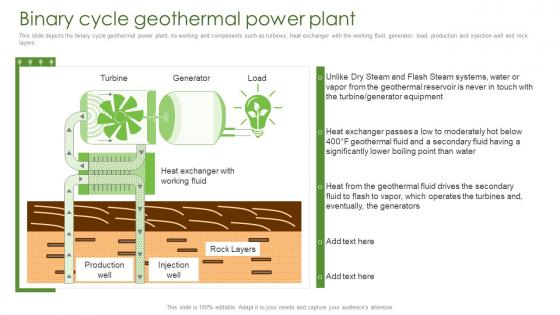
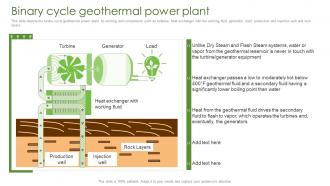
This slide depicts the binary cycle geothermal power plant, its working and components such as turbines, heat exchanger with the working fluid, generator, load, production and injection well and rock layers.
People who downloaded this PowerPoint presentation also viewed the following :
Binary Cycle Geothermal Power Plant Geothermal Energy IT with all 6 slides:
Use our Binary Cycle Geothermal Power Plant Geothermal Energy IT to effectively help you save your valuable time. They are readymade to fit into any presentation structure.





FAQs for Binary Cycle Geothermal Power Plant
Binary cycle geothermal systems operate by using moderate-temperature geothermal fluid to heat a secondary working fluid with a lower boiling point, which then vaporizes to drive turbines for electricity generation. This approach enables power generation from lower-temperature geothermal resources, expanding geothermal energy applications across diverse geographical regions while delivering enhanced efficiency and reduced environmental impact.
Binary cycle systems use lower-temperature geothermal resources through a secondary working fluid with a lower boiling point, unlike traditional systems that directly use high-temperature steam or water. This approach enables geothermal energy development in more locations with moderate temperatures, ultimately expanding renewable energy access while reducing geographical limitations that restrict conventional geothermal installations.
Binary cycle technology offers enhanced efficiency, lower temperature requirements, reduced environmental impact, increased resource accessibility, and improved operational flexibility for geothermal energy production. This approach enables power generation from moderate-temperature resources previously considered unviable, with many utility companies finding that binary systems deliver consistent baseload power while minimizing water consumption and emissions.
Binary cycle geothermal energy proves most effective in regions with moderate geothermal resources, including the western United States, Iceland, New Zealand, parts of Italy, and geothermally active areas of Indonesia and the Philippines. These technologies enable power generation from lower-temperature resources by utilizing efficient heat transfer systems, with many developing nations finding that binary cycles expand their renewable energy capacity while delivering cost-effective electricity generation.
Binary cycle geothermal systems commonly use organic working fluids like isobutane, isopentane, ammonia, and various refrigerants such as R-245fa and R-134a. These fluids are chosen because they have low boiling points that enable efficient heat transfer from geothermal brine, enhanced thermal efficiency across varying temperature ranges, and operational stability, ultimately delivering reliable power generation with minimal environmental impact.
Higher geothermal resource temperatures significantly enhance binary cycle plant efficiency by enabling greater heat transfer to the working fluid, improved thermodynamic cycle performance, and increased electricity generation per unit of geothermal fluid. Through advanced heat exchangers and optimized working fluids, power plants operating with resources above 150°C achieve substantially higher capacity factors, reduced operational costs, and enhanced economic viability, ultimately delivering stronger returns on investment in an increasingly competitive renewable energy landscape.
Environmental considerations for binary cycle geothermal energy include groundwater protection, surface land impact, induced seismicity risks, air quality management, and ecosystem preservation around geothermal sites. While binary systems minimize direct emissions compared to traditional power generation, operators must monitor subsurface fluid management, wildlife habitat disruption, and long-term reservoir sustainability, ultimately delivering cleaner energy with proper environmental stewardship.
Binary cycle geothermal systems significantly reduce carbon emissions by utilizing naturally occurring underground heat instead of combustion, producing virtually zero direct greenhouse gases during operation. These systems enable power generation with emissions roughly 95% lower than coal-fired plants, with geothermal facilities across industries like utilities and manufacturing finding that this clean baseload energy delivers consistent renewable power while minimizing environmental impact.
Binary cycle geothermal plants typically require higher upfront capital costs than solar or wind projects, ranging from $2,500-4,000 per kW compared to $1,000-2,000 per kW for renewables. However, these systems deliver significantly lower operational costs, higher capacity factors exceeding 90%, and consistent baseload power generation, with many energy developers finding that long-term operational savings ultimately offset initial investments.
Technology advancement enhances binary cycle geothermal efficiency through improved heat exchangers, advanced working fluids, and optimized turbine designs, enabling better heat transfer and power generation from lower-temperature resources. These innovations streamline operations by reducing maintenance requirements, increasing power output, and expanding viable geothermal sites, with many energy companies finding significantly improved project economics and competitive renewable energy costs.
Binary cycle geothermal energy integrates into existing grids through advanced power conditioning systems, grid-tie inverters, smart metering technology, and automated load balancing controls that ensure seamless connectivity. These systems enable utilities to incorporate geothermal baseload power while maintaining grid stability, with many energy companies finding that binary cycle plants deliver consistent 24/7 generation, reduced transmission losses, and enhanced grid reliability in increasingly complex energy markets.
Binary cycle geothermal energy projects face challenges including high upfront capital costs, lengthy permitting processes, resource assessment uncertainties, transmission infrastructure requirements, and technical complexity in fluid management systems. While these obstacles present initial hurdles, many energy companies find that strategic partnerships, government incentives, and advancing drilling technologies increasingly streamline deployment, ultimately delivering renewable baseload power and long-term operational cost advantages.
Binary cycle systems typically achieve 10-13% thermal efficiency compared to 15-20% for flash steam systems, but excel in lower-temperature resources where flash systems cannot operate effectively. While binary cycles may have lower peak efficiency, they enable geothermal development in broader geographic areas and deliver consistent baseload power with minimal environmental impact, ultimately expanding renewable energy access for utilities and industrial facilities.
Binary cycle geothermal energy presents exceptional long-term sustainability prospects through renewable heat sources, minimal environmental impact, consistent baseload power generation, and decades-long operational lifecycles. These systems enable continuous electricity production with significantly lower carbon emissions than fossil fuels, while geothermal reservoirs naturally replenish, with many power plants finding operational lifespans exceeding thirty years.
Regulatory policies significantly impact binary cycle geothermal development through permitting requirements, environmental assessments, land use approvals, and interconnection standards for grid access. These frameworks can either streamline or complicate project timelines, with many energy companies finding that supportive policies in states like California and Nevada accelerate deployment, while complex regulatory environments may delay investment, ultimately affecting competitive positioning in renewable energy markets.
-
It is my first time working with them and that too on a friend's recommendation. I would say, I am not expecting such a worldly service at this low price.
-
Thank you SlideTeam for such an excellent service.