

Blockchains Impact On Education Enhancing Top Methods For Online Identity Verification BCT SS V





Try Before you Buy Download Free Sample Product
 Impress Your
Audience
 100%
Editable
 Save Hours
of Time


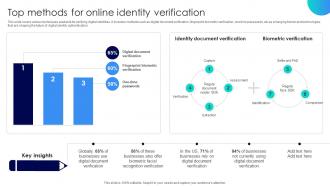
This slide covers various techniques available for verifying digital identities. It includes methods such as digital document verification, fingerprint biometric verification, one time passwords, etc as emerging trends and technologies that are shaping the future of digital identity authentication.
People who downloaded this PowerPoint presentation also viewed the following :
Blockchains Impact On Education Enhancing Top Methods For Online Identity Verification BCT SS V with all 10 slides:
Use our Blockchains Impact On Education Enhancing Top Methods For Online Identity Verification BCT SS V to effectively help you save your valuable time. They are readymade to fit into any presentation structure.









FAQs for Blockchains Impact On Education Enhancing Top Methods For Online Identity Verification
Blockchain technology enhances academic credential security by creating immutable, tamper-proof digital records that eliminate forgery, enable instant verification, and provide decentralized storage across multiple nodes. Universities and employers increasingly find that blockchain-based credentials streamline hiring processes, reduce verification costs, and deliver greater trust in academic achievements, ultimately providing institutions with competitive advantage in credential management.
Blockchain enhances educational transparency by creating immutable records of academic credentials, financial transactions, research data, and institutional governance decisions. Through distributed ledger technology, universities and schools can provide stakeholders with verifiable access to degree authenticity, funding allocation, and administrative processes, ultimately building greater trust and accountability in educational systems.
Blockchain facilitates student identity verification through immutable digital credentials, cryptographic authentication, decentralized identity management, and tamper-proof academic records that eliminate fraudulent enrollment. Universities and online education platforms can streamline admissions processes, reduce verification costs, and enhance security, with institutions like MIT and IBM finding that blockchain-based identity systems deliver faster credential validation and improved trust in remote learning environments.
Smart contracts can revolutionize educational financing by automating tuition payments, enabling milestone-based funding releases, and creating transparent scholarship distributions. Through blockchain technology, universities and educational institutions streamline payment processing, reduce administrative costs, and enable innovative funding models like income-share agreements, ultimately delivering faster transactions and enhanced financial transparency for students and institutions alike.
Decentralized learning records offer enhanced security, universal accessibility, student ownership of credentials, reduced verification costs, and elimination of fraudulent certificates. Through blockchain technology, students maintain portable, tamper-proof academic histories while employers streamline hiring processes with instant credential verification, ultimately delivering greater trust and efficiency in educational credentialing systems.
Blockchain enables secure, tamper-proof tracking of skills and certifications by creating immutable digital records, automated verification systems, and decentralized credential networks that eliminate fraud risks. Educational institutions, professional organizations, and employers increasingly leverage these transparent ledgers to streamline credential verification processes, reduce administrative costs, and deliver instantly verifiable qualifications, ultimately enhancing trust in educational achievements.
Educators face challenges including technical complexity requiring specialized knowledge, high implementation costs for infrastructure and training, regulatory uncertainty around data privacy compliance, and resistance to change from traditional institutions. However, these obstacles present opportunities for professional development, strategic partnerships with technology providers, and gradual pilot programs, with many educational institutions finding that phased implementation approaches ultimately deliver enhanced credential verification and improved administrative efficiency.
Blockchain supports lifelong learning by creating permanent, tamper-proof records of all educational achievements, from formal degrees to micro-credentials, professional certifications, and skill-based training throughout one's career. This comprehensive digital portfolio enables seamless verification across institutions and employers, with many professionals finding that blockchain credentials streamline job transitions and career advancement opportunities.
Blockchain enables students to control their educational data through decentralized storage, cryptographic security, and selective sharing permissions, while reducing institutional data breaches. Through blockchain-based credentialing systems, universities and schools can provide students with portable, verifiable records that enhance privacy protection and data ownership, ultimately delivering greater transparency and control over personal academic information.
Blockchain-based platforms enable educational institutions to collaborate by creating secure, transparent networks for sharing academic credentials, research data, course materials, and student records across institutional boundaries. Through immutable verification systems, universities and colleges can streamline credit transfers, joint degree programs, and resource pooling initiatives, ultimately reducing administrative costs while enhancing educational accessibility and institutional partnerships globally.
Blockchain in personalized learning could enable secure, portable learning credentials that follow students across institutions, adaptive smart contracts that automatically unlock content based on mastery, and decentralized peer-to-peer tutoring networks with transparent reputation systems. These applications streamline credential verification, enhance personalized pathways, and create trusted learning ecosystems, with educational institutions increasingly finding that blockchain delivers greater transparency, reduced administrative costs, and improved student experiences.
Blockchain reduces administrative costs by automating credential verification, streamlining student record management, and eliminating intermediary processing fees through smart contracts. Universities and colleges implementing blockchain systems significantly minimize manual verification processes, reduce transcript fraud investigations, and accelerate degree authentication, ultimately delivering faster administrative services while lowering operational overhead costs.
Blockchain enhances global educational accessibility by creating decentralized learning platforms, enabling cross-border credential verification, and reducing costs through peer-to-peer resource sharing. This technology streamlines access to quality education in underserved regions, with many international institutions finding that blockchain-based systems deliver more equitable learning opportunities and seamless academic mobility worldwide.
Blockchain enables secure, verifiable micro-credential systems by creating tamper-proof digital certificates, streamlining cross-institutional recognition, and establishing decentralized verification networks. Through distributed ledger technology, educational institutions, employers, and professional organizations can instantly authenticate specialized skills and competencies, while learners build portable credential portfolios that transcend traditional academic boundaries, ultimately delivering greater workforce flexibility and personalized career development pathways.
Ethical considerations include student privacy protection, data ownership clarity, consent management complexity, algorithmic transparency requirements, and equitable access concerns. While blockchain enhances data security and gives students greater control over their educational records, institutions must carefully balance transparency with privacy, ensuring vulnerable populations aren't disadvantaged by technological barriers, ultimately delivering responsible innovation.
-
“Slides are formally built and the color theme is also very exciting. This went perfectly with my needs and saved a good amount of time.”
-
The slides come with appealing color schemes and relevant content that helped me deliver a stunning presentation without any hassle!