


 0 Comment
 Customer Reviews

Time is what determines security. With enough time, nothing is unhackable!
Cyberattacks have become an omnipresent threat, targeting organizations across industries, from financial institutions to healthcare providers, and even governments. It is no longer a question of if a breach will occur, but when. In this digital age, where information is power, safeguarding your data isn't just a priority; it's a survival imperative.
With projections forecasting cybercrime to cost the global economy $10.5 trillion by 2025, reflecting a 15% increase year-on-year, businesses are more vulnerable than ever. Even large enterprises with substantial cybersecurity defenses can fall victim to the onslaught of cybercriminals.
Amidst this ever-evolving landscape of digital peril, we present a shield forged in the crucible of experience: Information Security Risk Assessment Templates.
In the battle against cyber threats, time is of the essence. Every moment wasted solving complex cybersecurity problems, struggling with complex risk assessment processes, and trying to make sense of scattered data is a moment where vulnerabilities persist. Our templates are the solution to this quandary. They offer a comprehensive, practical, and efficient approach to assessing and mitigating information security risks.
Our 100% customizable cyber security ppt templates offer the flexibility you need to adapt and protect. The content-ready framework gives you the structure required to safeguard your most valuable asset—your information.
Let's explore!
Risk Assessment and Management Plan For Information Security
This comprehensive PPT Deck empowers organizations to identify cybersecurity threats and mitigate them. Safeguarding critical data and organizational assets is crucial, and this presentation is your key to achieving that goal. Explore cybersecurity threats global firms face and gain insights into the systematic process of managing information security risks. The heart of this presentation lies in the Information Security Risk Management Plan, which aids in pinpointing vulnerable assets. It incorporates vulnerability ratings and risk assessment matrices to evaluate and prioritize risks.
Discover effective mitigation strategies to resolve security concerns and prevent data breaches. This PPT Bundle also provides guidance on employee training to equip your team to respond effectively to information security threats. Study the roles and responsibilities of the risk management team and understand the importance of budget allocation for cybersecurity risk management. It underscores the profound impact a robust risk management plan can have on enhancing an organization's information security capabilities.
Our template, consisting of 76 editable and content-ready slides, is a goldmine of knowledge. In this preview, we present the top 10, which are an absolute must-have for organizations seeking hands-on expertise in information security risk assessment and management.
Template 1: Current Information and Data Security Capabilities of the Firm
You can’t derive a solution to a problem without a prior assessment of the current situation. This section of our PPT Bundle helps evaluate your organization’s capacity to withstand cybersecurity threats. Cyberattacks your company faced the previous year highlighting vulnerabilities of all the departments are accounted for in this PPT Set. It also provides an inclusive ‘Gap Assessment’ to consolidate the derived insights. Download now!

Template 2: Overview of the Information Security Industry
Diving headfirst without judging the depth of the water is suicidal! The same goes for planning to defend against cyberattacks. This section of our PPT Deck provides you with a clear overview of the information security industry, its market growth, user spending, and the rising number of attacks (with categories) using a bar graph. Download now!

Template 3: Identifying Information Security Threats
This PPT Set discusses five major categories of information security threats: Malware, Phishing, SQL Injection, Zero-day Exploit, and Man-in-the-Middle Attack. It offers a framework to assess the financial impact of these threats concerning business disruption, information loss, revenue loss, equipment damage, and total cost of the attack. Download now!

Template 4: Process to Formulate Information Security Risk Assessment Plan: Identification of Information Assets
Our PPT Bundle explains the process of formulating the information security risk assessment plan in three stages. This PowerPoint Template explains the first stage: Identification of Information Assets. Here, you can list down your assets with subsequent sections explaining their descriptions and remarks. There’s a framework incorporated within this PPT Section where you can assign a criticality rating to these assets on a scale of 5 (5 being the highest and one being the lowest). Download now!

Template 5: Process to Formulate Information Security Risk Assessment Plan: Assessment of Information Security Risks
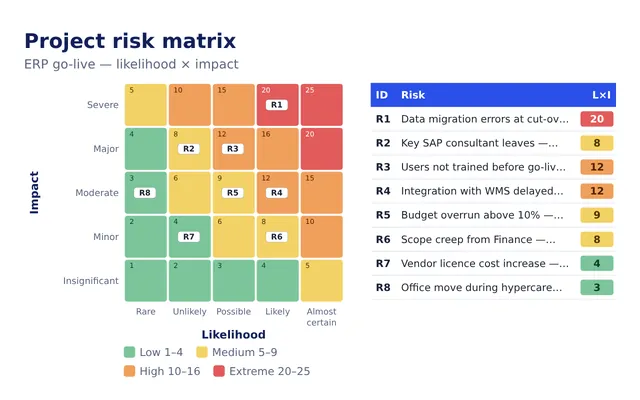
The second stage encompasses the assessment of information security risks. Here, you get a four-step process to perform this evaluation. Within this section, you get a layout for measuring the impact of the potential threats, and you can assign a vulnerability rating on a scale from 1 to 10. This PPT Set also features a risk assessment matrix with threat level. Get it today!

Template 6: Process to Formulate Information Security Risk Assessment Plan: Mitigating the Information Security Risk
Here’s the final stage, where you weave the threads of insights collected to stitch an effective mitigation strategy. This PPT Section presents an inclusive probability assessment matrix for risk management. It helps structure a mitigation plan for resolving encountered threats. Using these frameworks, you can build strategies to avoid information breaches, including strengthening firewalls., monitoring network traffic, preparing incident response plans, etc. Download now!

Template 7: Training for Monitoring and Managing Information Security Risk
Plans not put into action are just thoughts! Using this PPT Set, train your team for the apt execution of risk management strategies you’ve built throughout previous sections. This section helps identify the employees for the information security training program, allocates a budget for the training, and builds a timeline for the desired implementation of plans. Download now!

Template 8: Budget for Information Security Risk Management
When all the things are finalized, the only hurdle that’s left is allocating a budget. This PPT Design presents a pre-made structure you can use to point out the areas that will be targeted in risk management, their description, and the allocated budget. It helps bring all stakeholders on the same page before moving ahead with the process. Download now!

Template 9: Information Security Risk Management Challenges and Solutions
Information Security Risk Management is a topic too sophisticated to have no challenges! Planning for such a subject can present roadblocks that must be cleared to reach the destination, in this case, a strong security portfolio. This PPT Set explains the major challenges companies face and the solutions to implement to overcome them. Some pre-written challenges include: Fighting fraud, Internal vulnerabilities, Employee awareness, etc. Download now!

Template 10: Risk Management Dashboard for Information Security
Plans made, strategies devised, training given, budget finalized, and challenges tackled! All things done? Probably, yes! There’s an additional step! Without a measure of the performance of your effort invested in risk management, you can’t judge if this project was a success or a learning event! With the PPT Dashboard below, you can track top vulnerabilities, risk analysis progress, response progress for risk mitigation, and more. It presents a risk heat map with an action plan breakdown, giving you a clear picture of how your activities panned out on the real stage! Download now!

Templating Tomorrow's Security
With cyberattacks growing in sophistication and frequency, it is imperative to refrain from passive observation and proactively address this impending threat. The time to act is now, and these Information Security Risk Assessment Templates are your trusted companions on this journey. Information is your most valuable asset and your greatest vulnerability, and our PPT Layouts provide the means to safeguard it. Get them today!
FAQs on Information Security Risk Assessment
What is information security risk assessment?
Information security risk assessment is a systematic process organizations undertake to identify, evaluate, and prioritize potential threats and vulnerabilities to their information assets. These information assets include sensitive data, computer systems, networks, and other technology-related resources. The primary goal of a risk assessment is to understand the potential risks and their impact on an organization's confidentiality, integrity, and availability of information. It helps organizations make informed decisions about how to allocate resources to mitigate these risks and enhance their overall cybersecurity posture.
How do you conduct a risk assessment in information security?
Conducting a risk assessment in information security involves a structured approach to identify, assess, and manage potential risks. Here's a simplified overview of the process:
a. Define the Scope: Define what information assets, systems, and processes will be assessed.
b. Identify Assets: Identify and catalog the information assets within the defined scope.
c. Identify Threats: Enumerate potential threats and vulnerabilities that could impact the security of these assets. This includes external threats like hackers, internal threats like insider threats, and environmental threats like natural disasters.
d. Assess Risks: Evaluate the likelihood and potential impact of each identified threat. This involves assigning risk levels or scores.
e. Risk Prioritization: Prioritize risks based on their severity and potential impact on the organization's goals and objectives.
f. Mitigation Planning: Develop a plan to mitigate or manage identified risks. This involves implementing security controls, policies, and procedures to reduce the risk.
g. Monitor and Review: Continuously monitor and review the effectiveness of the risk mitigation measures. Risks evolve, and new threats may emerge, so ongoing assessment is crucial.
What are the five steps to risk assessment in information security?
The process of conducting a risk assessment in information security follows these five essential steps:
- Asset Identification: Identify and document all information assets that need protection. This includes data, hardware, software, networks, and even human resources.
- Threat Identification: Identify potential threats and vulnerabilities that could affect these assets. These threats can be external (e.g., hackers, malware), internal (e.g., employee errors or malfeasance), or environmental (e.g., natural disasters).
- Risk Analysis: Evaluate the likelihood and potential impact of each identified threat. This step involves assessing the probability of a threat occurring and the severity of its consequences.
- Risk Assessment: Combine the results of the risk analysis to calculate a risk rating for each identified threat. This rating helps prioritize risks based on their potential impact on the organization.
- Risk Mitigation: Develop a risk management plan that outlines how the organization will address and mitigate the identified risks. This may involve implementing security controls, policies, and procedures to reduce the risk to an acceptable level.