

 0 Comment
 Customer Reviews

A chill went down the spine of analysts in a data management firm when stakeholders asked for data related to a client that had been associated with the business for 13 years. The data was present in the database, but analysts could not figure out where. Additionally, outdated servers, forgotten backups, and inadequately labelled folders hindered clarity. The simple task of finding the client’s information triggered chaos and unprecedented audits across the enterprise. All these problems were avoidable, if the organization had adopted a structured data retention plan and deployed a reliable archival storage system.
Multiple organizations deal with extensive data that takes loads and loads of storage. In such an immense pile, it becomes tough to find accurate data. If an organization has to deal with a massive volume of information regularly, it becomes critical to adopt the practices of effective records management and information archiving.
However, it's easier said than done. When it comes to developing a data backup and archive plan, establishing a data storage strategy is complicated. This is where a data archiving strategy template can come to your rescue.
Present your data management strategy with polished, ready-to-use slides that make complex data visual and persuasive with the smart data management plan templates in this blog.
Whether you wish to establish an archival policy, long-term data preservation plan, or data lifecycle management approach, these documents bring accessibility, sustainability, and protection in data storage. Instead of developing a digital archiving strategy from scratch, the slides allow you to get your hands on a pre-designed records management framework.
SlideTeam’s 100% editable data archiving strategy templates are developed with the same purpose. These PPT Templates are ready-to-use documents that will allow you to get a practical, scalable, and professional data backup strategy in no time.
If you want to learn more about the offerings of these data compliance strategy templates, you can refer to those offered below.
Define rules, ensure compliance, and streamline data using the smart and effective data governance strategy templates provided in this blog.
Let’s explore!
Template 1: Data Archiving Strategy Template PPT Demonstration
When the matter of historical data storage is concerned, you need extensive planning and strategy. This is exactly what this PPT Framework offers. The presentation layout comes with supportive slides that define aspects of the data retention policy, including an overview. It also covers importance, challenges, objectives, types of data, legal compliances, retention policies, assessment landscapes, gap analysis, process of selecting the right tools, and every other element that may affect your archival storage system.
[product_image id=1485999]
Template 2: Data Archiving Strategy Overview
This PPT Template helps address your data archiving strategy in four parts. The first part is related to Data Retention, where you will explain to your audience what kind of data you plan to retain and why. The second part is associated with Access Control, which will define who will have access to the stored data and how. The third part is Compliance Check, where you can showcase the compliance you followed for secure data storage. And the last part is related to Cost Management, where you can evaluate and present the costs associated with information preservation.

Template 3: Importance of Data Archiving PPT Template
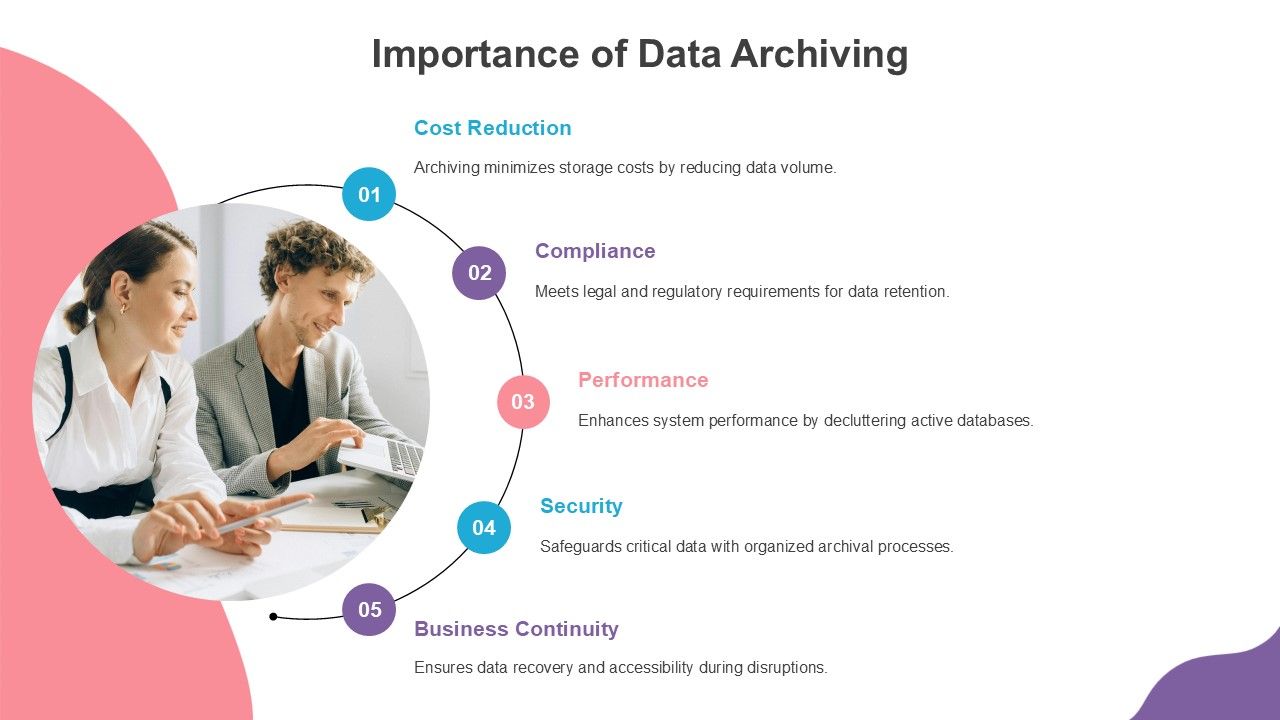
While presenting your case for data collection and storage, describing the importance of data archiving works in your favor. This extensive presentation template showcases aspects of data archiving, such as effective cost reduction, adherence to compliance, performance enhancements, better and advanced security, and ongoing business continuity. You can use texts to describe these advantages as necessary in the earmarked segments.
Template 4: Current Data Management Challenges PPT Template
Your target audience may be wondering: What’s wrong with the existing cloud archiving techniques and data management systems used in the organization? This PPT slide is your cue to showcase challenges with the existing system. Challenges can be related to extensive data volume, ineffective cost control, increasing compliance risks, risk of data redundancy, and other issues related to access control, data security, data retrieval, and resource allocation. You can describe these challenges as well if required.

Template 5: Legal and Compliance Considerations
When it comes to a third-party data storage strategy, concerns related to legal compliance are critical. This PowerPoint Slide allows you to describe the legal and compliance considerations you have planned to follow for long-term data preservation. These compliances can be associated with data privacy, regulatory compliance, retention policies, data access, audit trails, security measures, and legal notices.

Template 6: Data Retention Policies and Guidelines PPT Template
Usually, users are concerned about data retention policies and guidelines. This presentation layout will allow you to showcase data retention policies and guidelines way before questions as asked. You can state and describe policies related to review, compliance, duration, archiving, access, disposal, training, and audit. This information will bring peace of mind for your stakeholders and the upper management of the company.

Template 7: Archiving Solutions and Technologies
Here’s an extensive PPT Template that allows you to explain digital archiving solutions and technologies you have adopted in your organization. These solutions can be related to cloud storage, on-premise backup, data compression, automated archiving, encryption standards, and regular audits. You can use some text to explain how these technologies work and what they bring to the table for your organization with respect to the data retention plan.

Template 8: Implementing the Archiving Plan
Data or information archiving strategy is not a single, but a multi-step process that requires extensive attention. Even if one step is skipped or processed incorrectly, the system can fail. This presentation template protects you from such issues by streamlining the implementation process into a single document. The implementation process starts with the identification of data. Thereon, archiving data is determined, appropriate tools are selected, and a retention schedule is set up. Afterward, the actual data is archived, and access is tested before the review stage comes.

Template 9: Costs and Budgeting for Archiving
Whenever any new step is taken or new technology is introduced in an organization, stakeholders, investors, and top management are interested in costs associated with the change. This presentation template allows you to describe the costing structure of the new archival policy. In the tabular PPT template, you can state the costs associated with the archiving system year after year. If you have opted for a multi-year plan that welcomes discounts, you can reflect the same in the PowerPoint slide as well.

Template 10: Steps for Establishing Data Archiving Strategy PPT Template
Here’s an extensive PPT template that helps you showcase and establish steps involved in data archiving. The first step is related to inventorying and determining which data must be archived. Thereon, you can develop an all-inclusive data archiving policy that takes care of everything. Subsequently, you can proceed to select the perfect archiving tool. Once all these tasks are completed, you can get on to synchronize data archival and data lifecycle management terms. Finally, you can plan for regulatory compliance in the last stage of the cycle.

Preserve Today, Protect Tomorrow
Data is more than just mere information; it is an asset of your organization. Hence, you need a well-structured data retention policy, a secure archival storage system, and a future-ready data compliance strategy to get these assets to work for your business’s benefit with minimal risks.
SlideTeam’s data archiving strategy templates help you with this task. From historical data storage to cloud archiving, these templates will allow you to do and plan anything and everything for effective information archiving.
PS If you wish to turn complicated governance requirements into clear and executable plans, adopt the data governance plan templates offered in this blog.
FAQs on Data Archiving Strategy
1. What is the purpose of the data archiving strategy?
The main purpose of any data archiving strategy is to ensure long-term presentation of data, along with legal compliance and secure storage. Such a strategy allows your organization to support accessibility, reduce costs, and strengthen the entire data lifecycle management tactics by leveraging a structured archival storage system.
2. Why is data archiving important for the organization?
Data archiving is important as it helps in safeguarding historical records, supporting data compliance strategy, and reducing storage burdens on active systems. With effective data archiving, you can ensure information preservation and easy retrieval whenever the need arises.
3. What types of data will be archived, and what criteria determine this?
The types of data that can be archived include financial records, client files, contracts, emails, and other documents related to a project, deal, transactions, and otherwise. The criteria for data retention are determined by the data retention policy, frequency of use, and value as established by the business.