

 0 Comment
 Customer Reviews

Cyberthreats pose a tremendous problem for the entire data system, don't they? While companies thrive and grow, they are impacted by threats that impact devices, users, and information technology assets.
The endpoint detection and response team uses real-time analytics, also powered by AI technology, to protect against and detect cyberattacks. A business needs a strong foothold against infiltrators to protect its data system.
If the endpoint security solution is not managed effectively, the company's work and infrastructure will be significantly impacted. One way of managing a company's security threat detection and Response is by effectively managing its EDR.
If you are on the lookout for templates that would help you plan your EDR better, you are at the right place. This space gets you covered on templates that would make work easier for you while planning security protection measures around EDR.
Keep reading to check these out!
Template 1: Comparative assessment of EDR security solutions tools
This template shows the EDR software tools and includes tools, solution scope, delivery mode, features, pricing, and rating. The tools mentioned can be Cynet 360, Symantec endpoint protection, RSA net witness endpoint, and Crowd strike falcon insight. The solution scope could range from network monitoring, detecting hidden packages, EDR capabilities, and threat intelligence with a delivery model that could be virtual, cloud, or hybrid. The features of each tool can include automation, data collection, and real-time visibility. The pricing for the same can be given on request or directly mentioned. A rating of each tool can help in having a better assessment and a good view of cybersecurity endpoint protection.

Template 2: EDR work flowchart for managing security incidents
This template highlights the EDR tool working flowchart and includes endpoints, databases, restorations, IT analysis, and attackers. The attackers could have a planned incident that would impact the system. This is carefully analyzed by checking the endpoints and studying them via database, big data, and machine learning. The process would include the IT analysts studying the data by real-time endpoint behavior and making efforts for manual restoration to mitigate the security threat that has come up in the system.

Template 3: Corporate infrastructure protection through EDR phases
This template shows the EDR phases for corporate infrastructure and includes stages, duration, priority, status, and potential benefits. The visibility helps deploy agents for comprehensive coverage that would increase visibility across endpoints. Aggregation helps collect and centralize endpoint data. Detection is implementing advanced threat detection algorithms. Incident detection and Response is developing and testing incident response plans and real-time endpoint monitoring. Prevention is applying proactive measures to prevent threats.

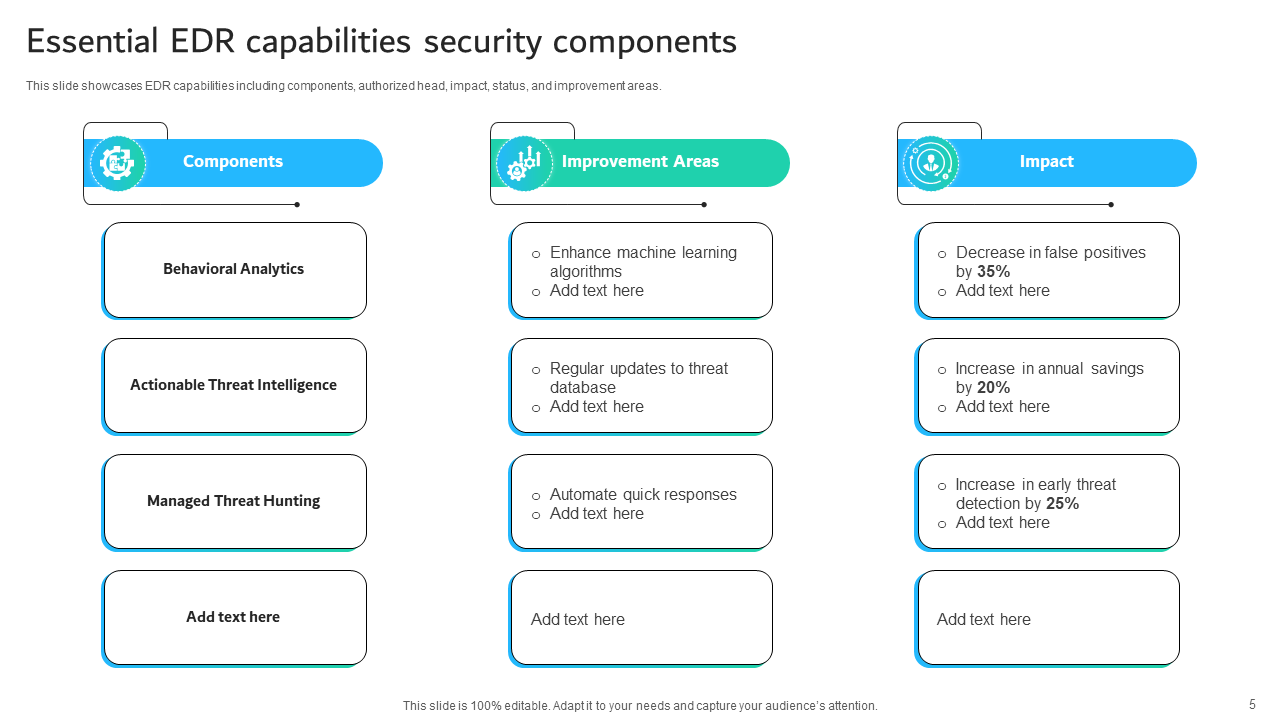
Template 4: Essential EDR capabilities security components
This template shows EDR capabilities, including components, authorized heads, impact, status, and improvement areas. The components can range from behavior analytics, actionable threat intelligence, and managed threat hunting to areas for improvement, such as enhancing machine learning algorithms and regular updates to threat databases. The impact can be studied carefully and mentioned. It could be related to the decrease in false positives, an increase in annual savings, or an increase in early threat detections.
Template 5: Endpoint detection and response solution core elements
This template shows EDR core elements and includes console alerting/reporting, EDR advanced response, EPP suite, and geographic support. Console alerting provides visibility into endpoint threat analysis and security status, while EDR advanced response comprises detailed forensics of incidents. The EPP suite has anti-malware detection and phishing activities, and geographic support includes having a support global enterprise due to information. The impact of each of these elements can be checked in a number of terms and mentioned against each element.

Template 6: Relevant approaches to endpoint detection and Response
This template represents EDR approaches and includes landscape inspection, automated patching service, BYOD device onboarding, and a cloud-native system. The approach to this could be landscape inspection, which includes implementing automated discovery tools, leading to device visibility and reduced endpoint blind spots. Automated patching service integrated automated patching with EDR, leading to security enhancement and reduced threat alerts. BYOD device onboarding has a quick device onboarding process with improved BYOD security posture. Cloud-native systems help in deploying cloud systems for improvement and better scalability.

Template 7: EDR solutions benefits contributing to asset management
This template focuses on EDR benefit solutions and includes sophisticated threats, robust visibility, and operational resources. The strategic action would be implementing continuous monitoring, comprehensive endpoint visibility, and automation of routine tasks. The impact of each benefit would range from a reduction in successful threats to an improvement in endpoints and time savings. Each benefit has a strategic action with a strong overall impact, and these can be checked for.

Template 8: EDR maturity and assessment model roadmap
This template shows the EDR maturity model and includes initiation, management, standardization, enhancement, and optimization. The initiation stage has endpoint types—laptops and desktops. The standard endpoint type would include cloud endpoints; optimization would have IoT devices, which servers and workstations would manage. The enhanced stage would last around 120 days, with mobile devices as the endpoint type. Each stage would have an impact, and it would be well studied using this comprehensive template.

Template 9: Comparative analysis between EDR EPP and XDR
This template illustrated the key differences between EDR, EPP, and XDR, including scope, prevention capabilities, response automatio,n and incident response impact. The aspects on which the analysis can be made can be scope, prevention capability, response automation, and incident response impact. The EDR includes endpoint visibility and Response, limited focus on detection, and advanced automation. The EPP includes endpoint protection, robust prevention against threats, basic automation, and a reduction in incident response time. XDR would include cross-layer detection and Response, integrated prevention, intelligent automation, increased incident response, etc.

Template 10: Comparative trend analysis from antivirus to EDR
This template shows a rapid shift from antivirus to EDR and includes role, detection method, response area, and security incident occurrence. The antivirus's role is to use traditional endpoint solutions and detect databases by the manufacturer. The response area is a traditional endpoint solution but fails to analyze the cause. The EDR's role also is to analyze traditional endpoint solutions, with a traditional endpoint solution method for detection, traditional endpoint solution as a response area, and tracking and analyzing the cause of security incidents occurring.

Final Word
Effective management of a company's resources against threats is crucial. This effective management comes at a cost, but its bearings are far more crucial in terms of revenue. This space will keep you covered on crucial templates that will help create a better impact on business and get information sorted better.