

 0 Comment
 Customer Reviews

Despite the wider range of financing options, generating adequate capital remains a big task for emerging businesses even today. From bootstrapping or self-financing to finding angel investors companies exercise lots of fundraising options these days. Yet, private equity and debt financing remain two of the most popular and rewarding capital-obtaining methods.
Check out these top sources of finance templates to understand the best financing models in detail.
Debt financing contributes to the USA's 18 trillion-dollar economy. On the other hand, a Forbes report suggested that private equity firms manage 20% of the business finances in the USA, with a market valuation of 1.7 trillion US dollars.
“In private equity, it’s not just buying and selling companies; it’s about working to improve companies.” - David M. Rubenstein, co-founder, Carlyle Group, Washington.
Both have pros and cons, given their mammoth economic impact. With the right investing partners who also have experience, expertise, and influence, your small startup can reach unscalable heights.
However, quite often, entrepreneurs struggle to identify and attract investors with such qualities. This either happens because they fail to pitch their ideas, selling propositions, and growth strategies in the desired manner, or they find it a daunting task, especially at the seed level. This makes them move toward debt financing until their IPO issuance.
SlideTeam solves this problem with its comprehensive, visually appealing, and content-driven presentation templates. In this blog, we discuss ideal pitch books to market your vision and draw private investors or investment banks. Nonetheless, we also compare debt and equity financing to educate you about their nuances so that you can make suitable financing decisions.
Template 1: Comparison Between Debt and Equity Financing
This template encourages equity over debt financing by comparing their key features, advantages, and drawbacks. It highlights the negative impact on cash flow caused by periodic interest payments in debt financing and finds shareholder equity a more profitable alternative. In addition, it illustrates how equity investment is more easily obtainable for startups as it requires them to show investors only their market opportunities and growth potential instead of complex creditworthiness. Download now!

Template 2: Evaluating Debt and Equity Overview of Fundraising using Equity Financing
This PPT slide consolidates the argument in favor of private equity investment over debt financing for raising funds. It mentions several reasons, such as zero interest, no repayment obligation, and investors' expertise. You can add more reasons to convince your stakeholders to choose equity investments. Use this PPT template to provide your audience with multiple equity investment options, such as venture capital, angel investors, crowdfunding, and Initial Public Offering (IPO). Grab this preset now!

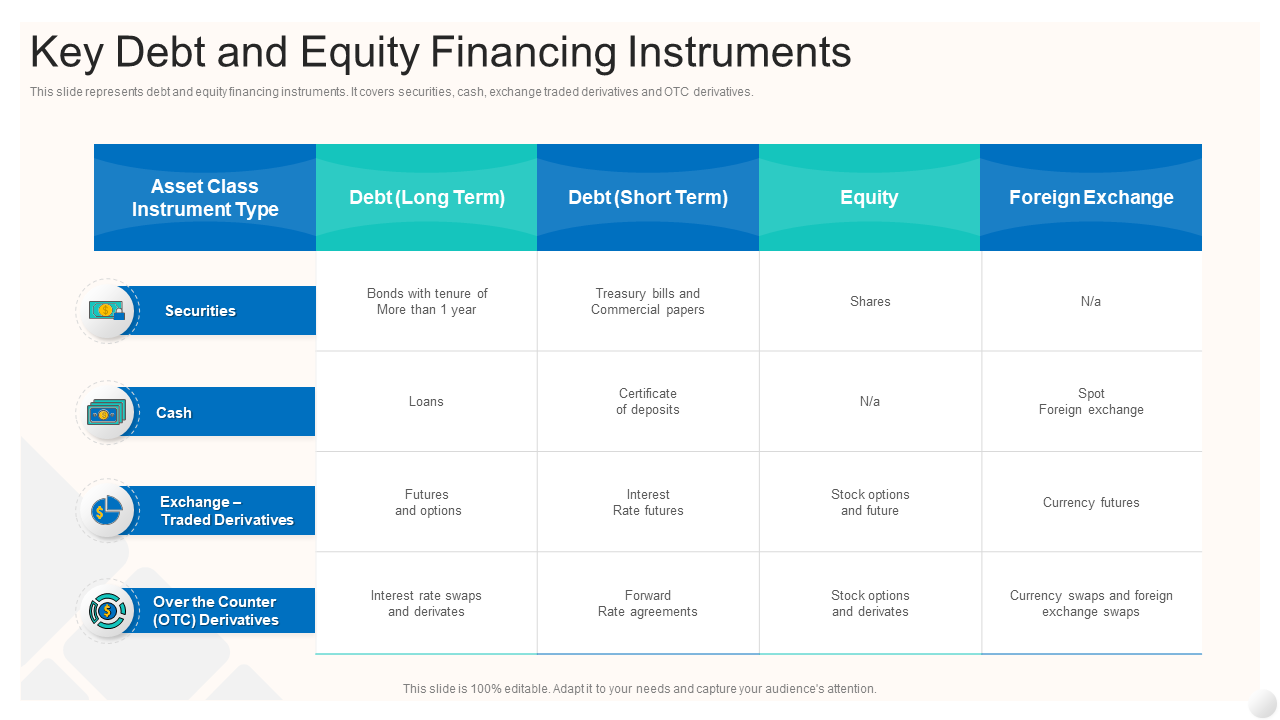
Template 3: Key Debt and Equity Financing Instruments
Diving deeper into the financing options, this slide explores various debt, equity, and foreign exchange financing instruments. It compares these three investment alternatives based on asset classes such as securities, cash, exchange-traded derivatives, and over-the-counter (OTC) derivatives. While you can only buy a company’s shares as their equity investor, debt financing offers treasury bills for short-term financing and security bonds for long-term investments.
Template 4: Pitch Deck for Equity Collective Financing Powerpoint Presentation Slides
This deck includes presenting the financing growth summary along with future projections, current business highlights, and product and service offerings to solve the existing market problems. It also traces the company’s historical development over the years to build its credibility among potential investors. It demonstrates the business’s current market valuation and its framework for generating the maximum return on equity investment. Pitch the market size expansion and exit strategy for larger and longer-term seed funding.
[product_image id=253998]
Template 5: Equity Debt and Convertible Bond Financing Pitch Book Template
Much like the previous deck, this bundle oversees and provides valuable insights into investments in IPOs, convertible securities, and debt assets. As an investment banking firm, you are already aware of the urgent requirement for an informative pitch book to attract investments into your clients’ businesses. This bundle solves your problem as it presents you with the opportunities to summarize offered services, clients and revenue details, global presence, IPO, and other successful investment deal counts in just one place. You can also introduce your top management team and showcase your market sizing strategies for better credibility and bigger growth capital.
[product_image id=638593]
Template 6: Business Model Canvas
A business model canvas is a single-slide document that allows you to paint the most realistic picture of your company for onlookers (investors). This slide allows you to mention your current business partners, like restaurants and pubs, in case you manage a food delivery service. In addition, you can flex your major resources, channels, and strategies to foster strong customer relationships and generate revenue and propositions that make partner investments profitable.

Template 7: Financial Summary of the Company
Evaluating the company’s financial health is one of the most significant steps for an investor before making an actual investment. You can make their work easier by disclosing the revenue generation trend from different products and services in the last five years. You can also break it down to present various revenue sources and geographical regions with their shares. Our data visualization tools offer support in presenting annual income trends.

Template 8: Primary Goals of Funding
Discussing why a company needs shareholder equity funding and what goals it can achieve with the funding gives the presenter an upper hand. Investors want to know how their capital would help the company’s growth. This slide offers ready-made templates that you can customize according to your research to display the estimated positive impact of the investment on the business’s market share, production capacity, employee headcount, and geographical expansion.

Template 9: Key Objectives of the IPO Issue
This layout lists the primary goals behind a startup's move away from financial leverage to its first-ever stock issuance. As already discussed, debt financing reduces profits by incurring heavy loan interest expenses on the company. At the same time, an initial public offering (IPO) issue offers a more organic way to generate funding. It helps the companies pay off their debts and offers an option to monetize the early grind.

Template 10: Real Estate Mezzanine Debt and Equity Financing Products
As the name historically suggests, mezzanine financing is a middle space between equity and debt financing. Using this hybrid model, companies sell their preferred stock without any additional collateral, interest, or dilution of ownership. This template sheds light on this capital-generating method in the real estate industry. In addition to the mezzanine, it discusses several other financing options, such as Sales leaseback transactions and distressed debt, to interest investors.

The Final Note
Startup investments are the backbone of any economy. They foster innovations and create a business environment conducive to entrepreneurship growth. A lack of them sees problems like cheap labor and product quality compromise. The onus also lies on the startups to attract adequate seed funding so that they don't operate without resources, and our refined PPT templates walk you through the intrinsic process to get the best results.
If you want to explore more investment templates, check out our equity investment templates and strategic fundraising plan templates to create the most appropriate pitch for any particular situation.