

Pitch deck for equity collective financing powerpoint presentation slides





Try Before you Buy Download Free Sample Product
 Impress Your
 Audience
 100%
100% Editable
 Save Hours
 of Time


Pitch Deck For Equity Collective Financing Powerpoint Presentation Slides is a virtual solution designed for astute entrepreneurs. Employ our compelling crowd equity PowerPoint presentation deck to transform potential investors into stakeholders. This crowd-investing PPT slideshow touches all the topics using a succinct format to communicate relevant info that interests investors. Communicate key business highlights, operational and financial overview, and primary pain points of the target market. Impressive data visualizations included here render a professional tone. The easy-to-follow layout ensures your investors can gain better insights. This graphically-sound investment crowdfunding PowerPoint theme includes tabular formats, bar graphs, pie charts, and state-of-art diagrams. It assists you in representing complex topics like total addressable market, or business model canvas. Use our equity crowdfunding PPT layout to demonstrate the need, allocation, and objectives of funding. Showcase capitalization table, shareholding pattern, exit strategy, and future expansion goals. Download our extensive and appealing business presentation to deliver an effective pitch. Our Pitch Deck For Equity Collective Financing Powerpoint Presentation Slides are explicit and effective. They combine clarity and concise expression.
People who downloaded this PowerPoint presentation also viewed the following :
Content of this Powerpoint Presentation
Slide 1: This slide introduces Pitch Deck for Equity Collective Financing. State your Company name and begin.
Slide 2: This slide Covers various aspects of company (i.e. business overview, products services, financial performance, shareholding pattern and valuation).
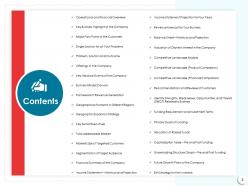
Slide 3: This slide displays Table of Contents.
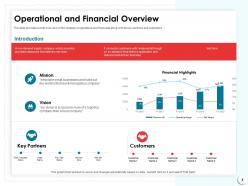
Slide 4: The slide provides a brief overview of the company’s operations and financials along with its key partners and customers
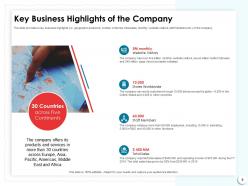
Slide 5: The slide provides a key business highlights (i.e. geographic presence, number of stores, total sales, monthly website visitors, staff members etc.) of the company
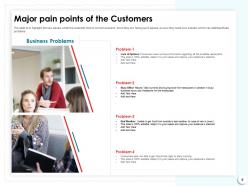
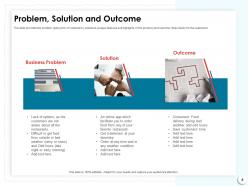
Slide 6: The slide highlights the key issues which the customer face in current scenario. Since they are facing such issues, so now they need new solution which can address these problems
Slide 7: The slide provides all the solutions (for the problems faced by customers) which the company offer through its products.
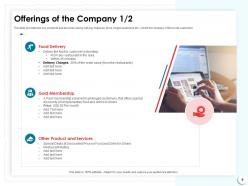
Slide 9: The slide provides the key products and services (along with key features, price, target customers etc.) which the company offers to its customers
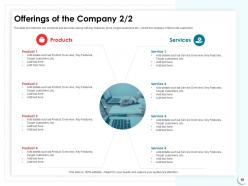
Slide 10: The slide provides the key products and services (along with key features, price, target customers etc.) which the company offers to its customers
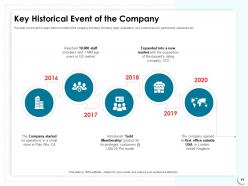
Slide 11: The slide covers all the major historic events of the company including founding, major acquisition, new product launch, partnership, expansion etc.
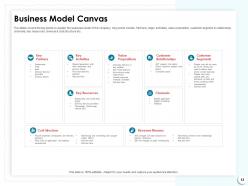
Slide 12: The slides covers the key points to explain the business model of the company.
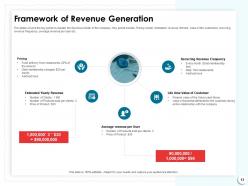
Slide 13: The slides covers the key points to explain the Revenue model of the company. Key points include: Pricing model, Estimated revenue, life time value of the customers, recurring revenue frequency, average revenue per user etc.
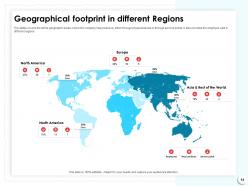
Slide 14: The slides covers the all the geographic areas where the company has presence, either through physical stores or through service points. It also provides the employee split in
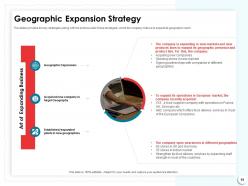
Slide 15: The slides provides the key strategies (along with the actions under those strategies) which the company follows to expand its geographic reach
Slide 16: The slide provides the name, designation and brief biography of key senior level executives (C-level employees and head of Departments)
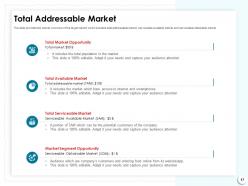
Slide 17: The slide provides the market overview of the target market which includes total addressable market, serviceable available market and serviceable obtainable market
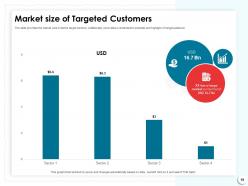
Slide 18: The slide provides the market size of all the target sectors. Additionally, it provides overall market potential and highlight of target audience
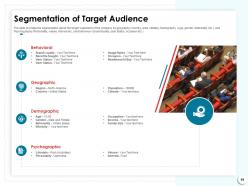
Slide 19: The slide provides the segmentation about the target customers of the company by geography (country, area, climate), Demography (Age, gender, Nationality etc.), and Psychography (Personality, values, interest etc.) and behaviour (brand loyalty, user status, occasion etc.)
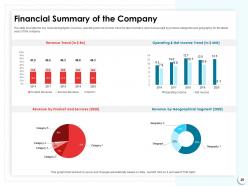
Slide 20: The slide provides the key financial highlights (revenue, operating and net income trend for last five tears; and revenue split by product categories and geography for the latest year) of the company
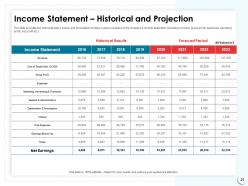
Slide 21: The slide provides the historical (last 4 years) and forecasted (coming 4 years) numbers of the company’s income statement (including revenue, gross profit, expenses, operating profit, net profit etc.)
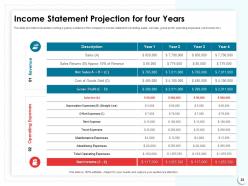
Slide 22: The slide provides forecasted (coming 4 years) numbers of the company’s income statement (including sales, net sale, gross profit, operating expenses, net income etc.)
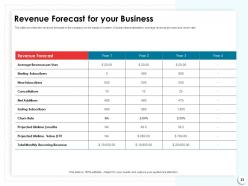
Slide 23: The slide provides the revenue forecast of the company on the basis of number of subscribers estimation, average revenue per user and churn rate
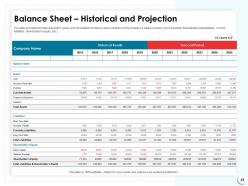
Slide 24: The slide provides the historical (last 6 years) and forecasted (coming 6 years) numbers of the company’s balance sheet (current assets, fixed assets, total liabilities, current liabilities, shareholder’s equity, etc.)
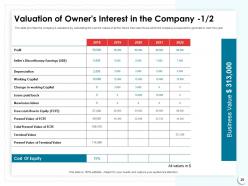
Slide 25: The slide provides the company’s valuations by calculating the current values of all the future free cash flows which the company is expected to generate in next five year
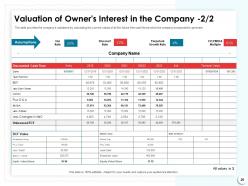
Slide 26: The slide provides the company’s valuations by calculating the current values of all the future free cash flows which the company is expected to generate.
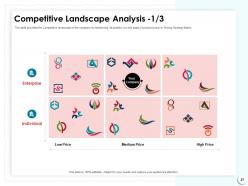
Slide 27: The slide represents the Competitive landscape of the company by mentioning its position (on the basis of product price) in Pricing Strategy Matrix
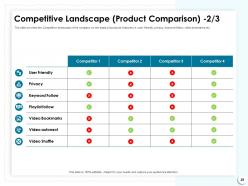
Slide 28: The slide depicts the Competitive landscape of the company on the basis of products’ features i.e. user friendly, privacy, keyword follow, video bookmarks etc.
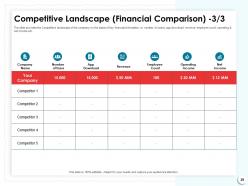
Slide 29: The slide provides the Competitive landscape of the company on the basis of key financial information
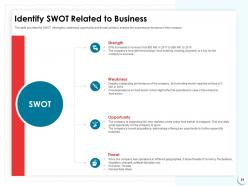
Slide 31: The slide provides the SWOT (strengths, weakness, opportunity and threat) points to analyse the business performance of the company.
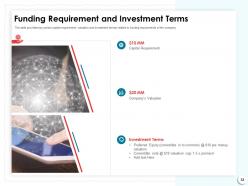
Slide 32: The slide provides key points (capital requirement, valuation and investment terms) related to funding requirements of the company.
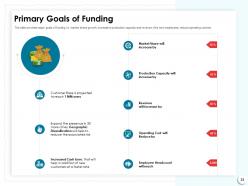
Slide 33: The slide provides major goals of funding i.e. market share growth, increase in production capacity and revenue, Hire new employees, reduce operating cost etc.
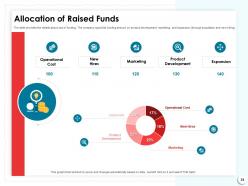
Slide 34: The slide provides the details about use of funding. The company spend its funding amount on product development, marketing, and expansion (through acquisition and new hiring)
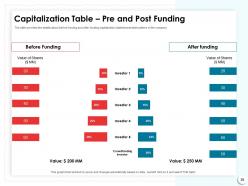
Slide 35: The slide provides the details about before funding and after funding capitalization table/shareholder pattern of the company
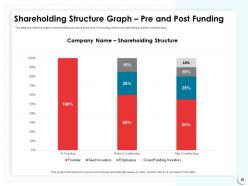
Slide 36: The slide provides the graph of shareholding structure at the time of founding, before crowdfunding and after crowdfunding
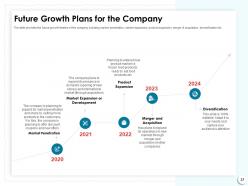
Slide 37: The slide provides the future growth timeline of the company including market penetration, market expansion, product expansion, merger & acquisition, diversification etc.
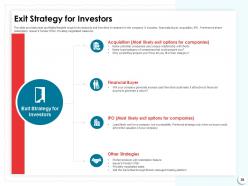
Slide 38: The slide provides most profitable/feasible ways for investors to exit from their investment in the company. It includes, financials buyer, acquisition, IPO, Preference share redemption, Issuer’s Tender Offer, Privately negotiated sales etc.
Slide 39: This is Pitch Deck for equity collective Financing Icons Slide.
Slide 40: This slide is titled as Additional Slides for moving forward.
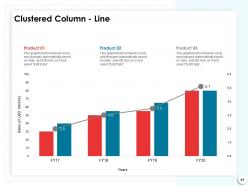
Slide 41: This slide displays Clustered Column - Line with product comparison.
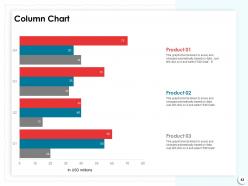
Slide 42: This slide displays Column Chart for Comparison of products.
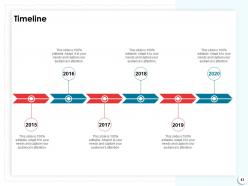
Slide 43: This slide displays Timeline process.
Slide 44: This slide displays Agenda.
Slide 45: This slide shows Our Mission, Vision and Goals.
Slide 46: This slide represents Magnifying Glass for highlighting important notes.
Slide 47: This is Venn slide.
Slide 48: This is Our Goal slide.
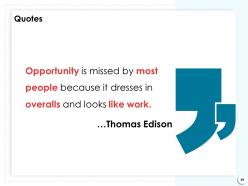
Slide 49: This slide displays motivational Quotes.
Slide 50: This is Thank You slide with Contact details.
Pitch deck for equity collective financing powerpoint presentation slides with all 50 slides:
Use our Pitch Deck For Equity Collective Financing Powerpoint Presentation Slides to effectively help you save your valuable time. They are readymade to fit into any presentation structure.




FAQs for Pitch deck for equity collective financing
Every successful pitch deck should include a compelling problem statement, unique solution, market opportunity, business model, competitive analysis, financial projections, and strong team introduction. These components work together by establishing credibility, demonstrating market understanding, and showcasing scalability, with many startups finding that clear storytelling connecting these elements ultimately delivers investor confidence and funding success.
A well-designed pitch deck influences investor perception by creating visual clarity, establishing credibility, and reinforcing key messages through consistent branding, professional layouts, and strategic information hierarchy. Clean design elements streamline complex data presentation, enhance storytelling flow, and demonstrate attention to detail, with many investors finding that polished visuals signal organizational competence and market readiness.
Common mistakes include overloading slides with excessive text, lacking a clear value proposition, presenting unrealistic financial projections, ignoring market competition, and failing to demonstrate traction. These pitfalls undermine credibility by overwhelming investors, obscuring key messages, and suggesting insufficient market research, with successful entrepreneurs finding that focused storytelling and realistic data ultimately deliver stronger investor engagement and funding opportunities.
Storytelling in pitch decks involves crafting a compelling narrative arc that connects your problem, solution, and market opportunity through customer journeys, founder backstories, and vision narratives. Successful startups use customer success stories, market evolution tales, and transformational visions to engage investors emotionally while demonstrating traction, ultimately creating memorable presentations that differentiate from competitors.
The ideal pitch deck presentation length is 10-20 slides delivered in 10-15 minutes, allowing ample time for questions and discussion. This strategic approach enables entrepreneurs to cover essential elements like problem, solution, market opportunity, and financial projections while maintaining investor engagement, with many successful startups finding that concise presentations ultimately deliver stronger funding outcomes.
Tailoring pitch decks involves adjusting content emphasis, detail level, and focus areas based on investor type and investment stage preferences. Angel investors typically prefer personal founder stories, early traction metrics, and market validation, while venture capitalists prioritize scalability models, competitive analysis, and detailed financial projections, with both requiring clear ROI potential and strategic market positioning.
Data visualization transforms complex information into compelling, digestible insights that capture investor attention through clear charts, graphs, infographics, and visual representations of market trends, financial projections, and growth metrics. These visual elements streamline comprehension, enhance credibility, and deliver persuasive storytelling, with many startups finding that well-designed data visuals significantly increase investor engagement and funding success rates.
Effectively communicating your unique value proposition requires clear problem identification, differentiated solution positioning, quantifiable benefits, and compelling market validation through customer testimonials or pilot results. Structure your value proposition across multiple slides, emphasizing competitive advantages, scalability potential, and measurable outcomes, with many successful startups finding that specific metrics and real customer examples ultimately deliver stronger investor engagement and funding success.
Essential financial metrics include revenue growth, gross margins, customer acquisition cost (CAC), lifetime value (LTV), monthly recurring revenue, burn rate, and runway projections. These metrics demonstrate business viability by showcasing profitability potential, operational efficiency, and sustainable growth trajectories, with many investors finding that clear CAC-to-LTV ratios and consistent revenue trends ultimately deliver the strongest competitive advantage in funding discussions.
Visuals maintain audience engagement by breaking up text-heavy content, illustrating complex concepts clearly, and creating memorable moments that resonate with investors. Strategic use of charts, infographics, product demos, and compelling imagery helps startups communicate their value proposition more effectively, while consistent visual branding reinforces credibility and professionalism throughout the presentation.
**INPUT**: What are the best practices for presenting a pitch deck in a live setting? **OUTPUT**: Best practices include maintaining eye contact with the audience, storytelling through clear narratives, using confident body language, practicing transitions between slides, and preparing for questions with supporting data. These presentation techniques enhance investor engagement by building trust, demonstrating market knowledge, and showcasing leadership capabilities, with many entrepreneurs finding that authentic delivery and strategic audience interaction ultimately create memorable impressions and competitive funding advantages. [Word count: 60 words]
Cultural differences significantly influence pitch deck expectations through varying communication styles, relationship-building preferences, risk tolerance levels, and decision-making processes across global markets. While Western audiences often favor direct, data-heavy presentations, Asian markets typically emphasize relationship establishment and consensus-building approaches, with many international organizations finding that culturally-adapted pitch strategies deliver higher engagement rates and improved investor relations.
Tools for creating professional pitch decks include PowerPoint, Google Slides, Canva, Prezi, Pitch, and specialized platforms like Beautiful.ai and Slidebean. These platforms streamline presentation development through customizable templates, collaborative features, and integrated design elements, with many startups and established companies finding that template-driven approaches significantly reduce creation time while maintaining professional visual standards.
Pitch decks should be updated every 3-6 months or when significant business changes occur, including new market data, financial milestones, product developments, strategic partnerships, or competitive landscape shifts. These updates ensure presentations remain current and compelling, with many startups finding that regular refreshes enhance investor engagement, demonstrate momentum, and ultimately deliver more successful funding outcomes in an increasingly competitive investment environment.
Effective Q&A management techniques include preparing for common questions, maintaining confident body language, repeating questions for clarity, staying concise with answers, and acknowledging when you don't know something. These approaches help presenters demonstrate expertise while building trust, with many entrepreneurs finding that structured Q&A sessions often strengthen investor relationships and reveal additional partnership opportunities.
-
Best Representation of topics, really appreciable.
-
The content is very helpful from business point of view.
-
Informative presentations that are easily editable.
-
Informative design.
-
Awesome presentation, really professional and easy to edit.
-
Easy to edit slides with easy to understand instructions.
-
Easily Understandable slides.
-
Wonderful templates design to use in business meetings.
-
Excellent products for quick understanding.