


 0 Comment
 Customer Reviews

IT risk management is the DNA of digital resilience for enterprises, tech firms, and every data-driven organization. It is not just about stopping cyber attackers; it is about protecting your digital assets and maintaining Operational resilience while building stakeholder confidence.
Given the rapidly evolving landscape of cyber threats and compliance requirements, an organization must have a comprehensive IT risk management framework in place. Failure to address this could result in data breaches, non-compliance fines, or system failures that put business success at risk.
However, the execution part is harder than knowing about IT risks.
From devising risk assessment measures to threat identification algorithms and methods for risk mitigation, this involves a complex battle with intricate data systems within a dynamic compliance management architecture. In this context, an IT risk management framework of the future would be a great resource. It makes execution easier and helps set a repeatable process that enforces measurable security, ownership, and sustainable IT security for your organization.
Learn more about Risk Management with our Top 10 Risk Management Framework Templates.
The real task of finding a solution is to find something that covers everything. There is no need to look further; SlideTeam has your back. Our fully edited PowerPoint slides are valuable in your communication journey!
Head over to our blog on the Top 10 Information Security Framework Templates, which helps you secure your data and compliance.
Here are 10 IT Risk Management Framework PPT Templates for IT leaders and cybersecurity personnel. Highly customized templates led by experts with frameworks, content, and visuals to ensure easy planning for cybersecurity and automated responses during incidents.
Take control of your IT risk landscape like never before. Let’s explore these templates one by one.
For proactive planning, check out our Top 5 Risk Assessment Framework Templates with Samples and Examples blog!
Template 1: IT Risk Management Framework
This PowerPoint slide reflects the framework for IT Risk Management (ITRM). It relates to business objectives, such as growth, agility, compliance, and customer value, within core IT management domains, which include cybersecurity, service operations, and supplier management. Furthermore, the presentation template facilitates an integrated operating model that encompasses governance, policies, risk planning, technology tools, and risk metrics, enabling effective risk monitoring and business continuity. This PPT design is suitable for CIOs, CISOs, Risk Officers, IT Managers, and their Compliance Teams. Download and share effective messages now.

Template 2: Organizational IT Risk Management Triangle Framework
This presentation design illustrates the Organizational IT Risk Management Triangle Framework. It moves from strategic to tactical risk. It includes Org Risk Assessment for top-down evaluation based on products or services. The PowerPoint template also shares details for Business Process Risk Assessment, covering risk prioritization and recovery planning. It also outlines Vendor Risk Assessment, which evaluates outsourcing threats, and IT Risk Assessment, which analyzes the inherent and residual risks of IT assets. This presentation diagram is ideal for CISOs, IT risk managers, compliance officers, and security analysts. Download now.

Template 3: Credit Risk Management Frameworks for Banks
The presentation deck outlines the Credit Risk Management Frameworks for banks. It covers essential areas, including bank figures, global presence, partnerships, market share, and turnover, in comparison to competing firms. The PPT package addresses the issues and challenges of credit risk management, the primary causes of credit risk, and the growing concern of non-performing loans. It also covers topics such as emerging banking risks, principal risk components, and vital assessment parameters. This PowerPoint deck is relevant to risk analysts, credit managers, compliance officers, and senior executives in the banking industry. Download now.
[product_image id=638591]
Template 4: CIOs' Initiatives for Strategic Optimization: Implementing the IT Risk Management Framework
This PowerPoint template showcases CIOs’ Initiative 9 – implementing a strong IT Risk Management Framework. The presentation visually details phased actions, such as launching an enterprise security program with incident response plans and evolving to long-term risk management. Additionally, it includes upgrading control environments and platforms, as well as strengthening security processes from threat handling to comprehensive security assessments. The PPT diagram also supports governance planning, regulatory compliance, and skills training. This slide is apt for CIOs, CISOs, IT risk managers, and compliance officers. Download now.

Template 5: IT Risk Management Strategies and Frameworks
This presentation deck delineates essential IT risk management strategies and frameworks for modern organizations. The PowerPoint bundle covers understanding IT risks and challenges, types of organizational risks, and proven assessment models. This PPT deck also learns how to identify, analyze, and prioritize risks, evaluate their impact, apply mitigation controls, and build a comprehensive IT risk management plan. It also focuses on governance, compliance standards, and data protection. This presentation resource is useful for CIOs, CISOs, IT risk analysts, compliance managers, and security consultants. Download now.
[product_image id=1407338]
Template 6: Employee Training Schedule
This PPT displays an organized training schedule for employees. It includes the employee's name, position or role, software, or tools, such as Jira Service Desk. It also includes the type of course, such as intermediate and advanced, along with the mode of training (online and onsite), and duration (7-12 days). This PowerPoint template supports a well-structured learning and tool mastery plan, leading to improved service operations. This presentation graphic is designed for IT support specialists, service desk agents, project managers, and operations leads. Download now.

Template 7: Importance of Software Project Management
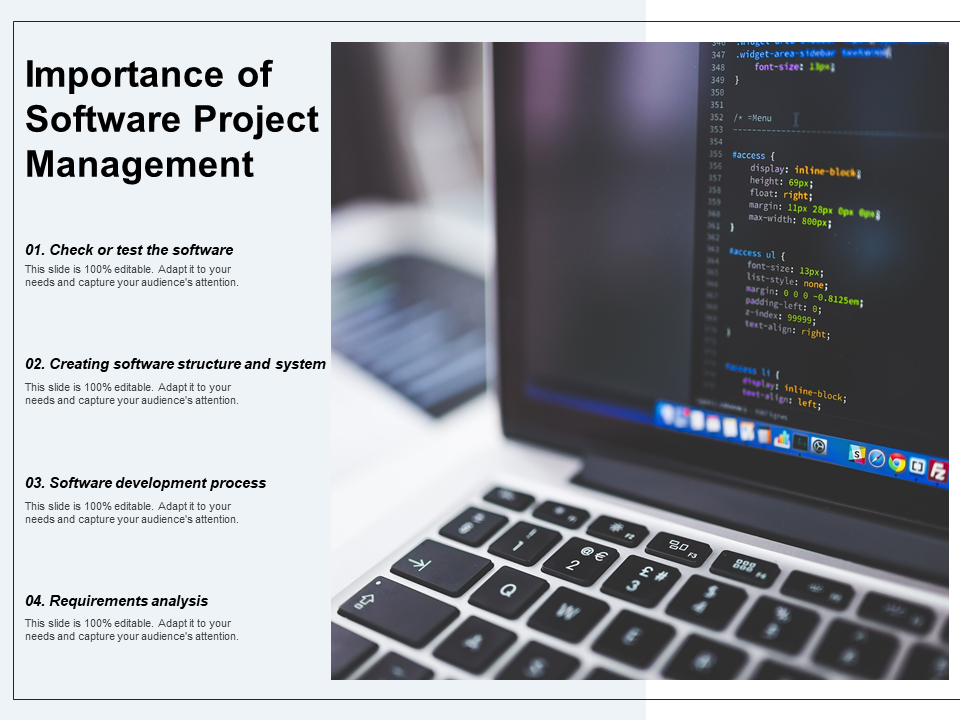
This PowerPoint illustration highlights the importance of software project management in ensuring the successful delivery of projects. It highlights the areas of software testing and creating the necessary structures and systems for a robust software backbone. The PPT layout also considers other areas, such as software development process management and thorough requirements analysis. This PowerPoint template is helpful for software project managers, developers, QA engineers, business analysts, and IT leads. Download now.
Template 8: Key Figures Related to the Bank
This presentation graphic exhibits key figures related to the bank. It mentions that the bank provides solutions for trade receivables worldwide. The bank reported a turnover of $2 billion for 2022. Now, it would be guaranteed $350 billion worth of receivables and has already funded around $55 billion. Furthermore, it has a direct presence in 70 countries, serves a staggering 150,000 clients worldwide, and employs over 10,000 professionals. This PPT image would be beneficial for financial analysts, investment bankers, risk managers, and strategic planners. Download right now.

Download This Presentation Now
Template 9: Challenges to Credit Risk Management
This PPT underlines key challenges to credit risk management. It begins with issues such as insufficient data management, where poor data leads to delays and non-group-wide risk systems that block meaningful and nuanced insights. The PowerPoint template also outlines that constant rework hampers efficiency due to inflexible model parameters. Additionally, the lack of robust risk tools prevents effective portfolio classification and re-grading. This PPT framework is perfect for credit analysts, risk officers, banking consultants, and compliance managers. Download now.

Template 10: Benefits of Credit Risk Management for the Bank
This PowerPoint framework highlights the key benefits of credit risk management for banks. It helps protect the balance sheet by better managing bad debt and write-offs. Banks can increase sales by entering new markets and expanding clean exposure. Moreover, it enhances credit management through third-party insights, reducing investigation costs. Additionally, it improves financing by using secured receivables as collateral or selling them without recourse. This PPT design enhances the value for credit managers, risk analysts, finance heads, and loan officers, thereby strengthening financial decision-making. Download now.

Navigate Threats with Confidence Framework
In today's high-stakes digital world, IT still struggles to manage the risks associated with static data; it needs a clear vision that outlines how cybersecurity threats and incident response strategies work in the IT context. These Templates, created by our experts, help IT executives clearly and effectively convey risks, policies, and ways to mitigate impact in simple steps.
Let's take the next step in IT risk communication. SlideTeam refers to professionally designed templates that help you align tech strategies with executive preferences. Download now to convert IT weaknesses into proactively managed IT resilience!
FAQs
1. What are the key steps in implementing an IT risk management framework?
When implementing an IT risk management process, consider six steps: identify risks, score impact, control priority, develop response strategy and controls, monitor the setting, and periodically evaluate and refine the framework. This process enables the enterprise to effectively monitor its IT risks.
2. How does an IT risk management framework ensure compliance with regulatory standards?
IT risk management frameworks ensure compliance with regulations by providing a standardized method of identifying and evaluating the risks that could lead to non-compliance. Organizations that comply with the requirements built into the risk management process can test for possible gaps in advance and, therefore, mitigate the level of sanctions or lawsuits.
3. What tools or technologies are commonly used to support an IT risk management framework?
Several tools and technologies augment IT risk management frameworks. These could be IT risk management software, a risk assessment tool, and Analytics or Visualization for risk data. Frameworks such as NIST RMF or COBIT/ISO 27001 provide structured guidance for risk management processes.