



 0 Comment
 Customer Reviews

Lean manufacturing is an essential practice in today's contemporary age to attain efficiency and innovation. Toyota, Intel, and Ford are certain companies that use lean methods to reduce waste, streamline flows, and increase productivity.
According to Industry Week’s report “The Future of Manufacturing: 2020 and Beyond,” lean manufacturing systems were ranked second in importance, just below quality management solutions. This indicates the key role of lean in the current operations. Lean manufacturing is not merely cost-cutting; it is a methodological tool with emphasis on quality control, efficiency, and continuous improvement to deliver customer satisfaction and long-term viability.
Why Should the Lean Manufacturing Concept be Adopted?
Lean manufacturing methods can lead to a 40% reduction in defects, more secure workplace results by 78%, and improved employee participation by 70%. It indicates there is a demand for the implementation of lean manufacturing by business firms to boost productivity up to 50%. Its implementation heavily depends on organizational size, industry setting, and availability of resources and training. The benefits of using lean manufacturing are
- Boosts productivity
- Eliminated waste
- Improves quality
- Enhances customer satisfaction
- Encourages employee engagement
- Drives long-term competitiveness
Fed up with traditional tools? Check out our blog on Lean Manufacturing to discover smarter strategies to drive innovation.
Role of Lean Manufacturing Metrics
Companies employ lean manufacturing measures, the most critical performance measures that identify the levels to which lean principles are being applied so that these advantages can be attained. For instance, Overall Equipment Effectiveness (OEE) is Availability multiplied by Performance and Quality, while First Pass Yield (FPY) is good units divided by the quantity produced. All these metrics, together with Cycle Time, Lead Time, and Takt Time, allow businesses to track efficiency, quality, and waste reduction in real time.
By tracking such metrics, organizations not only can detect areas of inefficacy but can also sustain continuous improvement. Such a focus on improvement, driven by the data from lean manufacturing metrics, is central to determining the actual effect of lean programs on long-term performance.
Also, explore our Top 10 Manufacturing Metrics Templates to increase operational efficiency. Click here.
Let’s understand the templates now!
Template 1: Importance of Lean Manufacturing and Metrics
This PowerPoint slide emphasizes the role of lean manufacturing and metrics. Lean manufacturing should be implemented for the reasons such as waste minimization, process efficiency, improving quality, employee engagement, customer satisfaction, and learning. These benefits have a vital contribution to raising the overall productivity of an organization. Grab the presentation now!

Template 2: Measuring Waste: The 7 Wastes
Do you recognize what waste lean manufacturing eliminates? This slide briefs on the seven waste lean manufacturing faces. These are overproduction, waiting, transportation, improper processing, inventory management, unnecessary motion, and wasted talent. Its identification and sustenance is the job a lean manufacturing process performs. Grab the presentation!

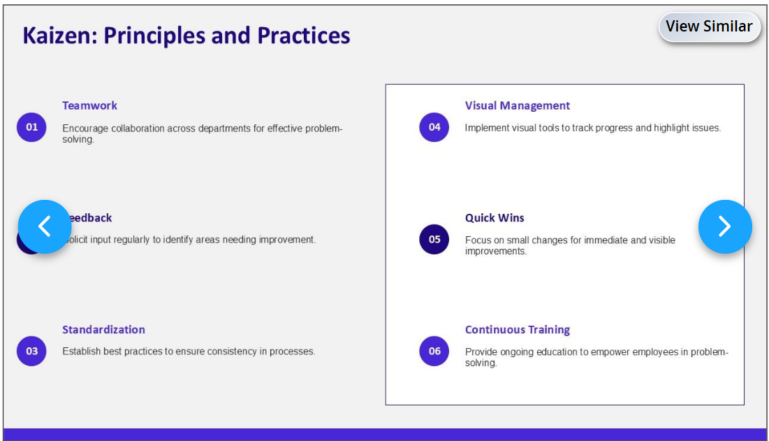
Template 3: Kaizen: Principles and Practices
Kaizen is a philosophy that focuses on small changes in process to improve efficiency, quality, and productivity. This slide presents principles and practices on which Kaizen is based. The slide includes teamwork, feedback, standardization, visual management, quick wins, and continuous training. All of these build an improvement culture in which each employee makes a contribution to organizational growth. Download now and see how Kaizen can turn the daily routine into a cycle of continuous improvement and excellence!
Template 4: Five S Methodology in Lean
This slide explains the five S lean approach. It has come to be known by this name since it is abbreviated from five Japanese words—Seiri, Seiton, Seiso, Seiketsu, and Shitsuke, which, respectively, mean sort, shine, set in order, standardize, sustain, and safety. The 5S approach is one of the cornerstones of lean manufacturing, helping firms create an effective, safe, and sustainable culture that produces sustained competitiveness. Get access now!

Template 5: Integrating Lean with Other Methodologies
This presentation is very much applicable to professionals and students working on process improvement techniques. It assists in the integration of lean with other techniques by presenting sections in a tabular format that elaborates on lean principles, agile practices, six sigma, and total quality. It also brings to the limelight areas of focus, implementation, advantages, disadvantages, and examples. The highlights at the end of the presentation clearly state the percentage increase in efficiency, waste minimization, and improvement in quality. Download now!

Template 6: Manufacturing and Lean Engineering KPI Metrics
This slide focuses on the key performance indicators to measure and improve manufacturing efficiency and resource utilization capacity. It includes lean KPIs such as cycle time, machine downtime rate, production attainment, capacity utilization, and changeover time. This presentation is useful for the manufacturing industry to check on the performance and further work on improvement.

Template 7: Challenges in Measuring Lean Metrics
Facing challenges is just a stepping stone towards success. This PPT theme highlights the challenges in measuring lean metrics. These challenges are data gaps, inadequate measurement tools, cultural resistance, overcomplication, variability issues, etc. Furthermore, it also addresses the barriers such as lack of training, prioritization conflicts, and slow feedback. Get the presentation today to understand these obstacles and plan the strategies to overcome them!

Template 8: Technology Tools for Lean Metrics
This slide clearly outlines tools for lean measurement or to measure performance. The tools the slide mentions are data analysis, digital dashboards, process automation, and collaboration software. These tools help us enlighten ourselves about performance and work on continuous improvement. Not only do they simplify hard data, but they also allow quicker decision-making. Lastly, these tools help companies align their processes with lean goals and achieve sustainable growth.

Template 9: Best Practices for Waste Reduction Metrics
Waste measurement and waste reduction are fundamental to lean manufacturing. To ensure that waste reduction metrics are useful, businesses need to adopt the following best practices. It involves having very clear waste objectives, frequent auditing, employee training, analysis of data, and ongoing improvement. Access now!

Template 10: Metric Dashboard to Monitor Lean Manufacturing Process
This slide has a dashboard, which makes tracking and monitoring the lean manufacturing process easy. The upper parts show quantity figures, safety audits, manufacturing cost, and labor cost. A bar graph with simple user input is utilized to investigate production figures, i.e., time and downtime, which makes viewing data quite easy. There is also a frequency polygon that sheds light on manufacturing cost. At the bottom, it gives a clear picture of performance, quality, and the OEE meter.

Summing Up
Overall, Lean manufacturing metrics templates are perfect measures to measure performance, get rid of inefficiencies, and align operations with business objectives.
Through the use of these templates, organizations are able to monitor improvement in real-time, make intelligent decisions, and improve a culture of continuous improvement for long-term development.
PS: Explore our top 10 lean manufacturing tools presentation templates to see efficiency like never before.
FAQs on Lean Manufacturing metrics
What are the most important lean manufacturing metrics to track?
The important lean manufacturing metrics consist of Process Flow metrics like Cycle Time, Lead Time, and throughput; quality metrics like First Pass Yield and scrap rate; and metrics for Equipment Effectiveness like Overall Equipment Effectiveness (OEE) and capacity utilization, on-time delivery, cost per unit, and changeover time.
How is Overall Equipment Effectiveness (OEE) calculated in lean manufacturing?
Overall equipment effectiveness (OEE) is calculated using the formula:
OEE = availability x performance x quality
By multiplying these three factors, OEE reveals the percentage of planned production time that is really productive.
What is TAKT time, and how is it used in lean production?
Talk time acts as a pulse of the production process. It is the production rate at which a company needs to produce a product that must be aligned with customer demand for production. In lean manufacturing, talk time reduces waste and bottlenecks. It also establishes a sustainable production speed.