

 0 Comment
 Customer Reviews

To help an organisation achieve its goals, maintain its quality standards, and meet customer requirements consistently, a Quality Management System (QMS) comes in handy. This QMS is an organized system of processes, procedures, and policies, which is the core of operational efficiency and continuous improvement in any brand.
The PDCA or Plan-Do-Check-Act cycle is fundamental to QMS management.
But what does PDCA methodology mean?
- Plan: Decide on a goal or process and develop a proposition for achieving the desired result.
- Do: Implement the plan (e.g., a pilot project or small-scale initiative).
- Check: Evaluate the results as you monitor and gather data and metrics.
- Act: Take steps based on what you learned - standardize your success, or modify the failed process or activity for improvement.
This Quality Management System, supported by the PDCA process, enables brands to deliver consistent quality across multiple channels and maintain maximum customer satisfaction. Whether you operate a global chain or a company of five employees, delivering consistent quality does not happen by accident—it takes intent and structure and can be repeated.
For more on the topic, explore our blog on the Top 10 Plan Do Act Templates.
Presenting the Top 10 QMS PDCA Process Templates selected for their clarity, utility, and applicability across various industries. These process templates are not just checklists to tick off; they are designed to help organisations establish continuous improvement as a mindset.
Each of these PPT templates is 100% editable. You receive both structures in the form of content-ready slides and the editing capability to tailor the presentation to your specific needs easily.
Also, explore our blog on the Top 10 Business Process Improvement Templates with Samples and Examples.
Let’s explore these blogs one by one!
Template 1: PDCA Cycle in Quality Management and Problem Solving PPT
This slide introduces the PDCA Cycle in Quality Management and Problem Solving in a visual format. The main feature is a circular figure incorporating the four steps in the iterative approach, titled "Plan," "Do," "Check," and "Act," which reinforces continual improvement. Overall, this slide helps introduce a discussion of how the PDCA cycle provides a systematic approach to implementing quality management practices and points out problems in an organisation.
[product_image id=120228]
Template 2: Re-evaluating Goals / Ensuring Success of Goals
The slide includes four objectives, numbered Goals 1, 2, 3, and 4. Each goal is characterised with two performance indicators: a green check-mark labelled "Goal Achieved" and a red "X" labeled "Goal Not Achieved". All four goals indicate both performance indicators, which help to evaluate whether the goals are achieved or not. The slide could be used to represent the "Check" component of the PDCA cycle, as it is the action of checking the implemented actions listed. You can use this assessment process to evaluate the outcomes against the goals. This helps assess success and areas requiring improvement.

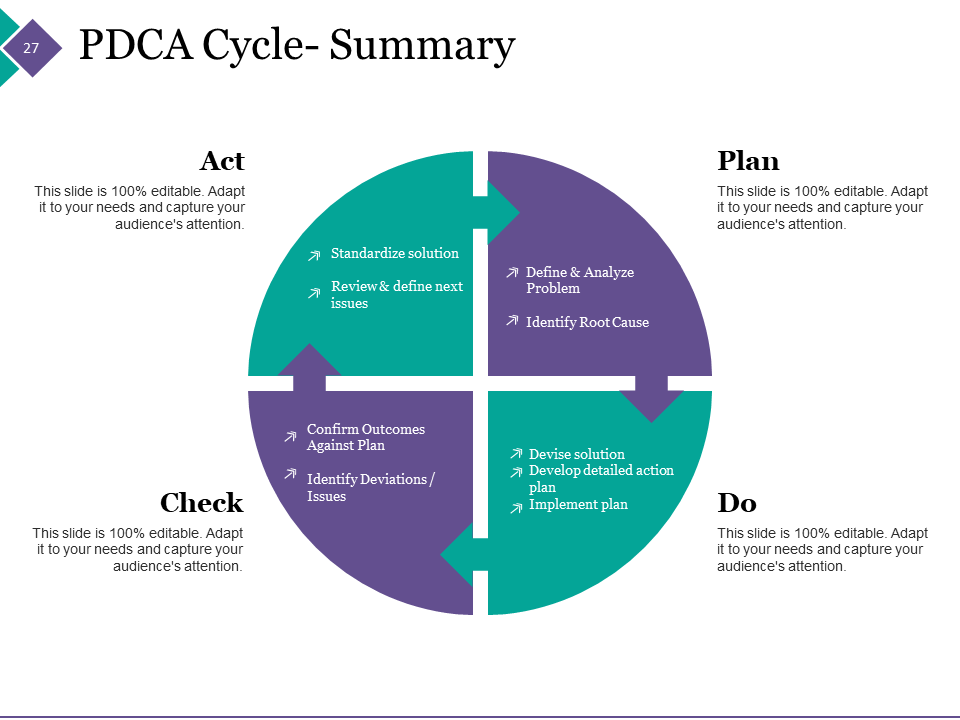
Template 3: PDCA Cycle - Summary Template
This slide presents a summary showing the four stages of the continuous improvement methodology as a cycle or improvement process. The first stage, Plan, identifies and describes the problem and determines its root cause. The second stage of the cycle identifies a solution, develops an action plan in great detail, and then implements it. The third stage confirms the results, compares them to the original plan, and identifies any variances in the new/old issues that require adjusting the action plan. The fourth stage of the cycle involves standardising the solution, reviewing, and defining the next issues.
Template 4: Kaizen 5S Framework- Good Housekeeping Template
This slide illustrates the Kaizen 5S Framework for Good Housekeeping, a method commonly employed as part of quality management systems. The framework comprises five elements that connect: Sort (separate the needed items), Set in Order (organize so you can retrieve needed items quickly), Shine (keep your workspace clean), Standardize, and Sustain (perform the process consistently). The repeated flow alluding to "Sustain", which is in a loop, refers to continuous improvement and habit creation.

Template 5: 3 MUs of Kaizen -Muda, Mura, Muri
This slide depicts the 3 MUs of Kaizen: Muda, Mura, and Muri. Muda (Wastefulness) is illustrated as a truck only partially loaded, indicating there is a better way to load the truck, while Mura (Imbalance) is depicted as a truck with an uneven and inconsistent load, and Muri (Overload) as a truck carrying more than its specified load. These three MUs relate to the PDCA cycle because, after understanding them, you will have learned how to eliminate them.

Template 6: Types of Wastes PPT
This slide outlines seven types of waste that are considered a focus of quality improvement processes, and are related to the planning and doing cycles of the continuous improvement process, PDCA. The wastes are: Defective Product, Overproduction, Waiting, Transportation/ Moving, Process Waste, Inventories/Storage, and Unnecessary Motions. Identifying waste and eliminating it is part of the Act phase of the PDCA quality approach, where actions are taken to improve a process and prevent the problem from recurring, aiming for improved efficiency and quality control.

Template 7: Kaizen vs Innovation PPT
This slide compares Kaizen and Innovation based on their impact on the Quality Productivity Level over time. Kaizen is illustrated as a series of incremental, ongoing improvements that lead to a steady rise. Innovation is illustrated as large, disruptive jumps in productivity, followed by periods of stability. Within the framework of the PDCA cycle, Kaizen aligns with the ongoing "Act" stage, facilitating incremental changes for continuous improvement. Innovation could be a larger "Plan" and "Do" stage, resulting in significant changes that are then followed by continuous improvement through Kaizen in subsequent PDCA cycles.

Template 8: The PDCA Cycle
This slide diagrammatically illustrates the PDCA Cycle in quality control. It presents four sections: Plan, Do, Check, and Act, showing the repeating process improvement model. Each phase is linked with certain activities: Plan involves explaining the reason and establishing goals. Do covers preparing an action plan and collecting data. Check includes analyzing the data and facts; and Act covers developing and testing solutions, confirming goals are achieved, regular monitoring, and implementing solutions.

Template 9: Reasons for Unproductivity Template
This slide presents four possible factors that can lead to reduced output for individuals. Less workforce refers to having insufficient personnel on the job. More work pressure refers to placing excessive work demands on individuals. Undertrained means that people lack the necessary skills or knowledge to perform the work. Less time means there is insufficient time to complete the work. Once the reasons for unproductivity are identified, the identified problems would be used during the next phase of the PDCA cycle, Act, which provides the team with directions for what corrective actions they need to take.

Template 10: Action Plan PPT Template
This slide outlines an Action Plan using a basic tool called the 5W1H technique, which is commonly employed in the Planning phase of the PDCA cycle for quality management. This framework prompts users to consider the project's purpose: WHY is it necessary? It asks about the project's scope: WHAT will be done and by WHAT dates? It clarifies responsibilities: WHO will execute the tasks? The method of execution is addressed: HOW will it be done? It also considers data location: WHERE will the necessary information reside? Finally, it emphasizes timelines: WHEN are the completion deadlines? By thinking this through in a systematic way, the slide provides a logical approach for planning and reviewing quality improvements within the PDCA cycle.

Conclusion
Selecting the appropriate QMS PDCA process template has the potential to revolutionize the way your organization grows and innovates. The 10 templates listed above will act as springboards to better decisions, improved team collaboration, and ultimately, more successful and sustainable outcomes. Whether you are refining existing processes or fostering new innovative ideas, the right template places the quality assurance cycle at the centre of any decision. Download these templates and experience continuous improvement in your organization with confidence, creativity, and renewed momentum.
PS: You can also use these Top 10 Program Improvement Plan Templates in your presentations.
FAQs
1. What are the 5 stages of the PDCA process?
The five stages of the PDCA process are Plan, Do, Check, Act, and Standardize. First, we plan, identifying problems and designing solutions. Next, we implement the plan on a small scale. Then, we check by analyzing the results, and then Act, making adjustments. Finally, we standardize the process so it can be used to improve your organisation.
2. What is PDCA process management?
The PDCA process cycle can help organisations manage their quality, improve efficiency, and reduce mistakes while developing the habit of starting with small incremental steps rather than risky large changes.
3. What are the 7 principles of quality management?
Improving customer satisfaction and ensuring consistent quality are facilitated by using a process-oriented approach, engaging people at all levels of the organisation, and taking a top-down approach to leadership and supporting collaboration. The principles also emphasize quality and continuous improvement, evidence-based decision-making, and relationship management with partners and suppliers.