

 0 Comment
 Customer Reviews

Software firms today operate in a fast-moving and highly competitive space. Those who can innovate at scale or in the right strategic way will have the most incredible odds of long-term success. Emphasizing this business model overview, you will find definitions and explanations of software companies, primarily those that follow the SaaS, freemium, and software-based business models that can scale in practical ways to improve their offerings in development, marketing, and customer application. Each section is designed to correspond directly with the software product lifecycle - from product to product lifecycle, product structure around engineering and gaming software formats, to agile development frameworks. The blog also highlights quality assurance work standards, deploying customer acquisition methodologies and understanding revenue passages. It also allows software companies to scale, focus on the customer, and what works with the data.
Template 1 - Understanding the Engineering Landscape Template
This ready-made template is crucial for creating a successful cloud software business. It offers a comprehensive framework that begins with market analysis, identifying opportunities and trends suitable for a SaaS or freemium model. Competitive benchmarking is also included in this deck to help assess licensing strategies, user base pricing, and monetizing open-source, positioning your software distribution strategy and platforms relative to other software products within the lifecycle.

Template 2 - Target Customers and Market Segmentation Template
The template defines key customer segments for a software company's business model. The deck starts with the enterprise clients, which are large businesses requiring them to scale. The template further discusses incorporating cloud-based software business solutions that involve a substantial B2B software sale. This categorization can support the adoption of faster-paced agile development frameworks, strategic software distribution, or establishing a PaaS model over the software product lifetime, and possibly a white-label software model.

Template 3 - Understanding Gaming Software Industry Template
The template provides a structured roadmap for informed entry into the gaming software sector. It illustrates three pillars of strategy: Market trends that fit into user and platform preference, demographic data, which helps future-proof an agile development framework, and the viability of other future software product lifecycles. These insights allow you to optimize SaaS model offerings, eliminate the guesswork in your licensing strategy, support your program-based sustainable software distribution strategy, and help form, manage, and calculate user-based pricing.

Template 4 - Business Model Canvas for Software Companies Template
This slide presents a business model canvas for software companies with B2B software services and custom software solutions targeting designers and creatives. The deck starts with value, offering cutting-edge tools with distribution using social and tutorials, complementing the traditional agile development structure. Revenues are generated using a SaaS model combining subscription-based models and one-time licensing. Key activities are updates and support for users to create opportunities, aligning the software product lifecycle, maintenance and support, and distribution strategies.

Template 5 - Revenue Streams in Engineering Businesses Template
Different revenue streams are highlighted in this template from a software development perspective for engineering-focused software companies. The revenue lines also cover consulting and project management for B2B software commercialization services, where the client receives tailored software solutions for the core product's continuous software product life cycle (PLC). Licensing is a key revenue line mentioned in this deck especially if a strong strategy is implemented and where software products are white label, or make money from open-source monetising strategies. Licensing provides an umbrella for SaaS model scaling, pay-per-use model adoption, and software accommodations for diversifying software distributed through enterprise software sales.

Template 6 - Quality Assurance and Testing Standards Template
This slide provides the necessary QA and testing standards for software firms providing SaaS models or custom software solutions. It includes test planning, design, and execution for a formalized testing process combined with Agile development models. Regression, user acceptance, and performance testing keep the software on track throughout the product lifecycle. Defect tracking enables iterative improvement, which is essential for business continuity in cloud and B2B software services. Complete documentation in this deck provides greater transparency for users implementing your software distribution strategy.

Template 7 - Game Development Process Overview Template
Use this slide to envision a concept development framework like a software company uses a Custom Software/ SaaS (Platform-as-a-Service) development process. It begins with the concept and proceeds to the design of gameplay mechanics organized by agile development processes. This development process integrates a digital marketing launch: it considers how to deliver the product across multiple platforms and leverages pricing models like freemium or pay-per-use to optimize the user software delivery strategy. Developments will consider B2B Software-as-a-service, Platform-as-a-Service, or 'Software as a product' sales across enterprise or open-source frameworks, allowing for reciprocity with open-source monetization.

Template 8 - Marketing Strategies for Software Products Template
This slide highlights basic marketing strategies for software organizations promoting SaaS models and custom-built software. Regarding content marketing, tutorials and blog posts highlighting user education should be leveraged throughout the software product lifecycle to drive user education. The above marketing strategies support the models of B2B software services, Platform-as-a-Service, and cloud software, increase the effectiveness of visibility and licensing strategies, and create long-term growth opportunities with community participation.

Template 9 - Agile Methodologies in Game Development Template
This slide focuses on aspects of agile methodologies specific to game development, primarily related to SaaS model scalability and iterative custom software solutions. Through this deck, agile methodologies will eliminate roadblocks to efficiency and improve communication processes, with multiple iterations occurring daily. Agile methodologies provide a more versatile means of distributing software products and build user-based pricing agility through the strata of end-user levels of maintenance and support.

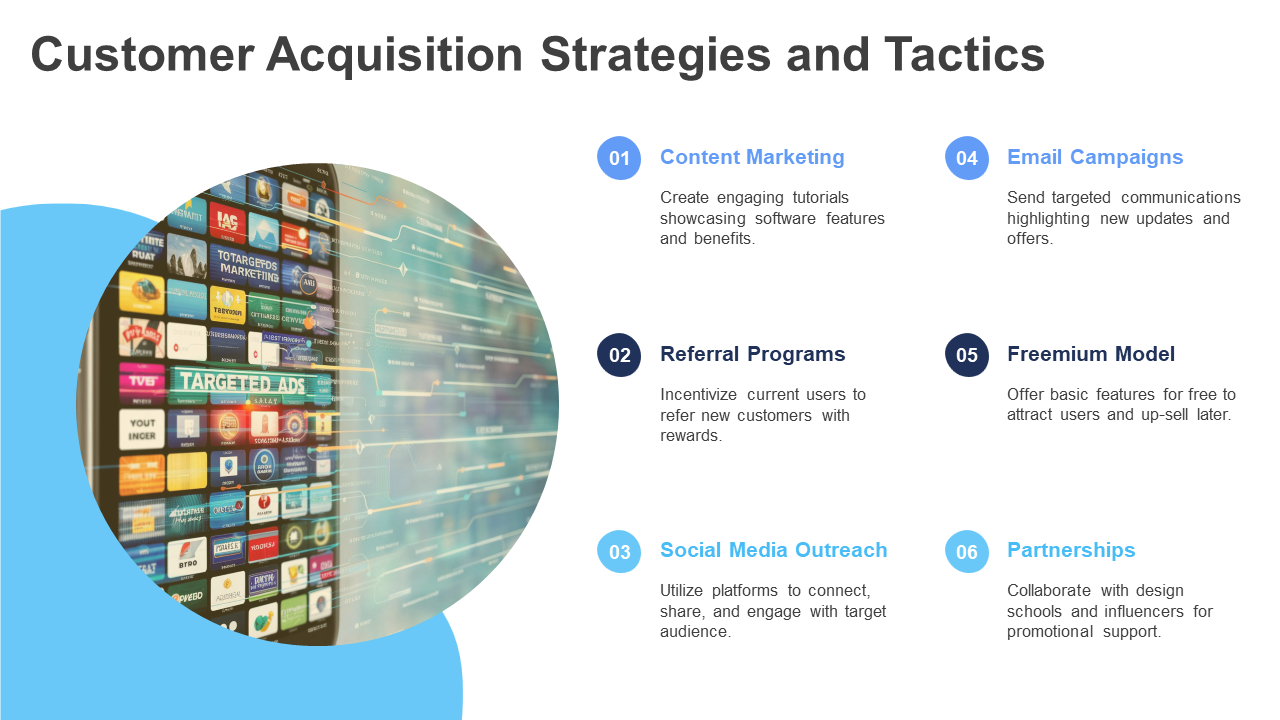
Template 10 - Customer Acquisition Strategies and Tactics Template
The strategies for customer acquisition on this slide are tailored for scalers of software companies that operate on Software as a Service (SaaS) and subscription-based models. The slide includes Content Marketing and Email Campaigns that display features and support the distribution strategy of software applications. The Referral Programs support organic growth, while Social Media Outreach enhances curated visibility for custom software solutions and B2B software service offers. These strategies are integrated into the software product lifecycle, benefiting users, consumption in white-label software models, pay-per-use plans, and enterprise software sales.
Conclusion
This extensive offering of templates is pivotal or a scalable software company business model that meets future demands. The templates provide actionable recommendations for customer acquisition, marketing, testing standards, and revenue sources, including opportunities for growth, user engagement opportunities, and patentable opportunities to improve the software distribution model. These templates are adaptable enough to accommodate the new economy theme of open source monetization, white label models, and Platform-as-a-Service (PaaS) approaches. To serve startups and enterprise software selling, these professionally structured templates, guides, tools, and processes support effective and efficient planning and implementation across the entire organization, allowing teams to launch, experiment, and scale at the velocity a software company needs. Use these templates to help align your operations with your changing business and marketplace needs, so you are always prepared to capitalize on the ever-changing, agile, and innovative digital space.
FAQs on Software Company Business Model
1. What are the four types of business models?
Four business models are commonly referred to when evaluating software companies: Business-to-Consumer (B2C), Business-to-Business (B2B), Subscription-based, and Freemium. B2C businesses sell directly to end users, often through the platform or digital storefronts. B2B businesses exist when you sell products or services to other businesses. B2B businesses are common, for instance, in enterprise-level software sales or when you offer custom software solutions to businesses. In a subscription-based business model, you could offer regular access to products or services, such as a company selling software as a service (SaaS) or a cloud software company. Finally, Freemium businesses usually provide free access to basic features and monetize through upgrades featuring premium content
.
2. What is the business model of tech companies?
Generally, tech companies base their models on delivering digital products or services using a model such as SaaS (Software as a Service), freemium, subscription, or pay-as-you-go. Software-based companies, for example, leverage cloud business models, provide custom software, offer licensing, or sometimes offer PaaS (Platform as a Service), leveraging technical infrastructure to build a business proposition. In summary, tech-based business models generally combine innovative product development, expansion-driven scalability, and targeted data-driven marketing to preserve an ongoing growth strategy within the lifecycle of the software product process and the associated software distribution strategies.
3. What is the startup business model?
A startup business model describes how a new venture delivers, creates, and captures value, usually through innovative products or services. Some standard business models in the tech sector are the SaaS model, freemium model, pay-per-use model, and open-source monetization. Ultimately, effective business models combine licensing and user-based pricing for B2B software services to maximize profits from business users, and then employ marketing, distribution, and maintenance to sustain and grow the venture over the long term, even in a dynamic, highly competitive landscape.