




 0 Comment
 Customer Reviews

The deck's been sitting in the shared drive for two weeks. Nobody's touched it.
Not because the process isn't broken—it clearly is. Shipments are delayed, approvals loop back three times, and the ops team keeps fielding the same complaint on different days. The problem's obvious. Documenting it in a way that actually gets something done? That's where things stall.
There's a specific kind of paralysis that sets in when you're asked to build a business process improvement plan from scratch. You know what's wrong. You've probably known for months. But translating that frustration into a structured, presentable plan—one that leadership will approve, that teams will follow, that has actual timelines and owners and metrics—that's a different task entirely.
And it's not just the writing. It's the structure. Where do you start? Root cause analysis first, or current-state mapping? Do you lead with the KPIs or the workflow gaps? Do you present it as a one-page summary or a full deck with phase breakdowns?
Most people do what's comfortable: they build something that looks like a plan but functions more like a status report. Long on description, short on action. The continuous improvement framework gets buried under context. The performance metrics show up without baselines. The stakeholder section is just a list of names.
So the templates exist. Not because the thinking is hard—it is, but that's not the point. They exist because structure is half the work, and starting from a blank slide costs more time than most teams can afford.
SlideTeam's business process improvement plan templates handle that structural problem directly. Pre-designed layouts for timelines, process maps, improvement cycles, and strategy frameworks—so you can put your actual analysis into slides that already know what they're supposed to say. Content-ready, customizable, and built around the real stages of process improvement work.
Here's what's in the collection.
Template 1: Business Process Improvement Plan Timeline
Tracking a business re-setup without a clear timeline is where most improvement efforts lose momentum. This PowerPoint slide is built for project leads and operations managers who need to map every task against real dates and owners. It captures task names, durations, start and finish dates, completion percentages, and ownership — all in one view. Process managers presenting a business process improvement plan will find this PPT preset particularly useful for accountability reviews. The template is 100% editable and customizable.

Download this PowerPoint Template
Template 2: Process Approach Business Representing Management Planning Improvement
Process management rarely fails for lack of effort — it fails for lack of a clear visual structure. This deck is built for operations leads and business analysts who need to present management planning and improvement in a credible, organized way. Twelve thematically consistent slides let you walk a room through current-state analysis, workflow improvement strategy, and next steps without losing coherence. The template is 100% editable and customizable.
[product_image id=395041]
Template 3: Business Process Improvement Steps to Achieve More Efficient Result
A five-stage improvement cycle drives measurable results when each phase is clearly visualized. This framework captures Initiate, Explore, Improve, Implement, and Celebrate — turning abstract progress into a structured sequence. Each stage anchors your audience's attention and keeps process improvement methodology on track. Build compelling operational efficiency presentations with clarity and precision. Transform your business process improvement plan decks today. Download this dynamic template now and unlock results-driven communication.

Download this PowerPoint Template
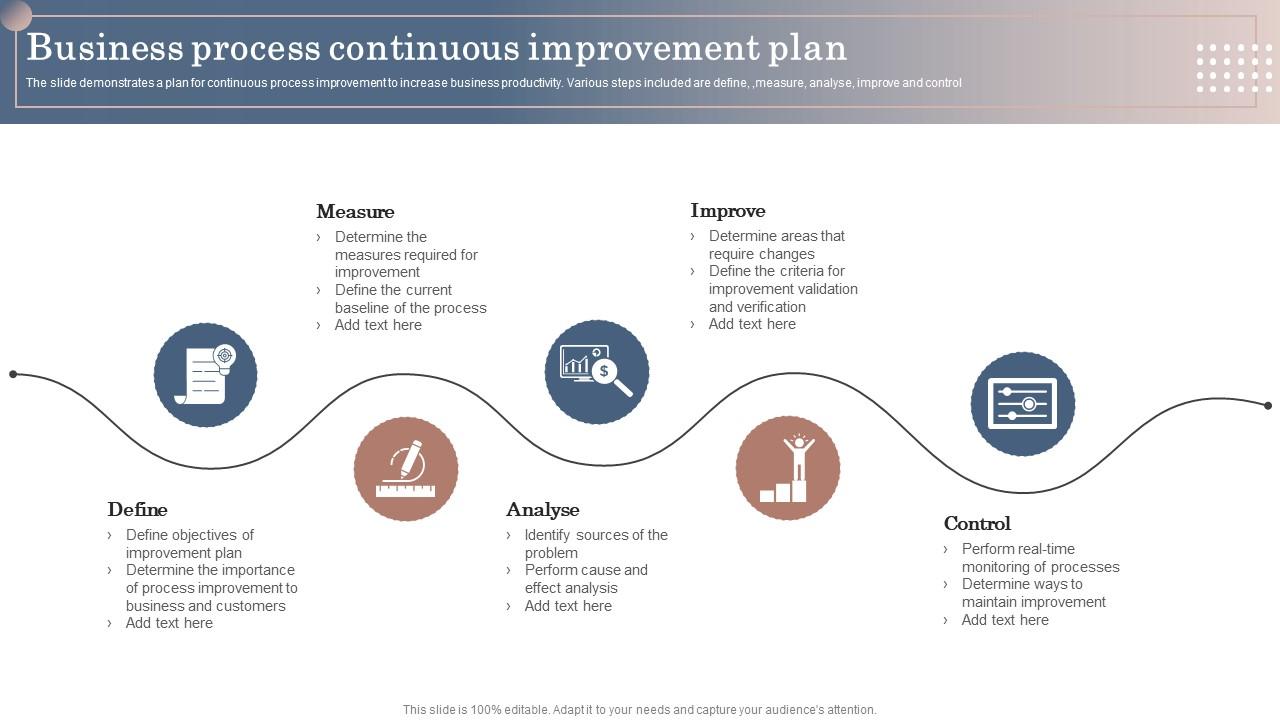
Template 4: Business Process Continuous Improvement Plan
Continuous improvement only holds when teams can see the full cycle, not just individual steps. This PPT template is built for quality managers and ops leads running a Define-Measure-Analyse-Improve-Control cycle to lift business productivity. It's the kind of slide that works in a Six Sigma methodology review or a lean process improvement rollout — where each phase needs its own visible weight. For teams implementing a business process improvement plan, this PPT preset makes the cycle legible to every stakeholder in the room. The template is 100% editable and customizable.
Download this PowerPoint Template
Template 5: Business Process Improvement Feedback Presentation Outline
Structured improvement starts with a clear presentation framework that everyone can follow. This five-stage outline covers quality improvement teams, total participation, customer focus, systematic problem solving, and statistical quality control. Each stage connects directly to measurable outcomes and team accountability. Present a complete business process analysis with confidence and precision. Transform your improvement planning presentations today. Download this dynamic template now and elevate your quality management communication.

Download this PowerPoint Template
Template 6: Continuous Improvement Process Outline for Creating New Business Plan
Building a new business plan demands a continuous improvement process that accounts for strategy, industry, and revenue simultaneously. This five-stage framework gives teams a clear sequence to follow from initial planning through iterative refinement. Each stage is visually distinct, making complex dependencies easy to communicate. Drive clarity in your operational excellence presentations with structured, professional layouts. Transform your continuous improvement framework today. Download this dynamic template now and unlock sharper business planning outcomes.

Download this PowerPoint Template
Template 7: Outline for Continuous Business Process Improvement
Most continuous improvement efforts stall not because of bad ideas but because the process itself isn't visible to the people running it. This PPT template is built for ops managers and process owners who need to present an Implement-Process-Analyse cycle in a structured, repeatable format. It works well in business process management reviews where teams need to align on what comes next. For anyone looking at business process improvement implementation, this slide makes the cycle concrete and discussable. The template is 100% editable and customizable.

Download this PowerPoint Template
Template 8: Business Process Improvement Plan Timeline PPT Summary
A timeline without visual clarity is just a list of dates — useful to nobody in a room. This PPT preset is built for project managers and ops leads who need to present a business process improvement plan timeline in a format that holds audience attention. It pairs structured phase tracking with clean design, making it easier to run stakeholder reviews and progress check-ins. The template is 100% editable and customizable.
[product_image id=1539958]
Template 9: Business Process Analysis and Improvement Plan Action Steps PPT Outline
Business process analysis is most useful when the findings and the improvement plan live in the same presentation. This deck is built for analysts and operations leads who need to move a room from current-state diagnosis to actionable next steps without losing the thread. It balances simplicity with enough structure to carry a full business process redesign conversation. Teams preparing a formal business process improvement proposal will find this PPT preset a practical starting point. The template is 100% editable and customizable.
[product_image id=1556504]
Template 10: Business Process Improvement Five Connected Steps PPT
Five connected steps give any improvement initiative a clear visual spine that audiences can follow in real time. This layout merges creativity with functional flow, ensuring each stage of your process improvement methodology lands with impact. The five-step sequence simplifies complex workflows into an intuitive, boardroom-ready structure. Use it for client pitches, operational reviews, or internal planning sessions. Transform your process efficiency presentations today. Download this dynamic template now and unlock sharper workflow communication.
[product_image id=1539957]
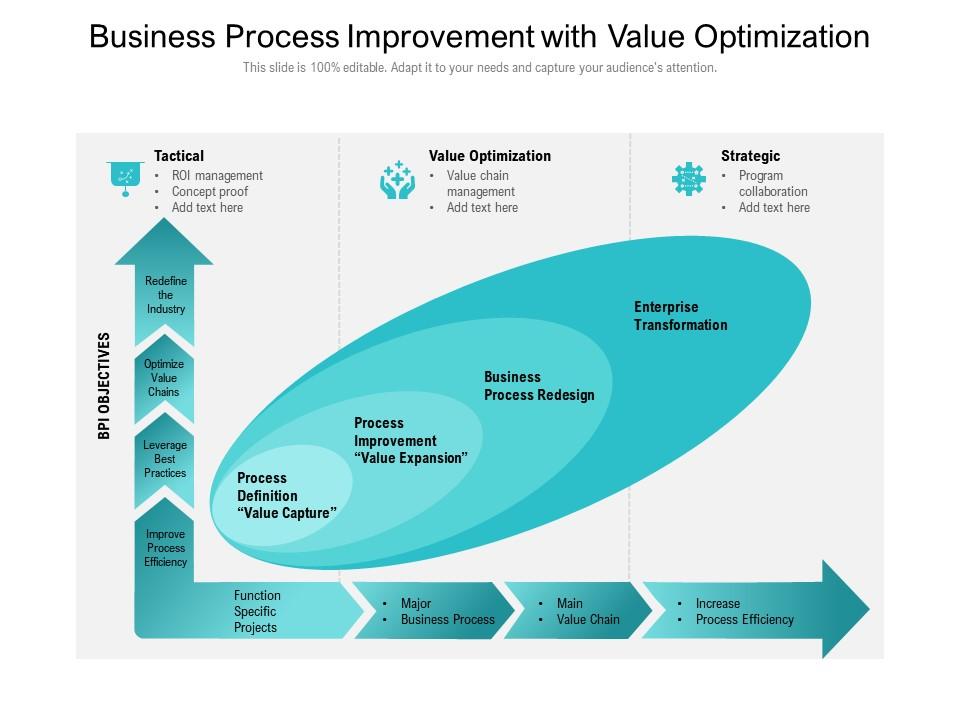
Template 11: Business Process Improvement with Value Optimization
Value optimization rarely happens at one level — it requires tactical, value-focused, and strategic thinking working together. This three-stage framework captures that full range, giving teams a visual anchor for business optimization strategy conversations. Each stage translates directly into action items your audience can track. Present your business process improvement plan with authority and structure. Transform your value optimization presentations today. Download this dynamic template now and deliver strategic clarity to every stakeholder.
Download this PowerPoint Template
Template 12: Continuous Business Process Improvement Plan OPs Check-In PPT
Efficiency in business processes depends on a cycle that teams can actually follow and repeat. This PPT slide is built for operations managers who need to present a four-stage continuous improvement plan — covering process management, objective-setting, evaluation, and process improvement itself. It's the kind of deck that fits a KPI tracking and improvement review or a quarterly ops check-in. For context, each stage is visually distinct, so the logic of the cycle is clear without additional explanation. The template is 100% editable and customizable.

Download this PowerPoint Template
Template 13: Business Plan Writing and Best Practices PPT
Strong business plan writing depends on structure as much as content. This complete deck captures best practices across every planning stage, giving teams a professional framework to work from immediately. Each slide is crafted to grab audience attention and keep complex information organized and clear. Build compelling business optimization strategy presentations with confidence. Transform your business plan writing process today. Download this dynamic template now and unlock persuasive, well-structured planning decks.
[product_image id=1529354]
Template 14: Business Process Improvement Plans PPT Designs
Good process improvement designs communicate intent before a single word is read. This complete deck delivers professional layouts purpose-built for business process improvement plans across multiple scenarios. Each slide commands instant attention while keeping your content structured and easy to follow. Present improvement initiatives, performance metrics, and workflow gaps with visual authority. Transform your process improvement presentations today. Download this dynamic template now and unlock designs that make your message impossible to ignore.
[product_image id=1753818]
Template 15: Business Process Improvement Sex-Step Planning PPT
Six clear steps give every improvement initiative a repeatable structure teams can act on immediately. This slide covers recognizing issues, analyzing and identifying root causes, redesigning, implementing, communicating, and monitoring outcomes. Each stage builds organizational productivity through disciplined, sequential action. Present your full business process improvement planning sequence with precision and clarity. Transform your operational excellence presentations today. Download this dynamic template now and unlock a framework your teams will actually use.
[product_image id=938411]
Template 16: Six-Month Continuous Process Improvement Plan PPT
A six-month improvement timeline makes planning concrete — weeks become milestones, milestones become accountability. This deck captures a continuous process improvement plan across a structured half-year arc, balancing simplicity with enough detail to drive real decisions. Each phase is visually distinct, so progress reviews stay focused and productive. Present your operational efficiency plan with clarity and confidence. Transform your improvement planning presentations today. Download this dynamic template now and unlock a roadmap your stakeholders can trust.
[product_image id=1731796]
Template 17: Effective Strategies for Business Process Improvement PPT
Effective strategies need a presentation that matches their ambition — not a generic slide deck. This template delivers a visually striking framework for communicating business process improvement strategies to any audience. Each layout is built for impact, whether you're in a boardroom review or a client strategy session. Present lean process improvement and workflow efficiency initiatives with authority. Transform your strategy presentations today. Download this dynamic template now and unlock a deck that turns ideas into decisions.
[product_image id=1486206]
Template 18: Business Process Improvement Strategies PPT Guidelines
Process improvement guidelines only work when they're presented in a format people will actually read. This complete deck pairs strong visual design with flexible layouts built for business process improvement strategies. Brand-aligned color schemes and pre-designed structures save time without sacrificing professional quality. Present your improvement methodology clearly to any internal or external audience. Transform your business process management presentations today. Download this dynamic template now and elevate every guideline into a compelling, actionable slide. For more on business process improvement templates, explore SlideTeam's full collection.
[product_image id=1836883]
Template 19: Identifying Lead Qualification Process for Clear Business Process Improvement Plan
Lead qualification is one of the most process-sensitive parts of any revenue operation. This PPT template is built for sales operations and marketing leads who need to map unqualified leads through to conversion-qualified leads across multiple channels. It's a practical fit for business process analysis sessions where teams are diagnosing where pipeline value leaks. So yeah, if the improvement plan touches revenue workflows, this slide makes the qualification funnel legible fast. The template is 100% editable and customizable.

Download this PowerPoint Template
Template 20: Business Process Improvement Strategies to Resolve Issues PPT
Process failures cost more when nobody's mapped the fix against the problem. This slide directly addresses common business issues — shipping errors, waste from poor purchasing, and process failure planning — with matched improvement areas for each. Two clear stages make the structure easy to present and even easier to act on. Build targeted process bottleneck solutions with specificity and credibility. Transform your operational issue presentations today. Download this dynamic template now and deliver improvement strategies that solve real problems.
[product_image id=918829]
Elevate Every Process Improvement Presentation with SlideTeam
SlideTeam's PowerPoint templates are the best in the industry for building a business process improvement plan that drives real outcomes. Their content-ready layouts cover everything from continuous improvement frameworks and KPI tracking to root cause analysis and workflow redesign — saving you hours of structuring time. Use these ready-made slides to present your operational efficiency plan with authority and clarity. Deploy these templates to turn process insights into decisions stakeholders will act on.
FAQs on Business Process Improvement Plan
What are the key components that must be included in a business process improvement plan to ensure measurable outcomes?
A solid plan needs four things: a clear problem statement, baseline metrics, defined improvement actions with owners, and a review schedule. Without baseline data, you can't measure change. Without owners, nothing moves. The improvement actions must be specific — not "reduce delays" but "cut approval time from 5 days to 2." A review cadence (weekly or monthly) keeps the plan alive after launch.
How do you identify which business processes require immediate improvement versus those that can be optimized over time?
Start with impact and frequency. Processes that fail often and affect customers or revenue come first. Processes that fail rarely or have low business impact can wait. A quick two-axis matrix — impact vs. effort — helps prioritize fast. Talk to frontline teams, not just managers; they know where the real friction is. Data on error rates, cycle times, and complaint volumes confirms the ranking.
What methodologies, such as Lean or Six Sigma, are most effective for structuring a business process improvement plan?
Lean works best when the main issue is waste — unnecessary steps, waiting, or duplication. Six Sigma fits problems with measurable defects and data to analyze. For rapid, iterative fixes, Agile process improvement cycles work well. Most organizations combine two: Lean to cut waste first, then Six Sigma to reduce variation. Pick based on the problem type, not popularity.
How can organizations establish baseline metrics before implementing a business process improvement plan?
Run the current process as-is and record key numbers: cycle time, error rate, cost per transaction, and throughput. Do this for at least two to four weeks to avoid anomalies. Document the steps in a process map while collecting data. These numbers become your before-state. Without them, post-improvement claims are opinions, not evidence.
What role does stakeholder buy-in play in the successful execution of a business process improvement plan?
Without buy-in, even well-designed improvements stall at execution. Stakeholders block resources, delay approvals, or quietly revert to old habits. Involve key people early — before the plan is finalized, not after. Show them how the change affects their own metrics. Decision-makers need the business case; frontline teams need reassurance that the change makes their work easier, not harder.
How do you prioritize process improvement initiatives when resources and budgets are limited?
Score each initiative on two dimensions: expected impact and cost to implement. High-impact, low-cost items go first — always. Bundle smaller fixes that share the same process area to save effort. Drop initiatives where the ROI is unclear or the timeline exceeds 12 months without an interim result. Revisit the priority list quarterly as constraints shift.
What are the most common pitfalls organizations face when developing a business process improvement plan?
The three most common failures: starting without baseline data, skipping root cause analysis and fixing symptoms instead, and not assigning clear ownership. A fourth is declaring success too early — before the change is embedded in daily work. Plans also fail when they stay in decks and never reach the teams doing the actual process. Communication and follow-through are where most efforts break down.
How can process mapping tools be leveraged to visualize inefficiencies before creating an improvement plan?
Draw the current process step by step before building any improvement plan. Tools like swimlane diagrams or simple flowcharts make handoffs and delays visible immediately. Mark every step where work waits, loops back, or requires manual intervention. These are your bottlenecks. A process map shared with the team often surfaces issues that data alone misses — people recognize their own pain points when they see the diagram.