


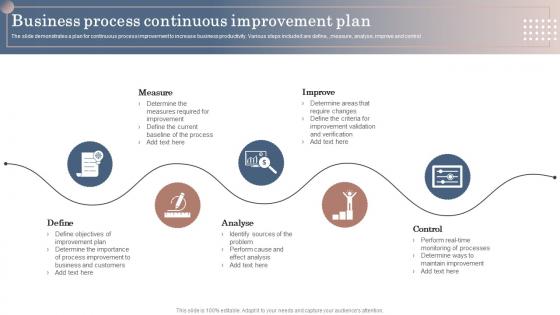
Business Process Continuous Improvement Plan




Try Before you Buy Download Free Sample Product
 Impress Your
 Audience
 100%
100% Editable
 Save Hours
 of Time


The slide demonstrates a plan for continuous process improvement to increase business productivity. Various steps included are define, measure, analyse, improve and control.
People who downloaded this PowerPoint presentation also viewed the following :
Business Process Continuous Improvement Plan with all 6 slides:
Use our Business Process Continuous Improvement Plan to effectively help you save your valuable time. They are readymade to fit into any presentation structure.





FAQs for Business Process
Key indicators include declining productivity metrics, increasing customer complaints, rising operational costs, employee frustration with workflows, and missed deadlines or quality targets. These warning signs typically manifest across departments through bottlenecks, redundant tasks, and manual processes, with many organizations finding that addressing these indicators early prevents competitive disadvantage and enhances overall efficiency.
Technology integration enhances business process improvement by automating routine tasks, providing real-time data analytics, and enabling seamless workflow coordination across departments. Through AI-powered automation and cloud-based platforms, organizations in manufacturing, healthcare, and financial services streamline operations, reduce processing times, and improve accuracy, ultimately delivering enhanced operational efficiency and competitive advantage.
Employee feedback serves as a critical diagnostic tool for identifying process inefficiencies, bottlenecks, operational gaps, and automation opportunities that management might overlook. Through regular surveys, focus groups, and suggestion systems, organizations uncover specific pain points, streamline workflows, and enhance productivity, with many companies finding that frontline insights deliver the most impactful process improvements.
Effective business process improvement methodologies include Lean Six Sigma, Business Process Reengineering, Value Stream Mapping, Process Mining, and Kaizen continuous improvement approaches. These methodologies streamline operations by eliminating waste, identifying bottlenecks, and optimizing workflow efficiency, with manufacturing, healthcare, and financial services organizations finding that strategic process redesign delivers faster cycle times, reduced costs, and enhanced customer experiences.
Organizations can measure business process improvement success through key performance indicators like cycle time reduction, cost savings, error rates, customer satisfaction scores, and employee productivity metrics. These measurements enable companies to track operational efficiency gains, quantify return on investment, and identify areas requiring further optimization, with many finding that regular monitoring delivers sustained competitive advantage and continuous improvement momentum.
Common pitfalls include insufficient stakeholder engagement, inadequate change management, lack of clear success metrics, rushing implementation without proper testing, and failing to address employee resistance. These challenges can derail projects by creating workflow disruptions, reduced productivity, and poor adoption rates, with many organizations finding that thorough planning, comprehensive training, and phased rollouts ultimately deliver smoother transitions and sustainable improvements.
A culture of continuous improvement enhances business performance by fostering employee engagement, streamlining operational efficiency, and accelerating innovation across all departments. This approach enables organizations to reduce costs, minimize waste, and respond more quickly to market changes, with many companies in manufacturing and financial services finding that sustained improvement initiatives ultimately deliver higher profitability and competitive advantage.
Stakeholder engagement techniques include collaborative workshops, process mapping sessions, regular feedback loops, cross-functional teams, and transparent communication channels. These approaches streamline buy-in by involving stakeholders in problem identification, solution design, and implementation planning, with many organizations finding that early engagement reduces resistance while enhancing process adoption and long-term success.
Business process mapping aids in identifying inefficiencies by visualizing workflows, revealing bottlenecks, and highlighting redundant steps across operations. Through detailed mapping, organizations can pinpoint delays in approval processes, eliminate duplicate data entry tasks, and streamline communication gaps, ultimately reducing operational costs and accelerating service delivery while enhancing overall productivity.
Leadership support significantly impacts process improvement success by securing necessary resources, driving organizational buy-in, and removing implementation barriers. Through executive sponsorship, companies streamline change management, enhance employee engagement, and accelerate adoption rates, with many organizations finding that visible leadership commitment ultimately delivers faster results, reduced resistance, and sustainable operational improvements across departments.
Data analytics drives informed decision-making for process optimization by identifying bottlenecks, measuring performance metrics, predicting outcomes, and revealing inefficiency patterns across operations. Through advanced analytics tools, organizations in manufacturing, healthcare, and financial services can reduce operational costs, accelerate cycle times, and enhance resource allocation, ultimately delivering competitive advantage and measurable ROI improvements.
Best practices for implementing lean principles include value stream mapping, waste elimination, continuous improvement culture, employee engagement, and standardized processes. These methodologies streamline operations by reducing redundancies, minimizing bottlenecks, and enhancing workflow efficiency, with many manufacturing and service organizations finding that systematic lean implementation delivers significant cost reductions and improved customer satisfaction.
Organizations ensure sustainability by establishing robust monitoring systems, creating standardized documentation, and implementing regular review cycles to track performance metrics. Through continuous employee training, clear accountability structures, and systematic feedback loops, companies maintain process improvements while adapting to evolving business needs, ultimately delivering long-term operational efficiency and competitive advantage.
Agile methodology enhances business process improvement by enabling iterative refinement, rapid feedback incorporation, and continuous adaptation to changing requirements. Through short sprint cycles and collaborative frameworks, organizations streamline workflows, reduce waste, and accelerate implementation timelines, with many companies finding that agile approaches deliver faster results and improved stakeholder engagement.
Organizations should prioritize process improvement by evaluating impact on customer experience, cost reduction potential, resource requirements, and strategic alignment with business goals. Many companies find success targeting high-volume, customer-facing processes first, such as order fulfillment or service delivery, as these improvements deliver immediate competitive advantage while building momentum for broader organizational transformation initiatives.
-
Thanks to SlideTeam, we have an ideal template to present all the info we need to cover. Their slides give our numbers and projections a more clear and enchanting look.
-
Wow! The design and quality of templates on SlideTeam are simply the best.