

 0 Comment
 Customer Reviews

The business plan's been sitting in a folder for two weeks. Renamed three times. Still not done.
Opening a convenience store sounds deceptively simple—products on shelves, a register, a location. But the moment someone asks about your financial projections, your convenience store location strategy, or how you plan to compete with the supermarket two blocks away, the folder stays closed.
It's not that the answers don't exist. Most entrepreneurs know their market. They've walked the neighborhood, counted the foot traffic, talked to potential suppliers. The problem isn't knowledge. It's the gap between what you know and what a plan actually looks like on paper—formatted, structured, credible.
There's also the audience problem. A convenience store business plan isn't written for one person. It's for the bank loan officer who's read 40 plans this month. The potential investor who wants to see your convenience store financial projections before anything else. The franchise partner who needs to trust your numbers. Each of them reads it differently. Each of them is looking for something specific.
And the document has to hold up under all of that. Which is why most people avoid starting it.
The blank slide is the real problem—not the content. Once someone builds the structure, fills in the sections, and shows what a solid plan actually looks like, it gets easier. That's why templates exist. Not to replace thinking, but to carry the structure so the thinking can happen faster.
SlideTeam's convenience store business plan templates do exactly that. Pre-designed, content-ready frameworks built for retail entrepreneurs, small business owners, and anyone who needs to present a store concept without starting from nothing. The slides handle the scaffolding—executive summary, market analysis, revenue model, organizational structure—so you can focus on what's actually specific to your store.
Here are the templates worth looking at.
Template 1: Annual Sales Territory Plan for Convenience Stores
Pinpoint exactly which territories are underperforming with this focused sales planning tool. The structured layout maps sales coverage, goals, action steps, and measurable impact side by side. Clear visual organization drives instant clarity across multiple store territories at once. You can align regional objectives with specific action plans to close coverage gaps fast. Built for convenience store operators managing multi-territory performance reviews, this template keeps every stakeholder aligned. Transform your territorial sales presentations today. Download this dynamic template now and unlock sharper sales coverage decisions.

Download this PowerPoint Template
Template 2: Convenience Store Business Plan PDF Word Document
A solid convenience store business plan needs more than a good idea — it needs structure a lender or investor can follow. This PPT preset covers executive summary, SWOT analysis, Porter's Five Forces, market sizing, and convenience store financial projections in one cohesive document. It walks through startup expenses, growth projections, and both offline and online marketing approaches. Practitioners building a small convenience store startup guide or a full retail store business plan reach for this deck first. Explore more convenience store business plan samples and examples to sharpen your approach. The template is 100% editable and customizable.
[product_image id=822952]
Template 3: Convenience Store Business Plan PPT Presentation
Getting a convenience store business model on paper — clearly, without clutter — is harder than it sounds. This PPT template gives practitioners a clean, balanced deck that communicates the core of a store concept without overcomplicating it. It works for early-stage founders walking investors through a convenience store startup costs overview or for operators updating a franchise partner on business direction. The slide structure keeps the audience focused on what matters. The template is 100% editable and customizable.
[product_image id=1590325]
Template 4: Convenience Store and Customer Experience PPT Structure
Customer experience is where convenience stores win or lose repeat business. This visually engaging deck captures every touchpoint—store layout, service flow, product placement, and brand identity—in one cohesive structure. Striking design elements ensure your audience stays focused on what actually differentiates your store. You can align visual themes precisely with your brand to build instant credibility. Ideal for retail operators presenting customer journey reviews or experience redesign proposals to leadership teams. Transform your customer experience presentations today. Download this dynamic template now and elevate every store interaction you present.
[product_image id=1620096]
Template 5: Convenience Store Types and Their Unique Business PPT Summary
Not every convenience store runs on the same model — gas station formats, urban mini marts, and franchise outlets each carry distinct business logic. This PPT preset helps practitioners lay out those differences clearly for investors, partners, or internal planning teams. It covers the key variables that separate one store type from another, from convenience store revenue streams to customer demographics. Whether you're building a gas station convenience store business plan or comparing mini mart formats, this slide makes the distinctions visible. The template is 100% editable and customizable.
[product_image id=1620097]
Template 6: Annual Sales Plan PPT Information
Annual sales planning needs a deck that keeps teams focused on targets, not formatting. This structured template maps out the full year — revenue goals, action steps, territory priorities, and performance milestones — in a clean, readable format. Bold visual hierarchy ensures leadership and field teams read the same priorities instantly. Flexible layouts let you adapt the plan to any store count or sales cycle without rebuilding from scratch. Built for retail managers and business owners presenting annual sales reviews or growth forecasts. Transform your annual sales planning presentations today. Download this dynamic template now and drive alignment across every territory.
[product_image id=1534644]
Template 7: Annual Sales Territory Plan for Convenience Stores PPT Example
Territory planning for convenience stores requires clarity — who owns which area, what the targets are, and how performance gets tracked. This visually sharp deck blends creativity and structure to communicate sales territory assignments and action plans without clutter. Customizable color schemes let you differentiate territories instantly for any audience. Regional managers presenting coverage plans or convenience store market research findings will find the layout immediately usable. The polished aesthetic builds credibility before you say a word. Transform your territory planning presentations today. Download this dynamic template now and command every regional sales conversation.
[product_image id=1534645]
Template 8: Convenience Store Business Plan PowerPoint Presentation Slides
Serious business development needs a document that answers investor questions before they're asked. This deck covers the full arc — company history, transaction records, stakeholder capacity, and forward-looking plans — in one well-researched structure. Custom charts and graphs make your convenience store financial projections statistically sound and visually persuasive. Every section is built to leave a lasting impression on lenders, partners, and acquisition reviewers. Ideal for entrepreneurs presenting a comprehensive convenience store business plan to external stakeholders. Transform your business plan presentations today. Download this dynamic template now and unlock the credibility your expansion needs.
[product_image id=1172210]
Template 9: Convenience Store Business Plan Highlighting Major Challenges Faced by Supermarket
Every viable business plan must confront the hard part: what can go wrong. This slide surfaces the six major operational challenges facing supermarkets and convenience stores — fierce competition, inefficient purchasing, inventory loss, and more. Each challenge is framed clearly so presenters can address it head-on, not sidestep it. The six-stage layout guides audiences through problems and their business implications in a logical sequence. Built for founders and operators presenting risk assessments or operational reviews to boards and investors. Transform your challenge assessment presentations today. Download this dynamic template now and turn every obstacle into a conversation you control.
[product_image id=1173299]
Template 10: Convenience Store Business Plan Strategic Business Model for Supermarket
Understanding how a supermarket actually operates — partners, activities, resources, revenue streams — is the starting point for any serious business plan. This PPT template maps the full convenience store business model on a single structured slide. It gives operations leads and founders a shared reference point for planning discussions. Whether you're presenting to a board or aligning a new management team, this deck keeps the conversation grounded. The template is 100% editable and customizable.
[product_image id=1173315]
Template 11: Convenience Store Business Plan Executive Summary of Supermarket Startup
The executive summary is the first thing an investor reads and often the last thing a founder writes well. This PPT slide gives supermarket startup founders a clean, focused structure to present current market status, growth opportunities, and entity details in one view. It covers product categories — groceries, beverages, healthcare products — alongside the pitch that ties them to market demand. For anyone building a convenience store startup costs overview or a full investor deck, this slide sets the right tone early. The template is 100% editable and customizable.
[product_image id=1173296]
Template 12: Convenience Store Business Plan Product and Services Offered by Supermarket
Laying out what a store actually sells — and why that range matters — is a surprisingly hard slide to build from scratch. This PPT preset covers the full product and services offering of a supermarket, from electronics to everyday consumables, in a clean two-stage structure. It gives business plan writers a clear way to communicate product breadth to US and international audiences. Operators presenting to franchise partners or investors will find the layout direct and easy to follow. The template is 100% editable and customizable.
[product_image id=1173309]
Template 13: Agenda Convenience Store Business Plan
A business plan presentation without a clear agenda loses the room before the first data slide. This PPT template gives convenience store business plan decks a six-stage agenda structure that orients every audience — investors, partners, internal teams — from the first minute. It signals professionalism and makes navigation through a long deck far easier. Plan writers presenting to stakeholders who need a clear roadmap through the material will find this slide immediately useful. The template is 100% editable and customizable.
[product_image id=1173284]
Template 14: Convenience Store Business Plan Organizational Structure for Effective Business Operations
A clear org chart signals operational readiness to every investor and lender reviewing a business plan. This four-stage hierarchy slide maps the full structure — CEO, finance, distribution, merchandising, regional management, and administration — in one clean visual. Audiences immediately grasp how decisions flow and who owns each function. Built for convenience store founders presenting staffing plans or operators formalizing a growing team structure. This template drives confidence in your operational depth before a single question is asked. Transform your organizational structure presentations today. Download this dynamic template now and demonstrate the leadership clarity investors expect.
[product_image id=1173306]
Template 15: Convenience Store Business Plan Possible Exit Strategies for Supermarket
Exit planning is what separates serious entrepreneurs from optimists. This five-stage slide maps the full range of exit options — sell-offs, IPOs, mergers, acquisitions, and private offerings — with the criteria that trigger each. Investors appreciate seeing this section because it signals financial discipline and long-term thinking. Venture capital reviewers and acquisition advisors can follow the logic without additional explanation. Built for founders presenting complete convenience store business plans to sophisticated external audiences. Transform your exit strategy presentations today. Download this dynamic template now and show every investor you've planned beyond the launch.
[product_image id=1173308]
Template 16: Convenience Store Business Plan Effective Revenue Generation Model for Supermarket Startup
Revenue modeling is where a business plan either earns trust or loses it. This PPT slide presents a five-year convenience store cash flow and revenue generation model, broken down by population capture percentage and income sources from 2023 to 2027. It gives investors and analysts a concrete view of how the supermarket scales over time. Finance leads and startup founders presenting convenience store ROI analysis or growth projections will find this slide does the heavy lifting. The template is 100% editable and customizable.
[product_image id=1173294]
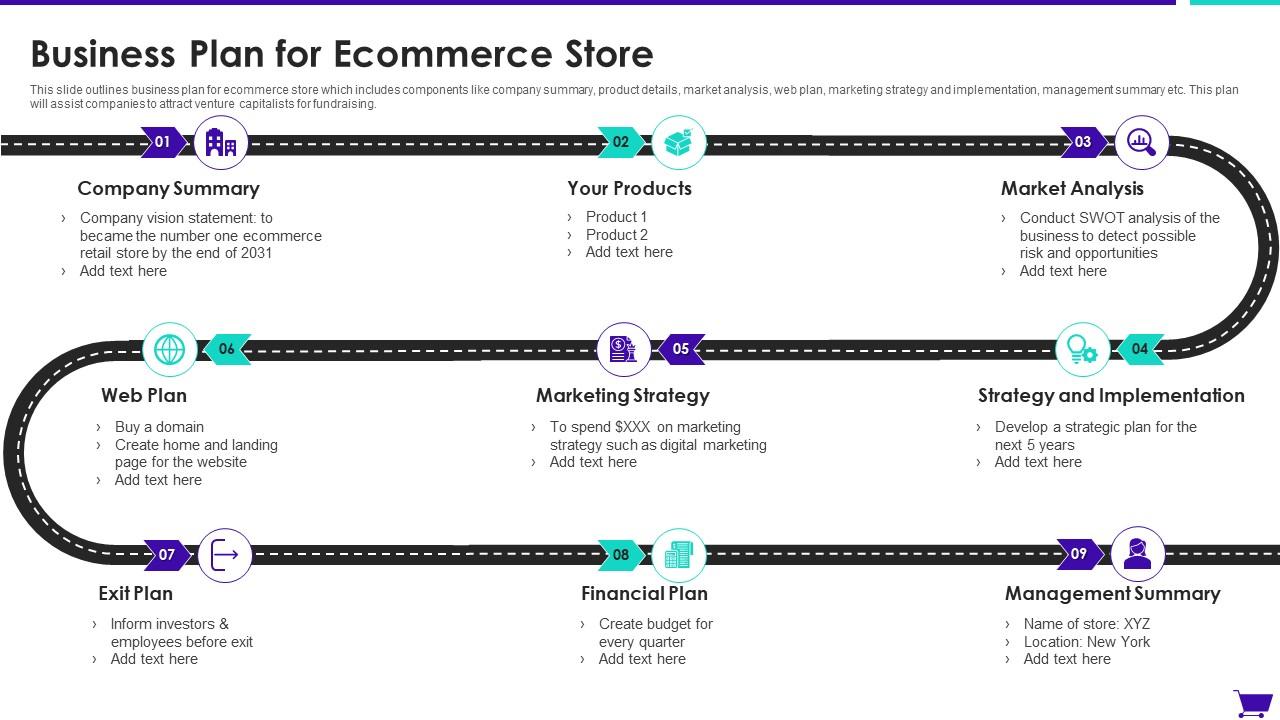
Template 17: Business Plan for Ecommerce Store
Ecommerce has changed how retail businesses attract investors, and a well-structured business plan reflects that shift. This PPT preset covers nine key components — company summary, product details, market analysis, web plan, marketing, and management — in a single cohesive deck. It gives founders a credible document to present to venture capitalists during fundraising conversations. For convenience store operators building hybrid retail and online models, this deck bridges physical and digital planning clearly. The template is 100% editable and customizable.
Download this PowerPoint Template
Template 18: Convenience Store Business Plan Key Abbreviations Used in the Plan
Business plans that span multiple sections — finance, operations, marketing, SEO strategy — often rely on abbreviations that not every stakeholder knows. This six-stage slide lists the key abbreviations used throughout the plan, giving readers a shared reference before they encounter the terms in context. It reduces friction for investors, legal reviewers, and new team members reading the plan for the first time. Founders building detailed convenience store business plans will find this slide keeps communication clean and professional. The template is 100% editable and customizable.
[product_image id=1173302]
Template 19: Create Competitive Advantage Business Effective Marketing Convenience Store
Competitive advantage doesn't explain itself — it has to be shown clearly. This four-stage graphic maps the marketing approach a convenience store uses to stand out, covering the key pillars that move customers from awareness to preference. The visual structure makes it easy for leadership teams to align on which advantages to prioritize and communicate. Founders building a convenience store marketing strategy section for their business plan will find this slide direct and immediately usable. The template is 100% editable and customizable.

Download this PowerPoint Template
Template 20: Convenience Store Business Plan Analyzing and Selecting Business Location for Supermarket
Location is one of the highest-stakes decisions in any convenience store business plan, and this PPT slide makes the case for a specific site with data. It covers feasibility analysis, economic factors, and future sustainability in a structured single-stage layout. Practitioners using convenience store market research to justify a location choice will find this slide gives that analysis a credible, visual form. It reduces the risk of a site decision looking arbitrary to investors or franchise reviewers. The template is 100% editable and customizable.
[product_image id=1173285]
Elevate Your Convenience Store Business Plan with SlideTeam
SlideTeam's PowerPoint templates are the best in the industry for building a compelling convenience store business plan. These content-ready slides cover everything from financial projections and revenue models to organizational structure and location analysis — saving you hours of formatting work. Use these ready-made frameworks to present with confidence to investors, lenders, and franchise partners. Deploy these PowerPoint slides today and turn your store concept into a plan that gets funded.
FAQs on Convenience Store Business Plan
What are the key financial projections that should be included in a convenience store business plan?
Include a five-year revenue forecast, monthly cash flow statement, and break-even analysis. Add startup costs, operating expenses, and gross profit margin by product category. Lenders also expect a sales forecast tied to foot traffic estimates and customer transaction volume. Keep the numbers grounded in real cost data, not optimistic assumptions.
How do you determine the ideal location for a convenience store to maximize foot traffic and revenue?
Analyze foot traffic counts, nearby competitor density, and proximity to residential clusters or transit hubs. Check zoning rules and lease costs for each shortlisted site. A location with high daily footfall and low direct competition typically outperforms on revenue per square foot. Run a simple feasibility check before committing to any lease.
What inventory management strategies should a convenience store business plan address to minimize shrinkage and waste?
Set par-level reordering for fast-moving items to avoid both overstock and stockouts. Use a basic POS system to track shrinkage by category — theft and expiry are the two biggest drivers. Conduct weekly cycle counts rather than one annual audit. Limit back-stock access to reduce internal loss.
How does a convenience store differentiate itself from competitors like supermarkets and online delivery services?
Convenience stores compete on speed, proximity, and extended hours — not price or product breadth. Stock high-margin impulse items, fresh grab-and-go food, and local products that supermarkets don't carry. Loyalty programs and a fast checkout experience keep customers from switching to online delivery. Own the last-mile convenience that bigger retailers can't replicate.
What licensing and regulatory requirements should be outlined in a convenience store business plan?
At minimum, a retail business license, food handler's permit, and sales tax registration are required in most jurisdictions. Tobacco and alcohol sales require separate state-level permits. If fuel sales are planned, underground storage tank permits apply. Check local zoning approval before signing any lease — it's the step most founders skip.
How should a convenience store business plan address the integration of fuel sales alongside in-store merchandise?
Fuel and in-store sales operate on very different margin profiles — fuel is high-volume, low-margin; in-store is the opposite. The business plan should show how fuel traffic converts to in-store purchases, since that cross-sell is where profitability lives. Model fuel and merchandise revenue streams separately, then show the combined cash flow. Factor in environmental compliance costs for fuel storage upfront.
What role does technology, such as point-of-sale systems and self-checkout, play in modern convenience store operations?
A modern POS system tracks inventory in real time, flags shrinkage, and generates sales reports by category. Self-checkout reduces labor costs at peak hours without adding headcount. Loyalty program integration via POS drives repeat visits measurably. These aren't optional upgrades — they directly affect operating expense ratios and convenience store profit margin.
How do you calculate the break-even point for a convenience store, and what factors influence it most?
Divide total fixed monthly costs by your gross profit margin percentage to get the break-even sales volume. The biggest influencers are rent, labor, and average transaction value. A higher basket size — driven by product mix and upselling — lowers the break-even threshold faster than cutting costs. Revisit the calculation quarterly as costs shift.