

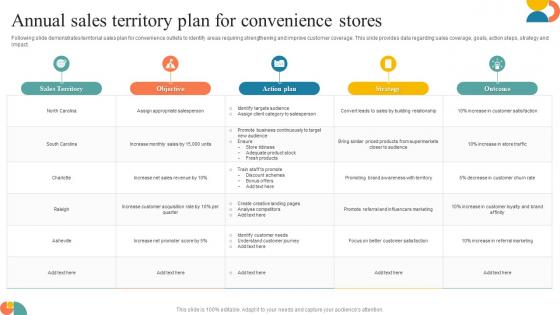
Annual Sales Territory Plan For Convenience Stores




Try Before you Buy Download Free Sample Product
 Impress Your
 Audience
 100%
100% Editable
 Save Hours
 of Time


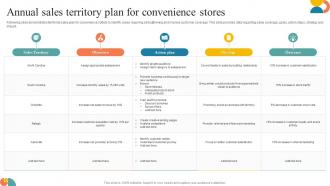
Following slide demonstrates territorial sales plan for convenience outlets to identify areas requiring strengthening and improve customer coverage. This slide provides data regarding sales coverage, goals, action steps, strategy and impact.
People who downloaded this PowerPoint presentation also viewed the following :
Annual Sales Territory Plan For Convenience Stores with all 6 slides:
Use our Annual Sales Territory Plan For Convenience Stores to effectively help you save your valuable time. They are readymade to fit into any presentation structure.





FAQs for Annual Sales Territory Plan
Look at where your money actually is first - which customers have the biggest potential and growth runway. Geography's huge too since you don't want reps burning gas all day (trust me on this one). Match territories to each person's sweet spot - maybe Sarah kills it with big enterprise deals while Mike owns the small business game. Balance is key though. You can't give someone all the goldmine accounts while another person gets scraps. The whole point is making sure everyone can realistically hit their targets without wanting to quit by December.
Dude, geographic data completely changes territory planning. Map out your current customers first - you'll probably see some weird gaps right away. Instead of randomly splitting accounts, you can actually look at drive times, customer density, and where competitors are crushing it. Makes way more sense than the old-school "just draw lines" method. Your reps get realistic coverage areas. Plus you can spot underserved markets and optimize routes based on real travel distances. Honestly, once you start analyzing demographics by location, the territory adjustments become pretty obvious. Way better than guessing.
Look, think of it like dividing up pizza slices - you don't want equal sizes, you want equal value. Market potential analysis helps you figure out which territories have the best revenue opportunities and customer density. That way you can put your sales reps where they'll actually make money, not just spread them around randomly. Gather up demographic data, check out competitor presence, and look at historical sales patterns first. The whole point is balancing workload while boosting overall performance. Honestly, skipping this step is how you end up with some reps crushing it while others struggle with dead zones.
First thing - grab your biggest accounts and spread them out so nobody gets screwed over. I made this mistake once giving someone like 200 tiny clients thinking it was "fair" - terrible idea! Revenue matters more than just counting accounts. Sometimes 50 enterprise deals is way harder than 150 small ones. Geography's huge too since drive time kills your actual selling hours. What I'd do is take your top 20% money-makers and distribute those first, then fill in around them. Don't just look at current revenue either - some accounts have crazy growth potential that isn't obvious yet.
Dude, if you're already using Salesforce, just go with Salesforce Maps - it's honestly pretty great and everything syncs up automatically. MapInfo and ArcGIS are crazy powerful but way too much unless you're doing some serious geographic stuff. Starting out? Google My Maps or even Tableau work fine for basic territory mapping. The thing is, doesn't matter how fancy the tool is if your team won't actually use it consistently. I'd just grab a free trial of whatever plays nice with your current CRM and see what sticks. Sometimes the simpler option wins out anyway.
Honestly, territory planning is a game changer for sales teams. No more stepping on each other's toes or fighting over the same prospects. Each rep gets their own turf to focus on, which means better results overall. The competition aspect is huge too - nobody wants to look bad compared to their teammates in the next territory over. Oh, and you'll actually be able to track what's working since everything's organized properly. I'd start by just mapping out who's covering what right now and see where people are overlapping. Trust me, it's messier than you think!
Honestly, the biggest mess-ups I see are making territories super lopsided - like one rep gets all the goldmines while another gets scraps. Don't just look at who's your "star performer" either; match territories to what people can actually handle. Geographic stuff matters way more than people think - I've watched reps burn out driving 6 hours between meetings. Revenue numbers are helpful but they're not everything. Look at growth potential and how complex those accounts actually are. Oh, and stop shuffling things around every quarter when someone has a bad month! Give it at least a full cycle before you panic and reorganize everything.
Honestly? Do it twice a year if you can manage it. Once annually is the bare minimum. Markets change fast, people quit, accounts shift around - you can't just set territories and forget about them for years. Pull performance data every quarter though, so you'll catch problems early. Big red flags that mean "fix this now": major turnover, losing a huge client, or when some territories are crushing it while others totally suck. I mean, why would you let that drag on? The teams that ignore this stuff for years always regret it later.
Track revenue stuff first - total sales, quota hits, average deal sizes per territory. But honestly, that's just backwards-looking data. Activity metrics matter more for predicting what's coming: prospect meetings, how fast deals move through your pipeline, retention rates. Market penetration is where it gets interesting though - are you actually capturing the potential in each territory or leaving money on the table? Don't just compare raw numbers between territories either, that's misleading. Compare similar markets. Monthly scorecard with 4-6 key metrics keeps you ahead of problems.
Dude, territory management got SO much easier once I ditched spreadsheets for actual tech. Mapping software shows you where customers are clustered and spots those annoying coverage gaps right away. Your CRM can track which territories are crushing it vs. underperforming - super helpful for rebalancing. There's even AI now that suggests optimal boundaries based on revenue potential and drive times, though honestly that might be overkill depending on your setup. The automation piece alone saves me like 3-4 hours weekly. I'd start with good mapping software that plays nice with your CRM - that's where you'll see results fast.
Look, territory planning is basically how you divvy up your people and budget across markets. Map it right and you can put your best reps on the biggest accounts, set realistic quotas based on what's actually out there. You'll also figure out where you need more bodies vs where you're bloated - though good luck with that convo if it gets political. Smart territory data shows you exactly where to dump marketing dollars too. I'd start by looking at what you're currently getting back versus what you're putting in. The gaps will jump out at you pretty quick.
Honestly, forget about just dividing by geography - that's old school thinking. Look at which products need real technical know-how versus the ones that basically sell themselves. Your reps have different strengths, so match them up accordingly. Bundle products that naturally work together so cross-selling happens organically. For your most complex stuff, maybe bring in overlay specialists who can dive deep. I'd start by checking your current win rates by product and territory first - you'll probably spot some obvious gaps where you're leaving money on the table. Don't spread people too thin across everything either.
Honestly, start with quotas that actually make sense for each territory - impossible targets just crush people's spirits. Mix in some friendly competition with leaderboards or whatever, but don't screw anyone over with wildly unequal territory sizes. I've watched great reps quit because their patch was secretly three times harder than everyone else's. Let your team weigh in on boundaries and accounts when you can. They know the ground better than you think. Celebrate wins loud and often. Oh, and coach regularly instead of those awkward quarterly check-ins nobody likes.
So instead of just drawing random lines on a map, you group customers by what they're actually worth or how they buy stuff. Like you could put all your big enterprise clients together even if they're scattered around, or make territories based on industries. Way better approach honestly. Match your reps to the customer types they're good with, and you'll balance out territory potential more fairly. I mean, the old geographic thing never made much sense anyway - you want to optimize for actual revenue, right? Just start by looking at your customer data to find the obvious segments first.
Dude, you should totally get your sales reps involved in territory planning. The buy-in you'll get is insane compared to just handing them assignments from above. They actually know their accounts - like who's about to blow up, who's sketchy, all that stuff you can't see from spreadsheets. When they help build the territories, they stop whining about quotas because they understand why things are set up that way. Honestly, I've seen teams go from constant pushback to actually caring about hitting their numbers. Try it with your best performers first - worst case, you waste a few hours in meetings (which you're doing anyway, right?).
-
If you are looking for satisfactory PowerPoint services, SlideTeam is your go-to place. I am fully contented with their research and development team.
-
The templates are easy to get, and the chat customer support is excellent.