


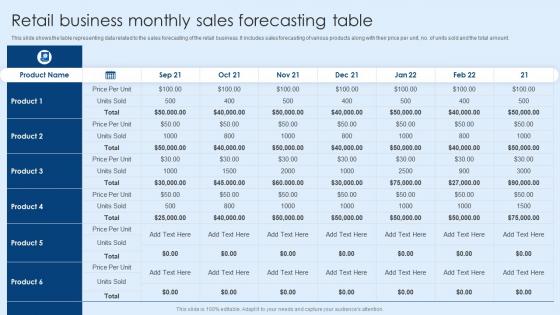
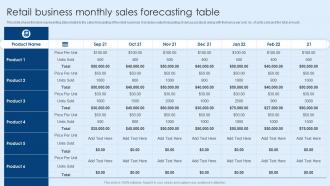
Retail Business Monthly Sales Forecasting Table




Try Before you Buy Download Free Sample Product
 Impress Your
 Audience
 100%
100% Editable
 Save Hours
 of Time


This slide shows the table representing data related to the sales forecasting of the retail business. It includes sales forecasting of various products along with their price per unit, no. of units sold and the total amount.
People who downloaded this PowerPoint presentation also viewed the following :
Retail Business Monthly Sales Forecasting Table with all 6 slides:
Use our Retail Business Monthly Sales Forecasting Table to effectively help you save your valuable time. They are readymade to fit into any presentation structure.





FAQs for Retail Business Monthly
Look, start with your historical sales and seasonal patterns - that's your bread and butter. Weather's massive if you're selling clothes or outdoor stuff. Don't sleep on economic indicators and what your competitors are doing either. Promotional activities obviously matter, plus inventory levels and big events/holidays. Customer demographics are weirdly underrated in my opinion. Local market stuff too. I'd honestly just focus on getting those historical trends down solid first, then add the external factors that actually matter for your specific business. No point tracking everything if half of it doesn't move sales anyway.
Look, your forecasting models need something real to work with instead of just taking wild shots in the dark. Historical data shows them actual patterns - like when people buy more during holidays or how promotions moved the needle. Think of it as having years of receipts proving exactly what customers did before. More quality data means your models get way better at figuring out what makes sales tick. I'd grab at least 2-3 years of clean data if possible. Honestly beats guessing every time.
Dude, you need SARIMA or Holt-Winters for retail stuff - they actually handle seasonal patterns instead of just guessing. Prophet's solid too, especially when your data's all over the place or you've got weekly AND yearly cycles happening. Moving averages? Total waste of time for this. They're blind to seasonal trends. I'd go with Holt-Winters first - way easier to wrap your head around and implement. Oh, and grab at least 2-3 years of data or these models won't have enough to work with. Trust me on that one.
So basically economic indicators are like your heads up for when shopping patterns shift. Unemployment drops? People buy more clothes and gadgets. Consumer confidence goes up? Same thing. GDP growth and wage data tell you how much cash people actually have to spend - once you track it for a while the patterns become super obvious. Interest rates really mess with big purchases since financing gets more expensive. Oh and inflation obviously matters too. You want to build this stuff into your forecasting maybe 2-3 months out because there's always that weird delay between when the economy changes and when people actually start spending differently.
Look, consumer behavior is where the real magic happens for sales forecasting. Historical data shows you what happened, but behavior tells you *why* - and that's what lets you predict what's coming next. People's buying patterns shift with seasons, prices, economic news, all that stuff. Track different customer segments instead of just looking at total sales - you'll spot changes way sooner. Like, my friend runs an online store and started doing this last year, totally changed her inventory game. Short story: behavioral insights help you see demand shifts before they actually show up in your sales numbers. Way more accurate than just extrapolating from past data.
Dude, forecasting tech is a game changer. Machine learning algorithms can crunch way more data than you'd ever handle manually - they actually get smarter over time too. Real-time POS systems automatically update your forecasts as sales roll in, which is honestly pretty sweet. No more outdated spreadsheets. Cloud platforms mean everyone on your team sees the same numbers instantly. The accuracy boost alone pays for itself. I'd say start simple though - just plug your sales data into a basic tool first and you'll see what I mean immediately.
For demand forecasting, start with MAPE (Mean Absolute Percentage Error) - it's super easy to understand across different products. I'd also add MAD (Mean Absolute Deviation) to see your actual unit variance. Honestly, forecast bias is my favorite though. Shows if you're always over or under-predicting, which saves your butt with inventory decisions. RMSE helps catch weird outliers too, but that's more advanced stuff. Focus on MAPE and bias first - you can get fancy with the rest later once you've got those down.
Oh man, weather totally screws with sales forecasts - learned that one the hard way! We got crushed with leftover swimsuits after this weirdly rainy summer. Temperature's the obvious one, but don't sleep on stuff like humidity and even how much daylight there is. People shop differently when it's gloomy out, you know? I'd start tracking weather alongside your sales data. You'll spot patterns fast. Unseasonably warm winter? Your coat sales tank. Random cold snap hits? Boom, everything flies off the shelves. Historical patterns help, but real-time forecasts are clutch too.
Ugh, so many ways to mess this up! First off, don't just look at last year's numbers and call it a day - markets change constantly. Seasonality is huge too, like Black Friday or back-to-school rushes. External stuff matters - holidays, recessions, whatever. Also, talk to your marketing and merchandising teams! I've seen too many forecasters working in bubbles. Keep your models simple honestly - I've watched people overcomplicate the hell out of basic predictions. Track how wrong you were last time so you can actually get better. Oh, and update your assumptions regularly instead of using the same old data forever.
Machine learning can spot sales patterns you'd never catch manually - seasonal stuff, weather changes, how promos affect buying behavior. The algorithms get better over time too, learning from their mistakes. Random forests work well, neural networks are solid, but honestly? Clean data matters way more than which algorithm you pick. I'd start with basic regression models first, then get fancy later. Your forecasts will be way more accurate and you won't waste hours tweaking predictions every week. Plus it's kinda cool watching the system learn.
Look, you can't forecast sales properly without knowing what's actually on your shelves. Inventory data is everything here - stock levels, how long stuff takes to arrive, what people are buying. Clean data = way better predictions. It goes both ways too. Good forecasting stops you from ordering too much crap that won't sell or running out of the stuff that flies off shelves. Trust me on this one. Make sure your inventory system connects with whatever forecasting tools you're using. Otherwise you're just guessing blindly. Start by fixing your current stock data first - you'll notice the difference right away.
So I'd grab your customer data and layer in demographic stuff - age ranges, income shifts, household sizes in your areas. Just did this for Q4 and honestly? Game changer. Census data's your friend here, plus local economic reports. If millennials are flooding your market, you'll probably see upticks in specific categories. Population growth matters too - sounds obvious but people miss it. Start with one demographic that clearly moves your sales needle. Don't overthink it initially.
Honestly, when everything's going nuts in the market, ditch those long-term forecasts for now. Weekly or daily predictions work way better. I'd grab real-time data - economic stuff, what competitors are doing, how consumers actually feel about spending. ML models adapt quicker than old-school methods, though even those get weird when markets are totally unpredictable. Oh, and definitely run multiple scenarios - like best case, worst case, and somewhere realistic in between. Update them constantly. Keep inventory loose so you can pivot fast. Review everything weekly minimum, or you'll get caught off guard.
Honestly, omnichannel makes forecasting way trickier but so much better in the end. Your customers are bouncing between online, in-store, mobile, social - everywhere really. The weird part? Someone might spend hours researching on your website then walk into the store to actually buy. Or the opposite. If you're still doing old-school channel-by-channel predictions, you're missing half the story. But once you start tracking the full customer journey across everything, your forecasts get ridiculously more accurate. I'd start by just figuring out how your customers actually shop - like, do they browse online first? Then tweak your models from there.
Dude, you absolutely need sales and marketing talking to each other for forecasting. Sales knows what's actually happening right now - like which deals are closing and what pushback they're getting. Marketing sees the big picture stuff - campaign results, lead quality, what's launching next month. Without both perspectives? You're basically flying blind. I've seen companies where sales has no clue marketing's dropping a huge campaign next week. Meanwhile marketing thinks everything's great while sales is dealing with major price complaints. Get them in regular meetings together and build dashboards they can both actually see. Trust me on this one.
-
If you have visited their site and failed to find the products, try reaching the customer service because it will be the case that you didn't use the search bar well.
-
Wow, never been this impressed with any online service provider. Really appreciate the customer support all along from the navigation to purchasing the right products.