

Retail Sales Target Incentive Plan




Try Before you Buy Download Free Sample Product
 Impress Your
 Audience
 100%
100% Editable
 Save Hours
 of Time


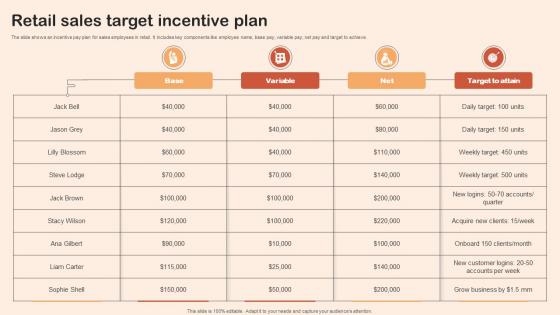
The slide shows an incentive pay plan for sales employees in retail. It includes key components like employee name, base pay, variable pay, net pay and target to achieve.
People who downloaded this PowerPoint presentation also viewed the following :
Retail Sales Target Incentive Plan with all 6 slides:
Use our Retail Sales Target Incentive Plan to effectively help you save your valuable time. They are readymade to fit into any presentation structure.





FAQs for Retail Sales
Honestly, start with your top 3 business goals and work backwards from there. Figure out what specific behaviors will actually drive those results. Your targets need to be realistic but still push people - nothing worse than impossible goals that just demotivate everyone. Make the tracking super transparent so there's no confusion about where people stand. I've seen too many programs fail because the rewards were weak or the timelines were unrealistic. Regular check-ins are clutch for adjusting things that aren't working. And make sure you're measuring what you actually want people to focus on, not just what's easy to track.
Figure out what you actually want your business to achieve first - more revenue, keeping customers around longer, whatever. Then make your incentives match those goals directly. Want happier customers? Pay people based on satisfaction scores, not just how much they sell. I learned this the hard way at my last job where we rewarded all the wrong stuff. Every metric should actually push your business forward, you know? Don't just pick random numbers. Check in every few months too since priorities change. Start by looking at your current plan - does it really support your top 3 goals?
Dude, you HAVE to get employee input or your incentive plan will flop hard. I've watched so many managers assume everyone just wants cash bonuses - totally wrong. Survey people first! Some want extra PTO, others care more about professional development or flexible schedules. The variety always surprises me. Make sure they weigh in on the actual goals too, otherwise you'll set unrealistic targets that piss everyone off. Honestly, if you skip this step and just design something in a vacuum, you're basically guaranteeing nobody will give a damn about it.
Pick 2-3 metrics that actually matter - ones your team can control and that tie to real business results. Mix it up with leading stuff (customer satisfaction) and lagging stuff (revenue). I've watched so many teams track like 15 different things and nobody knows what they're supposed to focus on anymore. Set targets that push people but aren't totally unrealistic. Be super clear about how hitting numbers connects to bonuses or whatever rewards you're doing. Oh, and definitely review quarterly because priorities shift way more than people think they will.
It's gonna depend on where your people are at in life, honestly. Younger folks usually love development opportunities and flexible schedules over straight cash. Mid-career employees? They want the money - mortgages and kids are expensive as hell. Senior people care more about being recognized and having autonomy. But here's what I'd actually do - just ask them directly what they want. I know it sounds obvious, but you'd be shocked how many managers just guess. Individual preferences are all over the place regardless of age. Some 25-year-old might really need that bonus while a senior person wants training opportunities. Survey beats assumptions every time.
Honestly, tracking hours is pointless when everyone's remote - focus on actual results instead. Look at project completion rates, collaboration scores, stuff that moves the needle for your business. Mix individual wins with team rewards so people don't get too isolated. A lot of companies mess this part up initially. Also throw in some incentives for knowledge sharing or jumping into virtual team stuff. Oh, and definitely survey your team first about what actually motivates them. You'd be surprised what people care about vs what you think they want.
Oh man, incentive plans can totally blow up in your face if you're not careful. Your sales team might chase quick deals instead of building real relationships. Or worse - people start gaming whatever metrics you set up, which helps nobody. Budget-wise? You could get hit with huge payouts you weren't expecting (learned that one the hard way). Clear goals are everything too. If targets seem impossible or confusing, your team just gives up. Honestly, run through some test scenarios first - like, what happens if someone hits 200% of goal? Better to catch the weirdness early.
Dude, cultural stuff totally makes or breaks global incentive programs. Americans love individual bonuses, but that can actually backfire in Japan where team harmony matters way more. Some places want public recognition, others prefer private rewards. Then you've got religious holidays, competition attitudes - it's a whole thing. Honestly, the biggest mistake is assuming what works in Denver will work in Denmark. Survey your international teams first to see what actually motivates them. You'll probably be surprised by the answers. Then customize everything by region instead of doing some one-size-fits-all approach.
Honestly, go with cloud-based compensation platforms - they'll handle all the calculation headaches and spit out real-time reports. Mobile apps are pretty clutch since your sales people can track their numbers anywhere. The key thing is connecting it to whatever HRIS and payroll stuff you're already using. Nobody wants to enter data twice, that's just asking for errors. Business intelligence tools help spot problems before they become disasters. I'd start by figuring out what manual processes are driving you crazy first, then see what tech actually fixes those specific issues. Way better than buying something shiny that doesn't solve your real problems.
So first thing - get your baseline numbers before you launch anything. Sales, productivity, retention rates, whatever you're trying to move. After the program runs, compare those exact same metrics. Here's the annoying part though - you can't really separate your program's impact from other stuff happening (market changes, seasonal weirdness, etc.). Most companies I know just live with that uncertainty tbh. For ROI, just divide your performance gains by what the program cost. Oh and don't forget to grab feedback from people too, not just the hard numbers.
Definitely check employment law stuff first - bonuses can totally screw up overtime calculations if you're not paying attention. State laws are weird about commission timing too, so look into that. Stock options? Yeah, get a lawyer involved early because the SEC is basically the fun police when it comes to equity. Honestly, the whole thing is more complicated than it should be. Tax requirements are another rabbit hole you'll need to deal with. Just have your employment lawyer review everything before you launch it - way easier than fixing problems later when people are already expecting their money.
Honestly, twice a year if you can manage it. Once annually at minimum though. Things move too fast now - you'll end up rewarding the wrong stuff for months if you wait too long. Big organizational changes are obvious triggers for updates. Same with strategy shifts or when you're like "why isn't this working?" Also worth checking if industry pay benchmarks have moved much. Random tip - just set the calendar reminder right now while you're thinking about it. I always forget this kind of thing otherwise, and then your team gets misaligned and demotivated.
Honestly, non-monetary stuff works way better than most managers think. Flexible schedules, public recognition, growth opportunities - that's what really gets people engaged. Sure, bonuses are nice, but feeling actually valued? That's gold. Mix both types of rewards though - don't go all one way or the other. Oh, and definitely ask your team what they'd want most. I was surprised when our group said they cared more about remote work options than the holiday party budget. Survey them first before you decide anything.
Honestly, once people can see how pay actually works, all that toxic guessing stops. Your team won't assume everything's rigged or based on who kisses up to the boss. I watched this happen at my old job - they finally explained the bonus math and people actually started caring about hitting targets instead of complaining. Performance suddenly matters when it's connected to real rewards they can track. Document everything clearly, but don't just dump it on them once a year during reviews. Talk about it regularly so it stays top of mind.
Honestly, just be super upfront about everything from the start. People hate corporate BS, so explain it like you're talking to a normal person. Do those face-to-face meetings because everyone's gonna have a million questions anyway. Show them real examples - like if someone hits X goal, they get Y dollars. That stuff matters. Keep updating them during the year so they're not totally in the dark about where they stand. Oh, and definitely get it all written down somewhere they can actually find it later. Maybe start with just a basic one-page summary before you dump the full manual on them.
-
Huge collection of high-quality templates. Worth each penny.
-
The templates are handy and I can personalize them as per my needs. Glad to be your subscriber!