


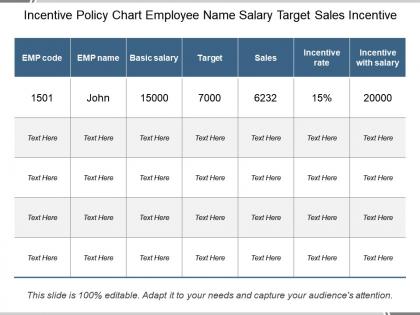
Incentive policy chart employee name salary target sales incentive




Try Before you Buy Download Free Sample Product
 Impress Your
 Audience
 100%
100% Editable
 Save Hours
 of Time


Our Incentive Policy Chart Employee Name Salary Target Sales Incentive ensure you land with your feet on the ground. They enable you to dive headlong into the fray.
People who downloaded this PowerPoint presentation also viewed the following :
Incentive policy chart employee name salary target sales incentive with all 5 slides:
Enlighten folks on avoiding harm with our Incentive Policy Chart Employee Name Salary Target Sales Incentive. Inform folks about injurious elements.



FAQs for Incentive policy chart employee name salary
First thing - survey your team about what rewards they'd actually want, because gift cards aren't everyone's thing. Set clear, measurable goals that tie back to what your business needs. Transparency is huge here - people get frustrated when they can't figure out how to earn stuff. Balance quick wins with longer goals so you're not just chasing monthly numbers. Oh, and definitely start simple before getting fancy with complex programs. Regular check-ins are key since you'll need to tweak things. Timing matters more than most people realize, honestly.
First, figure out what actually makes your company tick - teamwork, innovation, whatever it is. Your incentives have to match that vibe or you'll just confuse everyone. Don't throw money at individual performers if you're all about collaboration, you know? If work-life balance matters to your culture, maybe flexible time off beats another bonus. Creative teams often want recognition more than cash anyway. Honestly, just ask your people what they'd prefer - I bet their answers will surprise you. Bottom line: reward the stuff you want to see more of.
Track participation rates and goal achievement first - those are your bread and butter. Employee engagement scores matter too, but honestly? Retention rates tell the real story. People bail when incentives are garbage. Revenue per employee gives you the business side of things. Don't just rely on numbers though - surveys and focus groups catch stuff that data misses. Sometimes everything looks fine on paper but people still think the system's rigged. I'd probably check these quarterly, maybe monthly if you're tweaking things. Oh, and actually use what you learn to fix stuff.
So tech companies are obsessed with equity and stock options - they want you betting on their success alongside them. Finance is the opposite, all about fat cash bonuses every quarter. Wall Street vibes, you know? Retail's weird though, ranges from hourly workers getting tiny commission bumps to executives with crazy profit-sharing setups. Really depends where you land. It comes down to timing and how much risk you're cool with. Short bursts of cash vs. waiting for potential big payouts later. Your industry's competitiveness basically shapes the whole thing.
You absolutely have to ask your team what they actually want - otherwise you're just throwing darts blindfolded. Survey them regularly about which rewards matter most and whether your current stuff is even working. Cash bonuses motivate some people, but others would kill for extra PTO or training opportunities. The variety always surprises me, honestly. Don't make it a yearly thing either - keep checking in throughout the year. Here's the key part though: actually do something with their feedback or they'll just stop telling you what they think.
Look, you gotta match what actually motivates your people with what moves the needle for your business. Most companies just dump cash at employees and call it a day - which is kinda lazy honestly. Ask your team what they really want beyond their paycheck. Professional development? Flexibility? Recognition? Then tie those perks to metrics that matter - customer satisfaction, innovation, teamwork stuff. When someone's personal win connects to a business win, magic happens. They'll chase those goals because there's something real in it for them too. Way better than hoping money alone does the trick.
Oh man, the classic trap is you'll get exactly what you measure - but maybe not what you actually wanted. Bad incentives make people do weird stuff. Sales teams push products customers don't need just for quotas. Employees start gaming the numbers instead of doing good work (honestly people are SO creative at finding loopholes). Team collaboration goes out the window when everyone's chasing individual rewards. Plus your best people might bail if they think the system's rigged. My advice? Test it small first and ask yourself how you'd personally try to cheat the system.
Honestly, ditch the office stuff like free pizza and ping pong tables - they're useless now. Home office stipends work way better, or flexible PTO that people can actually use. I'd focus on results instead of tracking hours because who cares if someone crushes their goals at 6am in sweatpants? Survey your team first though - you might be surprised what actually motivates them. Digital recognition programs are solid too, like virtual shoutouts or online team events. The whole thing is about measuring what they accomplish, not where they're sitting. Collaboration quality matters more than being physically present anyway.
Wage and hour compliance is your biggest headache - don't let incentives accidentally drop people under minimum wage or screw up overtime math. Your criteria need to be totally objective so you're not discriminating against protected classes. Tax stuff gets messy since some bonuses become taxable income for employees. Union contracts can throw a wrench in things too if you've got them. State laws are all over the place, which is honestly annoying but whatever. Even if your plan seems simple, I'd definitely run it past legal first. Trust me on that one - better safe than dealing with a lawsuit later.
Honestly, just get a dedicated platform - it'll save your sanity. These things connect to your HR and payroll systems so you're not stuck updating spreadsheets forever (seriously, the worst). Performance tracking happens automatically, plus they calculate payouts based on whatever rules you set up. The reporting dashboard is pretty sweet too - shows real-time costs and how everyone's doing. Oh, and distribution gets handled for you. I'd map out what you're doing manually first, then find something that fixes those exact headaches. Way easier than you'd think.
Okay so Google's 20% time thing is actually genius - employees get one day a week for passion projects and that's literally how Gmail happened. Pretty wild, right? Netflix does unlimited PTO because they figure people can handle their own schedules. Salesforce is smart too - they tie bonuses to customer success, not just hitting sales targets. HubSpot has these quarterly "hack weeks" for innovation stuff. The trick is matching your incentives with what you really want people focusing on. Otherwise you're just throwing money around hoping it works.
Honestly, the only thing that really works is tying money to it. Pick 2-3 specific diversity goals - hiring numbers, promotion rates, whatever makes sense for your team. Then connect manager bonuses directly to hitting those targets. I've watched so many companies fail because they just do the feel-good workshops but don't actually reward results. Also throw in some incentives for mentorship programs or employee resource groups - people respond when their paychecks depend on it. Sounds cynical maybe, but behavior shifts fast once it's part of performance reviews.
Honestly, non-monetary stuff can beat cash bonuses for keeping people around long-term. Recognition and growth opportunities hit that intrinsic motivation - way more lasting than a quick money high. Plus they're cheaper for the company while building actual connection to the work. I mean, who doesn't want to feel valued beyond just their paycheck? The trick is making it genuine and matching what your team actually wants. Don't assume - just ask them what kind of recognition or development would actually get them excited. Survey works, or even casual conversations.
Don't pit them against each other - that's backwards thinking. Build on intrinsic stuff first: autonomy, meaningful projects, room to grow. Money and recognition should amplify what people already care about, not replace it. Here's the weird part - leading with cash for creative work actually makes performance worse. But celebrating big wins publicly AND financially? That works great. Different roles need different mixes too. Creative teams respond better to purpose and freedom, while sales might thrive on competitive rewards. Time it right and extrinsic rewards feel earned rather than manipulative.
Honestly, you gotta hit people from multiple angles or they'll miss it completely. Send the email breakdown first, but let's be real - half your team won't read past the subject line. Schedule team meetings to walk through examples with real numbers. Visual stuff works great too, like infographics showing actual dollar amounts. People need to see what's in it for them, you know? Throw it on the company intranet so they can check back later when they inevitably forget the details. Main thing is repeating the same info in different ways and always leaving time for questions.
-
Top Quality presentations that are easily editable.
-
Easily Understandable slides.